


Yearn Finance accepts crypto deposits and then goes on to route these funds into lending and liquidity markets automatically without the need for the owner to search for the highest interest manually. The platform was designed to cater to users who already own either ETH, USDC, or DAI and wish to have a mechanism that allows them to allocate these assets, rather than a platform for trading. What separates it from simply picking a lending market by hand is automation, and that convenience comes with trade-offs worth understanding before depositing.
Where Yearn came from
The idea was launched by Andre Cronje in January 2020 as a tool named iEarn, designed to help him move stablecoins into whatever lending protocol had the best interest rates on any given day. This then evolved to become yEarn, and finally Yearn Finance, with Andre releasing YFI in July 2020 through a fair launch without any allocation set aside for himself or the team. The number of deposits shot up by almost forty times in just a few days. He left the platform that October, which is why there's no Cover Protocol integration, yInsure, or StableCredit anymore.
How the vaults actually generate yield
"Yield optimization" means constantly checking which lending market or liquidity pool pays the best return for an asset and moving funds there, work that's normally too gas-expensive on a small position. A vault does this for a pool of depositors at once: deposit an asset like USDC and receive vault shares representing a proportional claim on its holdings. As the strategies earn, share value rises, so a holder redeems shares later for the deposit plus whatever yield accrued. Yearn's current architecture, V3, builds strategies as standalone contracts that plug into more than one vault, a shift from V2, where each strategy served a single vault.
Strategies and why automation matters
A strategy refers to the software code used to farm the deposited asset by lending or providing liquidity, and then returning the profits to the vault. Strategists write and propose these strategies, and each one goes through review before real capital gets allocated to it. Automation is important since optimization of positions in various protocols requires continuous monitoring, which most people lack the time for. This can cost you more in gas than it pays in gains when done manually.
What's live on Yearn right now
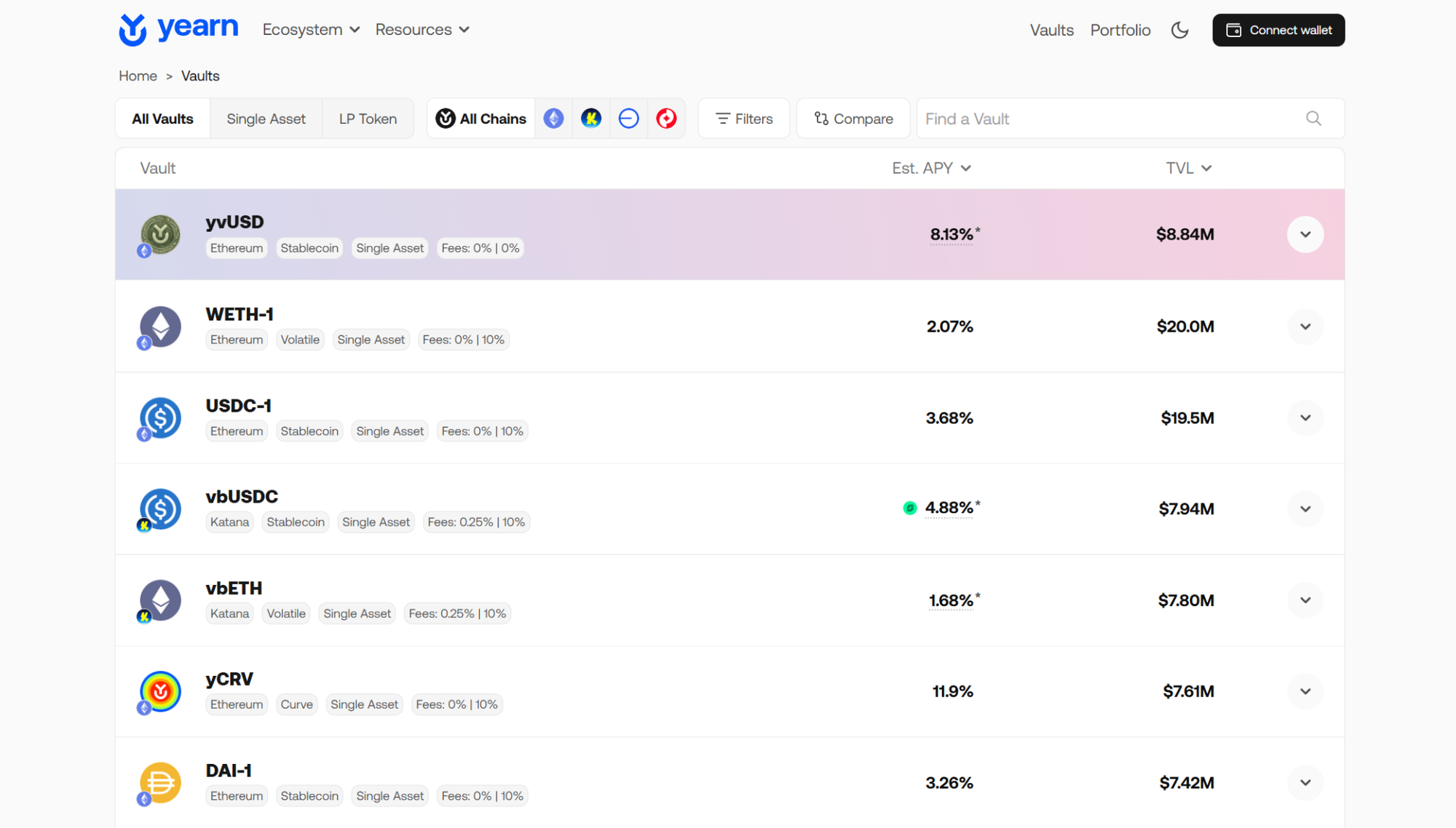
Current efforts include those with V3 vaults using a permissionless factory, as well as legacy V2 vaults that are still in operation, being mostly used in Curve Pools. In January 2026, Yearn rolled out its stablecoin vault yvUSD, a cross-chain vault with zero management and zero performance fees.
YFI, and how decisions get made
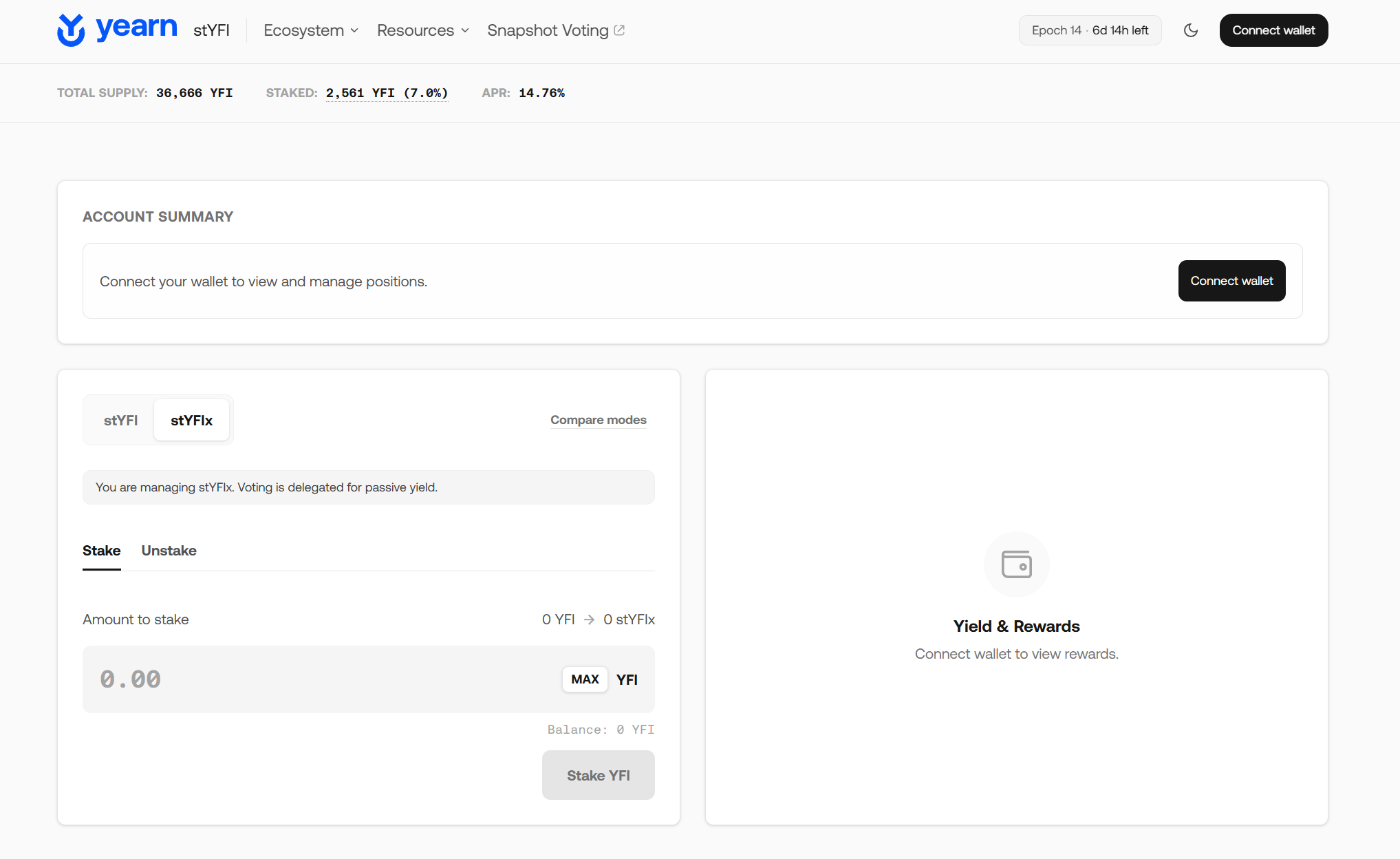
The supply of YFI is set to 36,666 tokens: 30,000 were given out to liquidity providers in that fair launch, and then another 6,666 were minted through a vote from token holders, half for contributors and half for the treasury. It has a trading price of around $2,320 and a market cap of roughly $84 million, according to CoinGecko. Its relatively high per-token price is largely a result of its very limited circulating supply of around 36,000 YFI. Staking YFI involves voting on proposals, though the execution of those actions happens via multisig and thus is more about governance rather than transactions. The protocol changed from veYFI, the old staking system with a four-year lock, to stYFI in October 2025.
Fees and other costs
Fees differ per vault rather than a universal approach. Old-fashioned V2 vaults have charged 2% annually for management services in addition to a 20% fee for performance, but most no longer charge the management fee for single-asset vaults. Factory-made V3 vaults usually limit the performance fee at 10%, and yvUSD does not charge anything in either regard. Users are responsible for gas in their wallets, and fees are always net of advertised APYs.
Using it versus doing DeFi manually
The yearn.fi dashboard displays vaults by asset, showing APY and total deposits before a wallet is even connected. Depositing takes two on-chain steps, approving the vault to spend your tokens, then executing the deposit, a flow familiar to anyone who has used a decentralized exchange. The advantage shows up against the manual alternative, where yield farming across separate protocols means paying gas on every move, while a vault collapses all of that into one position.
How it compares with other yield aggregators
The Convex platform, which controls Curve and Frax governance, has TVL amounting to around $561 million, over three times that of Yearn's approximate $185 million, according to DeFiLlama. The Beefy platform has a lower fee structure and operates on multiple blockchains, currently having around $113 million in TVL. Yearn is more limited in scope, operating primarily on Ethereum and a few Layer 2 networks but focusing on proven strategies on platforms such as Curve and Aave.
The risks that matter more than the advertised APY
All APR numbers listed on Yearn Finance are snapshots; they depend on market conditions and the strategy's performance and can be driven down rapidly by large amounts of capital flowing into a single position. Smart contract risk sits underneath all of it. In February 2021, an attacker used a flash loan to manipulate Curve's 3pool and drained about $11 million from an old V1 DAI vault before Yearn's multisig froze the damage; depositors were later made whole from treasury funds. Since then, vault contracts have gone through audits from firms including MixBytes, ChainSecurity, and Trail of Bits, and the protocol runs an active bug bounty covering both legacy and V3 code. None of that removes risk, only the odds of a repeat, and a strategy can still underperform or fail regardless of audit history.
Who Yearn actually suits
Yearn fits someone who already understands DeFi's basics like wallets and gas costs, and wants a system to handle the ongoing work of chasing yield. It suits smaller balances less well once gas costs are weighed against a modest APY, and it isn't built for anyone expecting fixed or guaranteed returns. Before depositing, it's worth reading the strategy behind a vault, not just the number next to it, since that strategy determines the yield and the risk alike.
 Matvii Diadkov
Disclaimer: All materials on this site are for informational purposes only. None of the material should be interpreted as investment advice. Please note that, despite the nature of much of the material created and hosted on this website, HODL FM operates as a media and informational platform, not a provider of financial advisory services. The opinions of authors and other contributors are their own and should not be taken as financial advice. If you require advice, HODL FM strongly recommends contacting a qualified industry professional.