


Cash App has quietly become one of the most-used financial apps in the US, but it doesn't fit neatly into one category. It started as a peer-to-peer payment tool, then picked up a debit card and a stock trading feature, and Bitcoin support came later. That combination puts it in an odd spot. It isn't quite a bank, and it isn't quite a brokerage, though it borrows pieces of both, along with a slice of what a crypto exchange does. For a crypto-native reader, the more interesting question isn't what Cash App is on paper. It's whether the Bitcoin functionality tucked inside a mainstream payments app actually holds up, or whether it's a stripped-down version that only makes sense for people who aren't planning to look anywhere else.
What Cash App actually is, and who's behind it
The product only makes sense once you know who owns it, since that ownership explains why Bitcoin got priority over every other coin.

Founded by Jack Dorsey and launched under Square in 2013, Cash App now sits inside a larger corporate structure alongside Square's merchant tools, Afterpay, and TIDAL. Square renamed itself Block, Inc. in December 2021 to separate the corporate parent from the Square-branded Seller business, folding Cash App in as one product line among several. Block's self-custody Bitcoin wallet, Bitkey, launched in 2023 and integrates directly with Cash App, a sign of how central Bitcoin is to the parent company's roadmap. Product and fee claims in this draft get checked against the cash app website and Block's investor relations materials directly, not third-party recaps
Core features beyond the crypto piece
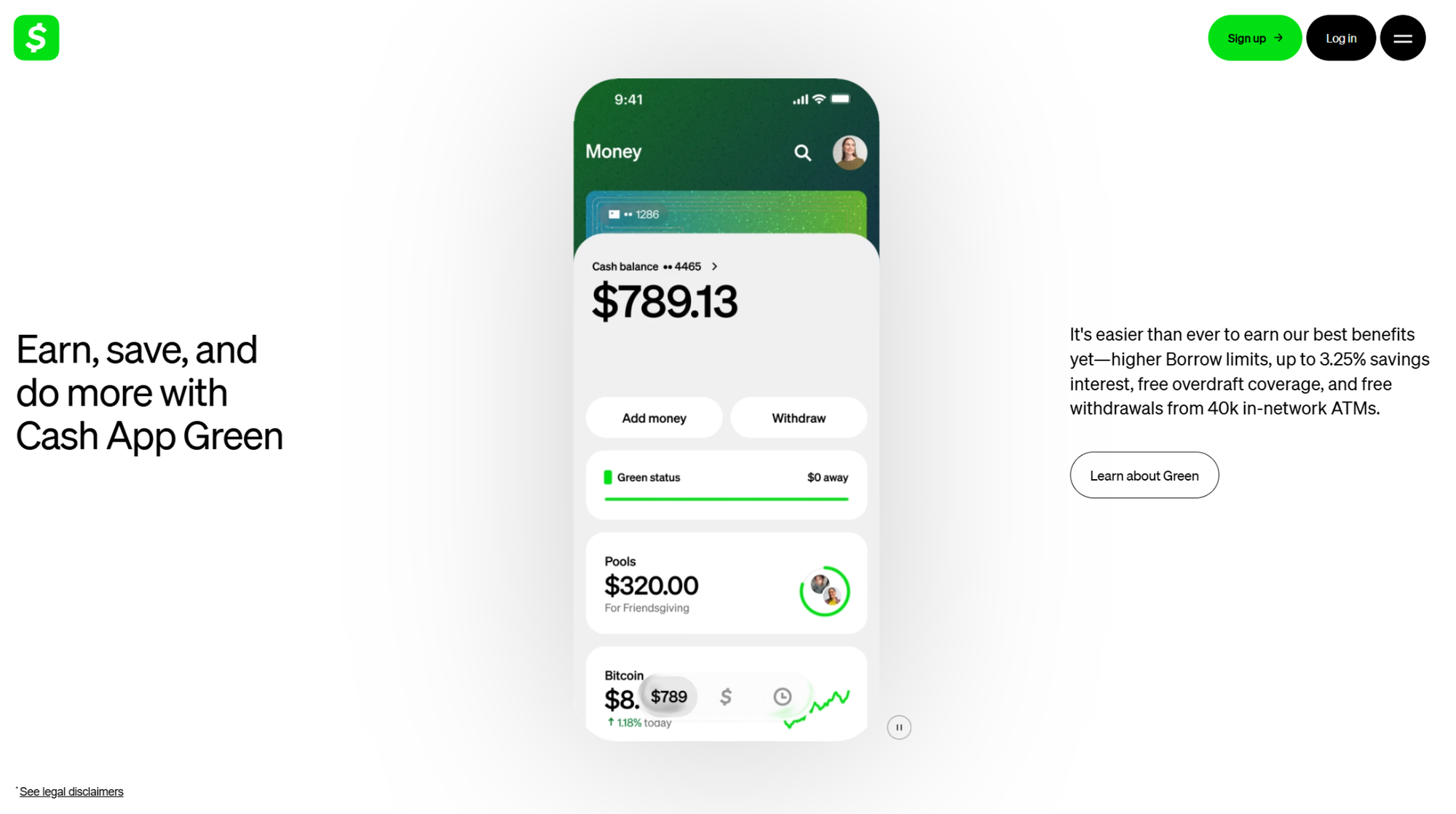
Before getting into Bitcoin specifically, it's worth mapping out what Cash App does as a plain payments and banking app, since that's still most of what people actually use it for.
- Peer-to-peer transfers between users, with a fee difference between instant and standard delivery
- Cash App Card is a fee-free Visa debit card tied to the in-app balance, with Boost discounts at select merchants
- Direct deposit, early paycheck access, and the basic savings feature
- Cash App Investing lets users buy fractional shares of stock for as little as $1, kept as a separate product from the Bitcoin wallet
Cash App's Bitcoin features
The Bitcoin features are the main reason most HODLFM readers picked this up, so they get more space than anything else in the piece.
Buying and selling Bitcoin
Users can buy and sell Bitcoin directly in the app with as little as $1, settled instantly against the Cash App balance or a linked card. BTC is the only crypto asset offered, no altcoins and no stablecoins.
Sending Bitcoin to an external wallet
Cash App allows on-chain withdrawal to a self-custody wallet, and it recently raised bitcoin withdrawal limits and cut fees on larger buys for eligible users, on top of already fee-free Lightning Network transfers. Framed as the one feature that separates it from apps that trap crypto inside the platform with no way out
Fees and spread on crypto trades
Cash App's published fee and spread schedule shows a spread of 0% to 0.75% depending on market conditions, with fees dropping toward zero on purchases over $2,000 or when buying via direct deposit or Auto Invest. The all-in cost is still harder to see upfront than on a dedicated exchange, worth calling out directly rather than glossing over.
Where it falls short of a full exchange
No limit orders or staking. No margin or futures trading. Thin charting tools. Positioned as fine for buying small, occasional amounts of BTC, not for managing an actual portfolio
What it actually costs to use
Outside of crypto, the fee list is short but not zero, and a couple of the charges catch new users off guard.
- Instant transfer fee against a fee-free standard transfer (rate determined currently using Cash App’s fee disclosure)
- Out-of-network ATM fees amount to a fixed fee of $2.50, while in-network ATM fees are charged for those with at least $300 worth of monthly direct deposit or $500 worth of monthly card spending
- Just a brief link to the crypto spread that was discussed earlier without mentioning any figures
Logging in, day-to-day usability, and what happens when support is needed
The application is designed for speed, and this is evident from the first time it opens; however, this very simplicity becomes a liability when something does go wrong.
- The sign-in process follows the cash app login experience, which involves either a phone number or an email along with a one-time code, but no password at all.
- The onboarding process does not go so well when it comes to more complex activities like crypto or investments.
- Cash App publishes an official scam warning about impersonation of cash app customer service, since the most reported scam involves fake support numbers used to phish login credentials
Security, regulation, and the lawsuit people search for
Regulation and security sit in different buckets here depending on whether the money in question is dollars or Bitcoin. Cash balances are eligible for FDIC pass-through insurance up to $250,000 through Cash App's partner banks, but only for users with a Cash App Card or a Sponsored Account. Cash App’s bitcoins are held in a custodial fashion, whereby Cash App is in control of the private keys, and not the individual, making it relevant to this audience rather than the average user, and it lacks deposit insurance. In the 2024 cash app class action lawsuit settlement related to data breaches in 2022 and 2023, the settlement is $15 million to those affected, whereby each person can receive $2,500 for any fraud experienced with the account from August 2018 to August 2024.
Where it fits next to the alternatives, and who it's actually for
None of this needs a scored verdict so much as a clear picture of who Cash App is built for.
- Strike is built Bitcoin-first on the Lightning Network with free self-custody withdrawal, a sharper contrast than PayPal or a full exchange like Coinbase, both covered briefly for context
- Perfect User: A person who currently uses Cash App as a payment application but needs a simple method to buy small quantities of Bitcoin without creating a new account.
- Inapt User: Active traders and people holding a significant quantity of Bitcoin for an extended period of time; anybody desiring control of his/her keys from the very beginning.
 Matvii Diadkov
Disclaimer: All materials on this site are for informational purposes only. None of the material should be interpreted as investment advice. Please note that, despite the nature of much of the material created and hosted on this website, HODL FM operates as a media and informational platform, not a provider of financial advisory services. The opinions of authors and other contributors are their own and should not be taken as financial advice. If you require advice, HODL FM strongly recommends contacting a qualified industry professional.