


Nine years is a long run for a crypto product, and 3Commas has spent most of it as a default name in automated crypto trading. It launched in 2017 and became an official Binance partner two years later. The platform itself never touches user funds; it links to exchange accounts through API keys, then layers automated DCA and Grid bots, plus a manual Smart Trade terminal, on top of exchanges traders already use. That's the pitch behind most crypto trading bots, to be fair, not just this one. What matters is whether 3Commas holds up against it.
How 3Commas connects to your exchange account
Nothing happens on 3Commas until an exchange account gets linked, through an API key pair generated on the exchange itself, then pasted into Sign Center, a storage layer 3Commas built to isolate that credential data. Trade and read permissions cover everything a bot needs to read account balances and manage open orders. Withdrawal access is a different story. It should stay switched off during setup, since 3Commas never asks for it, and turning it off means a compromised key still can't move funds out. IP whitelisting adds another layer on exchanges that support it, restricting API calls to 3Commas' own servers. It's not a safety guarantee, but it rules out the account being drained directly.
DCA bots, Grid bots, Smart Trade, and Signal bots
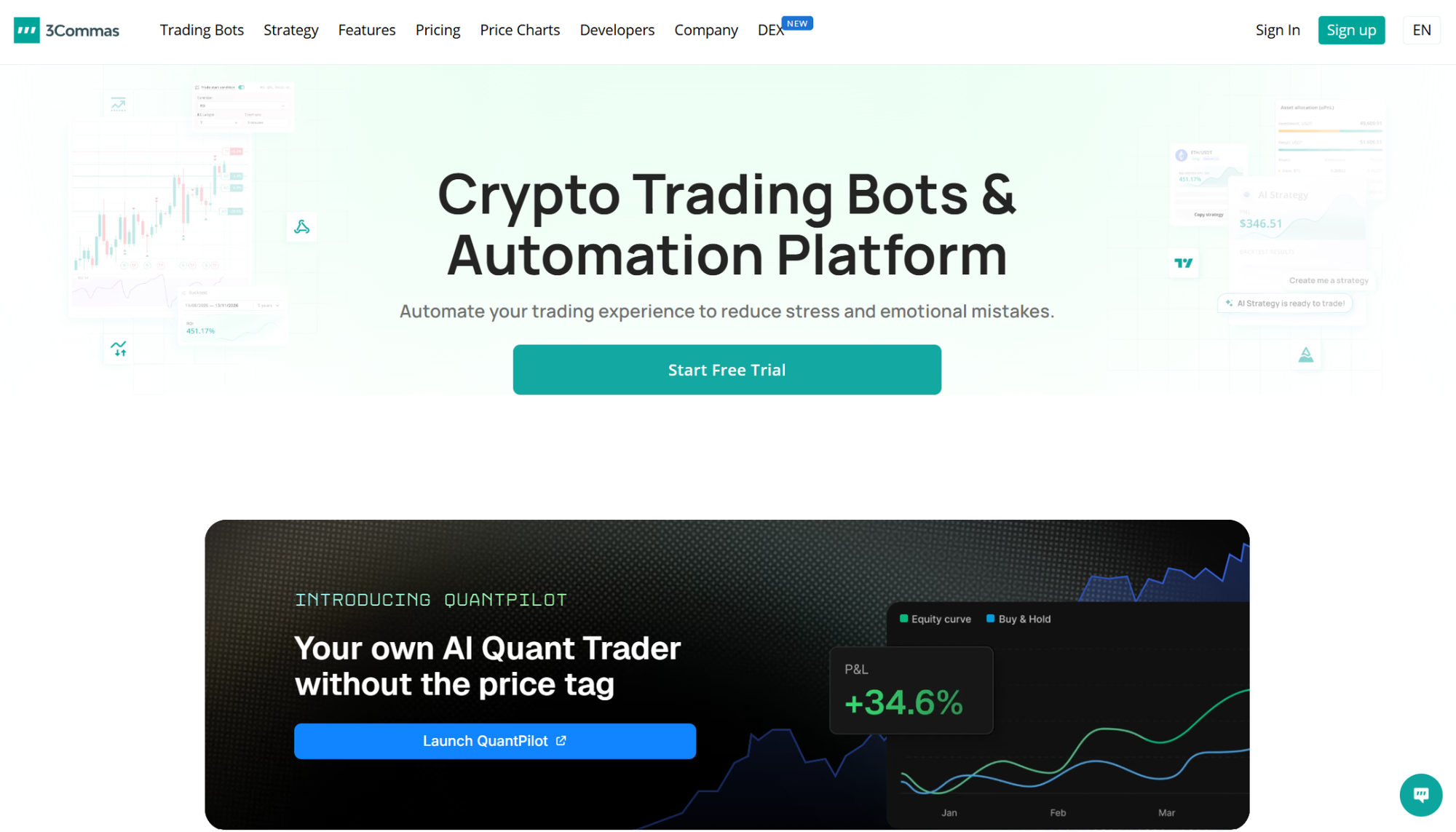
Averaging into a position instead of buying all at once is the whole idea behind a DCA bot. A base order gets followed by a series of averaging orders that fire as price drops, so the average entry price falls instead of the full position going in at once. Grid bots work differently. They hold a fixed price range and place repeated buy and sell orders inside it, which works when price chops sideways but stalls once the market picks a clear direction. Smart Trade is neither of those. It's a manual terminal for placing one trade with combined take-profit, stop-loss, and trailing exit orders across spot and futures markets. Signal bots close out the lineup, executing trades from TradingView alerts, webhooks, or custom code rather than a built-in strategy.
Building a bot and watching it run
Every bot type gets set up the same way: choose the exchange account and trading pair, then set the parameters, whether that means averaging orders on a DCA bot or step size on a Grid bot. Backtesting runs before anything goes live, and once active, the dashboard logs open deals, profit per cycle, and every order sent to the exchange. Adjusting a strategy mid-run is one click, not a rebuild.
Which exchanges it supports, and what else sits in the toolkit
3Commas connects to more than twenty exchange accounts once spot and futures markets are counted separately. The headline venues are Binance, Bybit, OKX, Bitget, Kraken, KuCoin, Coinbase, and, more recently, Hyperliquid, each running the full bot lineup on spot and futures. Smaller names like Bitfinex, Bitstamp, and HTX get lighter treatment, Smart Trade and Signal bots without the DCA and Grid lineup. Beyond the bots, there's a portfolio dashboard aggregating balances into one view, plus a copy trading marketplace for a fee.
Coverage narrows for US and EU traders
That list shrinks depending on where a trader lives. US users get five venues and mostly no futures access, while EU and EEA accounts sit inside MiCA-driven limits, pushing Binance futures into a credit-mode workaround and cutting Bitget spot trading entirely.
3Commas pricing: Starter, Pro, and Expert
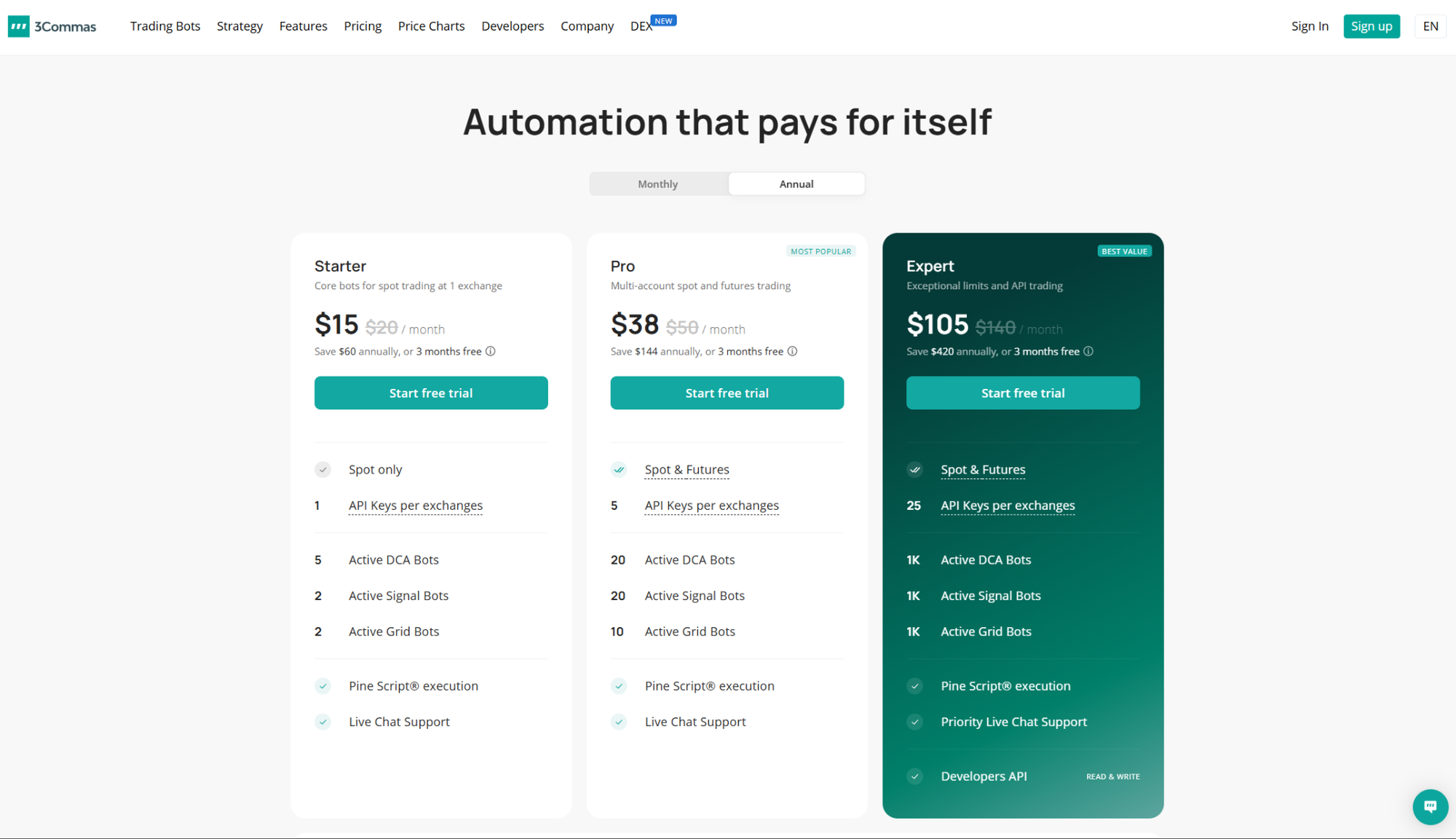
$20, $50, or $140 a month, that's the Starter, Pro, and Expert breakdown, dropping to roughly $15, $38, and $105 on annual billing, with a 7-day free trial at signup. What changes between tiers is volume more than access: Starter tops out at one exchange account, 5 DCA bots, and 10 Smart Trades, Pro moves that to 3 accounts and 20 bots, and Expert opens 15 accounts, up to 1,000 running bots, and read-write API access instead of read-only. None of the three plans skim a percentage of profit or charge per trade; the subscription is the entire cost on 3Commas' side, though every order a bot places still runs through whatever the exchange itself charges.
API permissions, Sign Center, and the 2022 key leak
Two-factor authentication on both the exchange and the 3Commas login sits on top of everything already covered, no withdrawal access, IP whitelisting, credentials isolated in Sign Center. Those measures didn't exist in their current form before December 2022, when 3Commas confirmed a database holding roughly 100,000 customers' API keys and secrets had been exposed, after an earlier statement had claimed no evidence of a compromise. Halborn, the security firm that later analyzed the incident, put losses across the affected Binance and KuCoin accounts at close to $20 million, moved through orders placed with the stolen keys rather than direct withdrawals. Timing matters here. The exposure predated its discovery by months, the denial came before the investigation finished, and Sign Center arrived afterward as a direct response. Whether that's enough is a judgment call, but today's posture isn't the one that existed when the leak happened.
Is the interface built for beginners?
Nobody gets a tutorial here. The dashboard assumes familiarity with order types instead of teaching them, and setup screens use terms like base order, averaging order, and grid step without much explanation. Smart Trade expects a trader who already knows what a stop-loss and a take-profit are for. A newcomer can get a DCA bot running by copying a preset in minutes, sure, but understanding why it's losing money through a downtrend, or why a Grid bot stalls once the market starts trending instead of ranging, takes more screen time than the interface hands you.
Automation against manual trading
The emotional decisions that wreck a lot of manual trades, panic selling near a bottom or chasing a pump too late, are what a DCA or Grid bot removes from the equation. Market risk is a different matter; automation doesn't touch it. A DCA bot without a stop-loss guard keeps averaging into a coin that never recovers, and a Grid bot built for a range breaks the moment that range does.
How 3Commas compares with Cryptohopper, Bitsgap, and Pionex
The practical differences between 3Commas and its competitors come down to pricing structure, not raw capability. Cryptohopper leans into a strategy marketplace, priced at $29 a month on entry and rising to $129 at the top. Bitsgap covers similar DCA and Grid ground from $23 a month, with a free tier for basic use. Pionex skips subscriptions entirely, charging a flat 0.05% trading fee instead. None of these wins outright; it depends on whether a trader wants 3Commas' wider exchange list, or a simpler flat-fee model like Pionex's.
Who gets the most out of 3Commas
The clearest fit is an active trader already running positions across several exchanges who wants DCA, Grid, and Signal automation under one dashboard, once Pro-tier limits are needed. Someone testing whether bot trading suits them at all is better off starting on Pionex or a free tier, where a losing month costs nothing beyond trading fees. Either way, the setup habits carry over: a dedicated API key with withdrawal permission off, and IP whitelisting turned on wherever supported. That separates a leaked key being a minor headache from a repeat of 2022.
 Tanya Petrusenko
Disclaimer: All materials on this site are for informational purposes only. None of the material should be interpreted as investment advice. Please note that, despite the nature of much of the material created and hosted on this website, HODL FM operates as a media and informational platform, not a provider of financial advisory services. The opinions of authors and other contributors are their own and should not be taken as financial advice. If you require advice, HODL FM strongly recommends contacting a qualified industry professional.