


Price charts tell you what happened. Glassnode tries to show what the people holding the coins were doing while it happened, which is a different question and often a more interesting one. It reads the ledger itself. Wallet activity and the price holders originally paid for their coins both end up on the chart. It's one of the best-known crypto analytics tools built on blockchain records, and it comes up whenever the question is whether Bitcoin holders are in profit or preparing to sell. Everything below comes from Glassnode's public documentation, its pricing page, and its Studio chart pages, checked in October 2026.
What is Glassnode, and why on-chain data matters
On-chain analytics means reading the public ledger itself: how many addresses are active, and when old coins suddenly move. Glassnode crypto charts turn that on-chain data into something a person can read without running a node. If you've wondered what Glassnode is in one line, that's it. The company spun out of Swissblock and says it has been delivering market insight since 2017. Jan Happel is its co-founder and CEO, and Rafael Schultze-Kraft was CTO as of 2020. The Swissblock origin matters a little, since the platform grew out of a firm working with digital assets and macro markets. Traders bother with all this because a ledger can't be quietly edited after the fact, so a spike in coins moving to exchanges documents what holders actually did.
How the numbers get built
Glassnode doesn't hand you raw blocks, and its definitions can shift. In 2025, Active Addresses stopped counting addresses that call smart contracts, and a separate metric now keeps the old behavior, so any trend line crossing April 2025 has a seam in it. Check the changelog before comparing readings from before and after that date. Behind every series sit choices about which addresses belong to one holder and which wallets count as exchanges. The docs explain many of them, yet two platforms can show different numbers for the same asset on the same day. Those choices carry into the metrics themselves, so a few are worth knowing by name.
The metrics worth learning first
Start with MVRV, which divides market cap by realized cap. SOPR looks only at coins that moved in a given window and asks whether they were spent above or below their original value. Exchange net position change shows the 30-day change in coins held in exchange wallets, though the address labels behind it are Glassnode's own and recent readings can get revised. Sustained outflows are typically read as coins moving to self-custody and sustained inflows as possible selling pressure; either reading is only as good as those labels. Active addresses count unique senders and receivers, a rough pulse for network activity. The supply metrics slice coins by holder age and by whether they're in profit.
Reading MVRV and SOPR without overtrusting them
When market cap sits above realized cap, the average holder is in unrealized profit. Below it, the average holder is underwater. The same guide notes market cap has dipped to or below realized cap only a few times, and those moments often lined up with bear-market bottoms. A handful of events is a thin sample. SOPR works the same way: a reading under 1 means coins are moving at a loss on average, which might be capitulation near a bottom or sellers taking losses on the way down. The chart can't say which, and it only describes coins that have already moved, so none of this works as a trading signal on its own.
Glassnode Studio for Bitcoin, Ethereum, and other assets
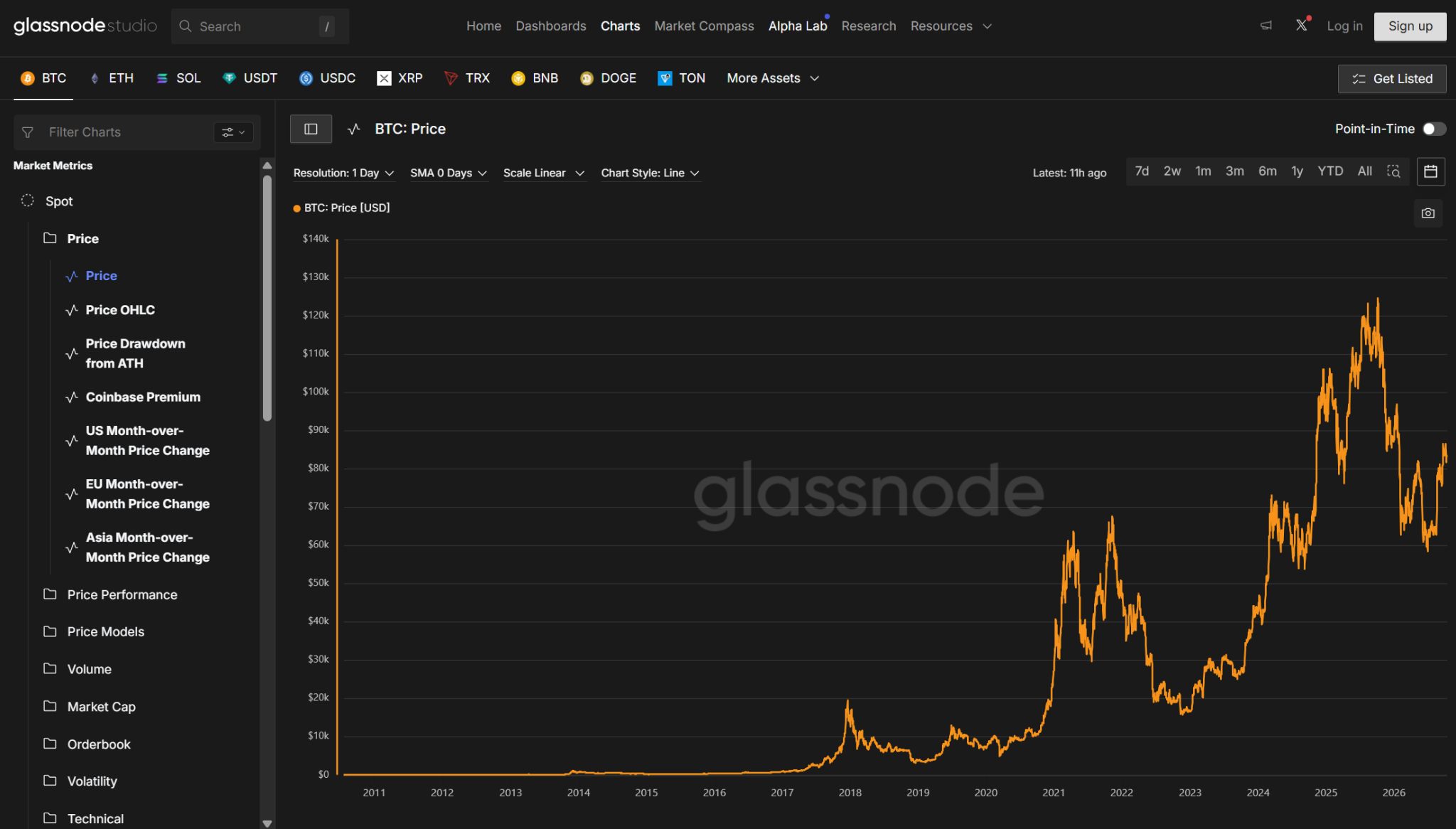
Glassnode Studio is where most people spend their time. It's a no-code workspace that overlays on-chain, spot, and derivatives data, with dashboards you can build or borrow from a library, notes you can pin to charts and share by link, alerts that fire at thresholds you pick, and a backtesting mode for testing ideas against history. Glassnode Bitcoin analysis is the obvious starting point, but there are active-address charts for Ethereum and Solana too. For market research, the side-by-side layout is the useful part: put MVRV under a price chart, and you can see whether a rally came with holders cashing out. Trading analysis leans harder on resolution, which is why daily data on the cheaper plan frustrates anyone watching short moves. Studio doesn't read like a portfolio tracker, so monitoring here means watching the markets behind the coins you hold.
Glassnode pricing and what you get for free
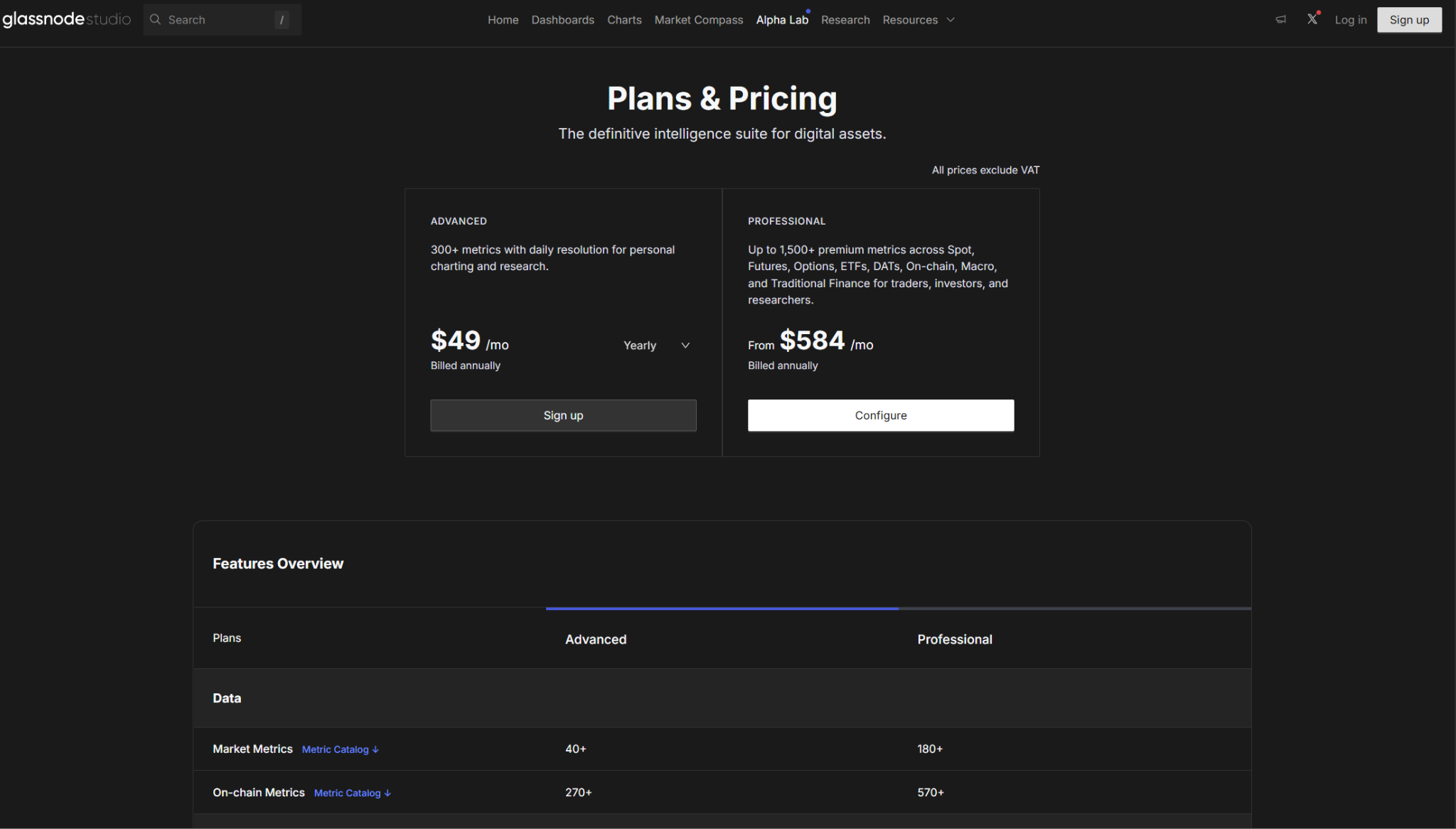
As of October 2026, the Glassnode pricing page lists two Studio plans. Advanced costs $49 a month billed annually. It covers 270+ on-chain and 40+ market metrics at daily resolution, with four years of history and 10 alerts under a personal-use license. Professional is quote-based and built for teams: 570+ on-chain and 180+ market metrics, up to 15 years of history, resolution down to 10 minutes, 500 alerts, and custom seats and licensing. On top of that sit an optional API, a CLI, an MCP server, an Excel add-in, and research dashboards, none of which Advanced includes. API access runs on credits, where a Bitcoin call costs one and an altcoin call costs two, so heavy altcoin work gets pricier than it looks. No free Studio plan is listed, which catches people out because older reviews still mention one. What stays free is reading: Glassnode publishes research reports openly, but they're commentary, and the live charts stay in Studio.
How Glassnode stacks up against other on-chain tools
Each tool answers a different question. CryptoQuant leans toward exchange flows and derivatives, with a free Basic tier and three paid ones above it. Nansen focuses on labeled wallets and Smart Money tracking, and it's down to one Pro plan at $49 a month billed annually. Santiment adds social data, with a free plan that lags 30 days and Pro at $49 a month. Glassnode's strength is holder behavior, meaning realized profit and loss and coin age, rather than who owns a particular wallet. On cost, CryptoQuant and Santiment give a beginner somewhere to start before paying anyone, which Glassnode's lineup doesn't. Pick by the question you're asking, not by which logo looks bigger.
Is Glassnode legit, and who is it for?
It's a registered company, Glassnode Services AG in Baar, Switzerland, and it makes its methodology public through its documentation. Retail users can reach it through the $49 personal plan. The quote-based tier adds the API and up to 15 years of history, which is where professional teams come in, though it's worth reading the plan terms against your own use before committing.
Where Glassnode falls short
The learning curve is real. The docs list SOPR alongside variants like aSOPR and STH-SOPR, and a beginner can easily chart the wrong one. Cost is the other wall: Advanced is a personal-use license without API access, which pushes teams toward a quote, and since Professional pricing isn't published, budgeting means a sales conversation. Exchange labels get revised, and definitions change, as the Active Addresses update showed, so a saved chart can drift from what it showed last year. Wallet-level tracking is Nansen's territory, and a holder who checks prices once a week will likely leave most of Advanced's 270+ on-chain metrics unopened.
 Matvii Diadkov
Disclaimer: All materials on this site are for informational purposes only. None of the material should be interpreted as investment advice. Cryptocurrency investments involve significant risk of loss. Please note that, despite the nature of much of the material created and hosted on this website, HODL FM operates as a media and informational platform, not a provider of financial advisory services. The opinions of authors and other contributors are their own and should not be taken as financial advice. If you require advice, HODL FM strongly recommends contacting a qualified industry professional.