





When a brand-new token requires a permanent market, Hyperliquid is the first exchange that many traders visit, and the platform is one of the ways to see how far on-chain trading has come in 2026. The exchange operates a proprietary blockchain, settling leveraged trades via the fully on-chain order book, which is quite a different approach from the automated market maker exchanges that prevailed in 2021. Here's a review of Hyperliquid for 2026 covering everything about Hyperliquid, its architecture, trading costs, and the risks involved.
What is Hyperliquid, and how it differs from a typical exchange

Centralized exchanges such as Binance and Bybit maintain custody over users' funds, and order matching takes place on servers that are inaccessible to anyone who does not work in the company. Decentralized exchanges that came before had found ways to deal with the problem of custody but relied on automated market makers and pools based on formulas and were good only for spot trading but fell short when it came to providing tight spreads for leveraged futures trading. Hyperliquid is an exchange that bypasses both these problems, as it uses a blockchain platform created for running a centralized limit order book that records all transactions on-chain.
Inside HyperCore, the order book that actually runs on-chain
HyperCore is the layer at which the perpetual and spot order books exist and is not a smart contract deployed on a general-purpose blockchain like most other DeFi projects. Rather, it is the blockchain’s very own state, which is modified via block production by the validator nodes. The consensus mechanism utilized is that of HyperBFT, which is a high-speed Byzantine fault-tolerant protocol whose order finality is achieved in approximately 0.2 seconds and throughput reaches as high as 200,000 orders per second.
How a leveraged trade moves through the system
Trades begin when a user connects their wallet without having to sign up or use their email. The trader chooses between cross or isolated margin and sets their margin level. After this step, an order is placed by the user that HyperCore matches just like other orders. Leverage limits depend on the type of asset. The major assets, such as BTC and ETH, have leverage up to 50x, but this limit reduces depending on the tiered margin level and is capped at 3x to 5x for large positions.
The trading experience on Hyperliquid
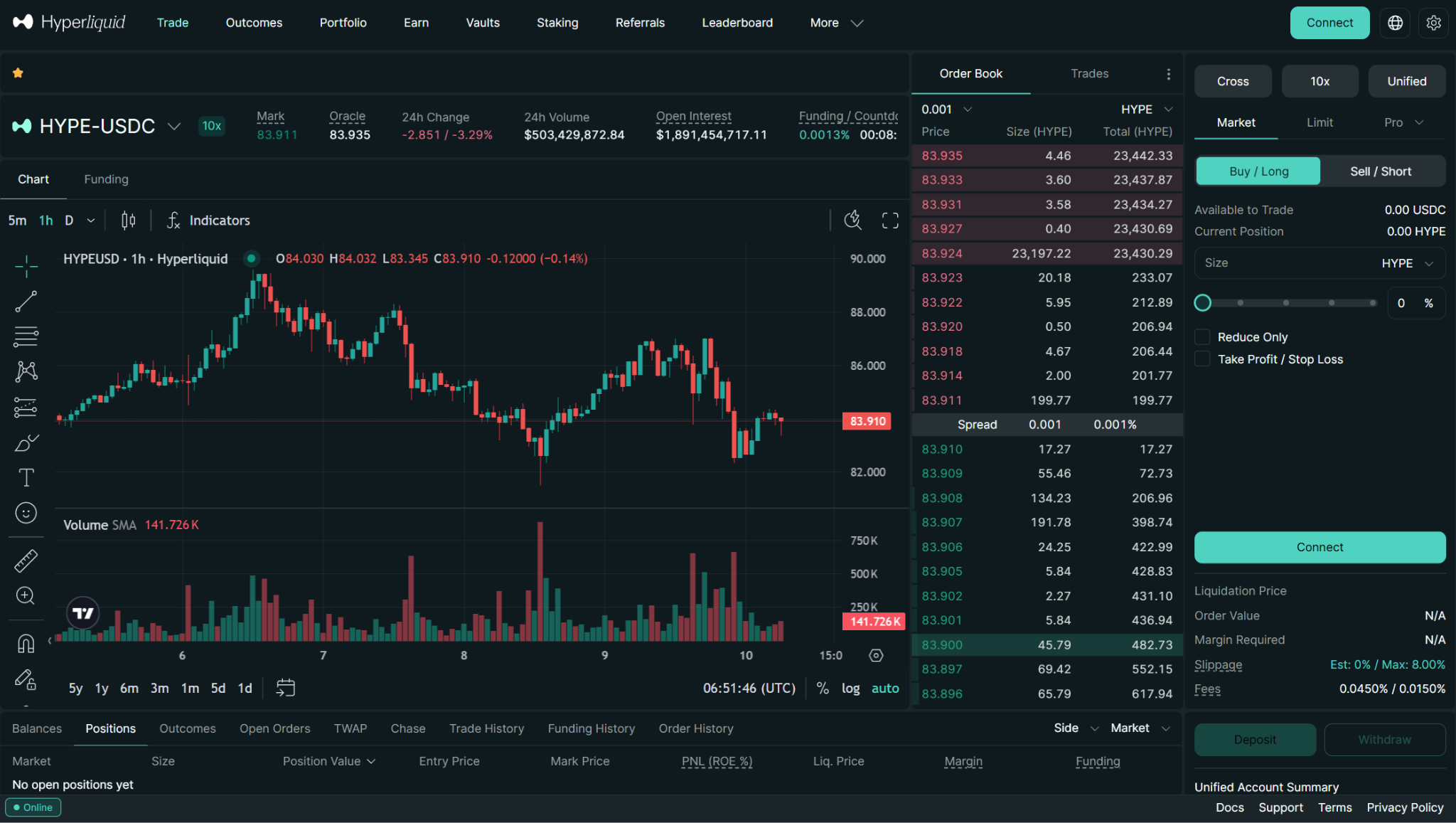
Hyperliquid is web-based software, requiring no desktop app. To fund a wallet, one needs to transfer USDC from Arbitrum, with the requirement of a 5 USDC minimum deposit and a flat 1 USDC withdrawal fee, as the exchange does not take custody outside of the bridge.
The interface is intuitive for any user who ever worked with a centralized futures exchange terminal, as it utilizes TradingView-like charts and a depth-of-order book ladder. Stop-loss and take-profit orders behave like those on any other platform, whereas the learning curve lies with the wallet.
Hyperliquid fees and how liquidity holds up
Hyperliquid’s trading fees of 0.015% maker and 0.045% taker for perps are relatively low compared to those on most centralized platforms even without considering any discount. Staking HYPE will get you an additional 5% to 40% discount depending on your tier, while discounts based on volume will apply once the $5 million threshold is surpassed after 14 days. All of this will be irrelevant without liquidity. The protocol of the exchange in question has about $5.9 billion in total value locked and has processed over $245 billion worth of perpetuals volume in the last 30 days, which is more than one-third of all on-chain perps out there.
Hyperliquid vs. Binance, Bybit, and dYdX
On paper, the comparisons between Hyperliquid and Binance, as well as Hyperliquid and Bybit, come down to custody more than cost. Binance runs 0.02% maker and 0.05% taker with leverage up to 125x. Bybit runs 0.02% and 0.055% with leverage up to 100x. dYdX, the closest on-chain comparison, uses a similar order-book model with fees near 0.02% maker and 0.05% taker, but caps most markets closer to 20x leverage.
The HYPE token and Hyperliquid HYPE staking
HYPE has a maximum supply of 1 billion tokens, with roughly 220 million circulating and a market cap north of $18 billion near $84 a token. The token secures the network through delegated staking and pays for gas on HyperEVM, on top of setting fee-discount tiers. What sets Hyperliquid HYPE apart from most exchange tokens is the Assistance Fund, which routes the bulk of trading fees into open-market HYPE purchases that get burned. In December 2025, validators voted to permanently burn roughly $1 billion worth of HYPE the fund had accumulated.
What's being built on HyperEVM
Two execution layers work through the consensus layer: HyperCore for the order book and HyperEVM, which is a general-purpose blockchain with the same state. Through builders code, users can use any front end and have their orders processed via Hyperliquid, earning a revenue of up to 10 basis points on volume from each transaction. HIP-3 makes this even more powerful since any user who stakes 500,000 HYPE tokens will be able to build a perpetual market.
Is Hyperliquid safe? Decentralization and the JELLY test case
Hyperliquid claims to be fully decentralized, with the order book actually processing through validators that create blocks according to the HYPE staked on them rather than through the servers of a company. This is true, but the validator set is small enough that a coordinated response is quick, which is good and bad. In March 2025, an attacker hacked the price of the JELLY token so as to induce significant losses to Hyperliquid's own liquidity pool, with the validators delisting the token and closing the position very quickly in order to contain the damage, which also shows a coordination that a permissionless chain could not have accomplished in this time frame. The bridge contracts have had external audits, and Hyperliquid does run a bug bounty program.
Who actually gets the most out of Hyperliquid
For starters, those who have never held a wallet before, using centralized exchanges with customer support and fiat on-ramps makes more sense. For those that have experience trading derivatives and already use metrics such as funding rate and order book depth, the Hyperliquid future product will be able to compete with any centralized product when you take into consideration the lower fees after staking discounts.
The risks worth sitting with before depositing
Both sides of the leverage coin: even with a tiered margin structure that shields the protocol as it scales, it remains the case that any rapid strike on an overleveraged position will lead to a quick liquidation into a small book, thereby exacerbating the poor fill. The risk from smart contracts and bridges doesn’t go away entirely irrespective of the audit record. The JELLY event demonstrated how liquidity can evaporate for a single asset much quicker than the risk model anticipates.
Hyperliquid blocks US persons from its interface and bars VPN workarounds in its terms, so anyone in a restricted jurisdiction is trading outside the platform's own rules, with no support desk to fall back on if it goes wrong.
 Matvii Diadkov
Disclaimer: All materials on this site are for informational purposes only. None of the material should be interpreted as investment advice. Please note that, despite the nature of much of the material created and hosted on this website, HODL FM operates as a media and informational platform, not a provider of financial advisory services. The opinions of authors and other contributors are their own and should not be taken as financial advice. If you require advice, HODL FM strongly recommends contacting a qualified industry professional.