

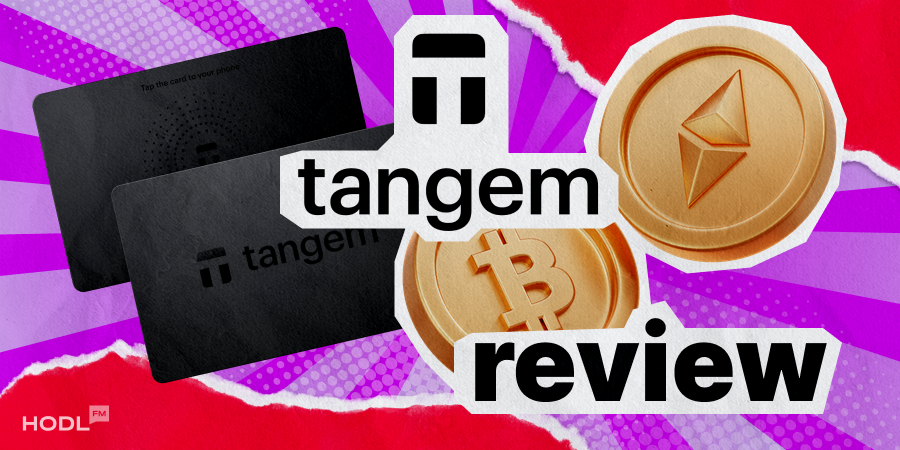



Most hardware wallets look like a small gadget with a screen. The Tangem wallet looks like a bank card, and you use it by tapping it against your phone. That tap is the whole interface, and any Tangem review has to start there. It's a neat take on cold storage for carrying convenience, and the tradeoff is signing without an on-device screen.
How we reviewed Tangem
This is a research-based review. We didn't test a physical card, so the details come from Tangem's documentation and competitors' product pages, with one independent certification record, all checked in October 2026. Claims that are Tangem's own are labeled as such. HodlFM has no affiliate relationship with Tangem.
What sets Tangem apart from other hardware wallets
A Tangem hardware wallet is a credit-card-shaped device with a secure chip inside, which makes it a Tangem cold wallet in the plainest sense. There's no screen on it, so balances and send screens all live in a phone app. Ledger and Trezor devices carry their own displays, which lets you check what you're approving without trusting the phone alone.
How Tangem works
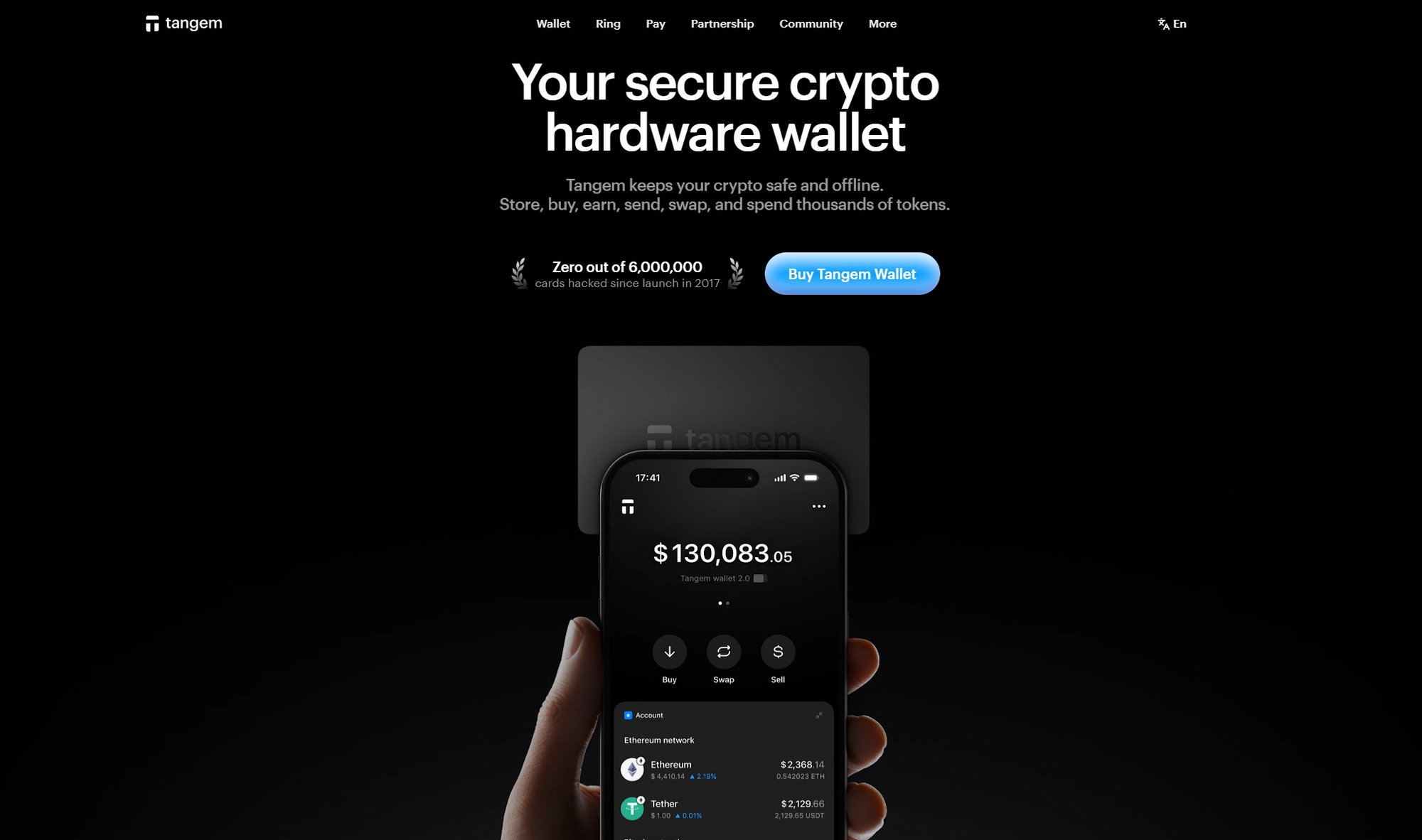
You open the Tangem app, hold the card to the back of an NFC-capable phone, and the card signs the transaction on its own chip. The private key stays there. NFC only works at close range, and Tangem's scanning guide says a thick phone case can block the signal. Per Tangem, daily use means opening the app and tapping the card to approve. With no second screen, read the address and amount before tapping, because the wallet signs what it's shown.
Seedless by default, seed phrase if you want one
Out of the box, there's no seed phrase. The setup relies on two or three linked backup cards instead. If you'd rather have a phrase, Tangem's seed phrase FAQ says the app can generate one or import one from another wallet. The catch is permanent: once you've used a phrase, you can't go back to the card-based key model or add backup cards.
Tangem products and pricing
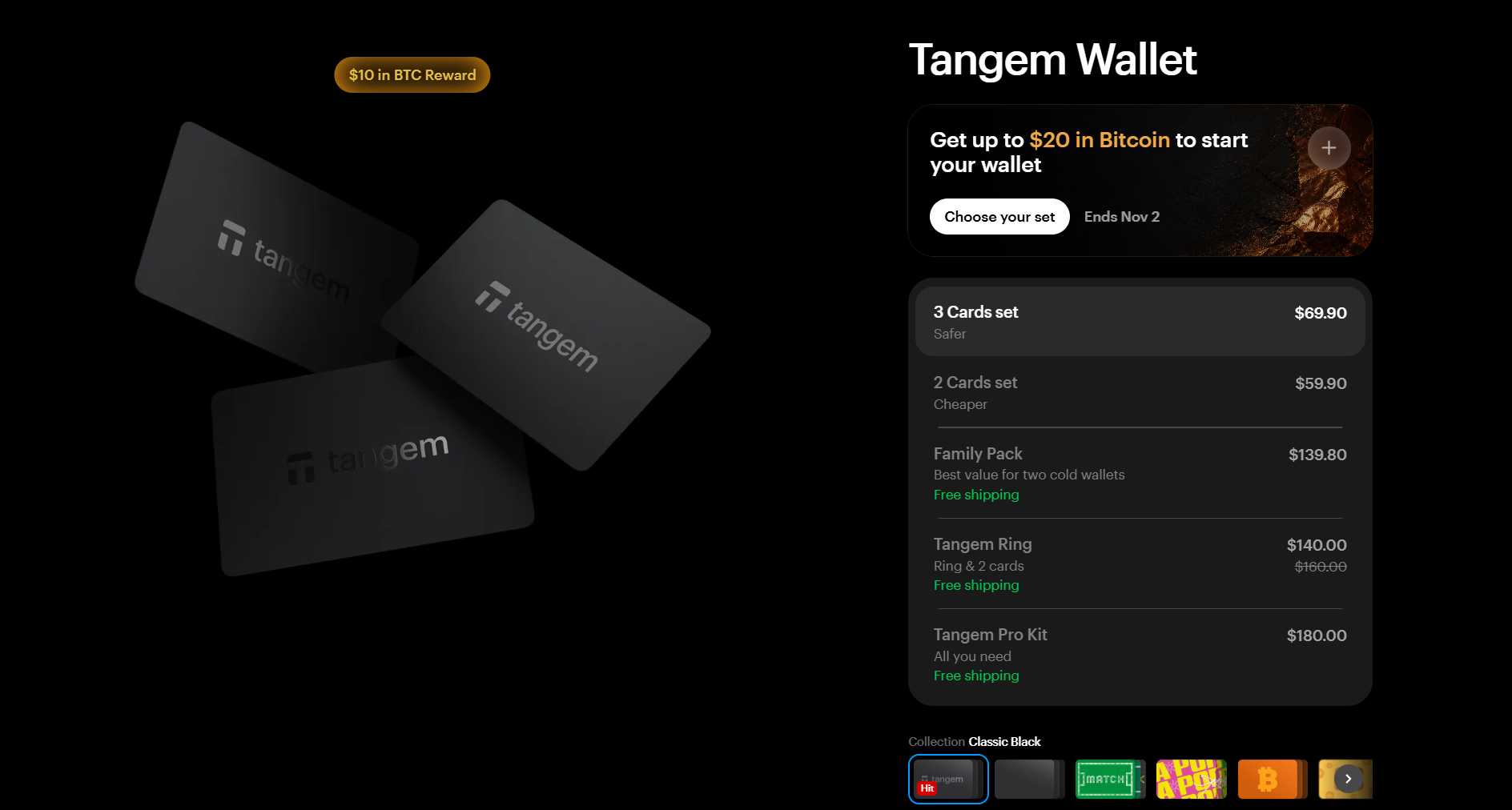
Tangem's pricing page lists five options, and the cheapest card set is $54.90.
The ring is the odd one out. Tangem's own comparison says it has no built-in three-backup system like the card set, and cards can't be added once setup is finalized. Neither product needs a battery, and both carry an IP69K rating.
Tangem supported coins and networks
Tangem's own pages disagree. As of October 2026, its homepage cites 14,100+ tokens across 90 blockchains, while its US page says 16,000+ across 85, and we couldn't confirm which is newer. What counts is whether your coin and chain are on Tangem's list, so check before buying.
Is Tangem safe?
No hardware wallet is immune to theft, malware, or user error, and Tangem is no exception.
What the design protects
The card uses a Samsung secure element certified to EAL6+, and Tangem says the card firmware is installed at the factory and can't be updated. Tangem's security page says signing needs a physical tap, and the access code (at least four characters) guards against a stolen card. After six wrong attempts, the delays grow, topping out at 45 seconds. That's a speed bump, not a vault door. EAL6+ also describes the chip only, not your phone, the app, or the services you connect. Independently, France's ANSSI lists Samsung's S3D350A secure-element family as EAL6+ certified, and the Tangem app's code is public on GitHub.
What stays on you
Per Tangem's lost wallet guide, losing one card means tapping a backup instead, and a stolen card is a reason to move funds right away. If the phone goes missing, the keys stay on the card, so a new phone with the app is enough. The hard case is losing every card with no seed phrase, where Tangem says neither you nor the company can recover the funds. The guide has no separate steps for a damaged card, so backups are the plan. A compromised phone is a concern too, since it's the only place you read transaction details.
Buying from a reseller
Tangem says buying from a reseller is safe because the card is a sealed chip with no port or battery to tamper with, and the app runs a cryptographic check only a genuine card passes. It also flags a card activated before it reached you, in which case Tangem says to reset it so the chip creates new keys. That covers the card, not a fake app or an infected phone.
Tangem fees and third-party services
Every send carries a blockchain network fee that goes to the network, not Tangem. Swaps run through outside providers, andTangem's swap guide says a DEX fee covers the provider's commission plus the network fee, while an exchange provider also adds the cost of moving tokens to and from it. One exception: Tangem charges 0% commission on eligible stablecoin swaps, though gas, spreads, and provider conditions still apply. Staking is also handled by third-party services rather than by the card. Buying and selling work the same way. Availability shifts with the asset and provider, and your region can limit it, so trust the in-app quote.
Tangem pros and cons
Pros
- Thin, portable card with no battery and no cable
- Backup cards come in the box, so redundancy is part of the price
- Seedless by default, so there's no written phrase to expose
Cons
- Needs a phone with working NFC
- No built-in screen to verify transaction details
- Seedless recovery depends entirely on your cards
Tangem vs Ledger and Trezor
Tangem vs Ledger mostly comes down to whether you want a screen.
Specs come from Ledger's Nano Gen5 and Nano S Plus pages and Trezor's Safe 3 and Safe 7 pages. Ledger's prices come from its launch post and Nano guide (S Plus is approximate), the phrase from its hardware wallet page.
There's no universal winner. Ledger and Trezor lead on checking details on the device. Tangem leads on carry weight and bundled backups. The Nano S Plus doesn't support iPhones at all.
Who Tangem suits
Beginners get the gentlest route: no phrase to write down, and backups arrive with the card. Long-term holders may like it most, since the cards can sit in different places and rarely get touched. Frequent traders could find the phone-only workflow limiting.
Is Tangem legit? Final verdict
In the practical sense, yes. It's non-custodial by Tangem's own description and the chip is certified, though that doesn't make it bulletproof. Tangem fits if you want a thin, screenless cold wallet with bundled backups and don't mind relying on an NFC phone. Pick Ledger or Trezor if you want to verify transactions on the device or need a wired connection. Either way, the weak points stay yours.