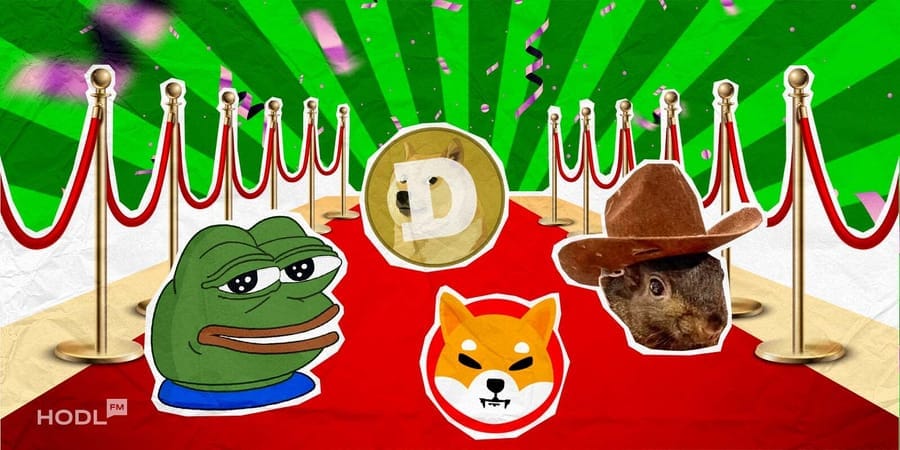



Dogecoin is the 10th largest cryptocurrency by market cap. That sentence would have sounded absurd in 2013, when Billy Markus and Jackson Palmer launched it as a parody of Bitcoin. At $13.39 billion today, it sits larger than many blockchain projects that have spent years building actual utility, and it leads a group of five memecoins whose combined value now exceeds $21 billion.
Dogecoin still holds the floor
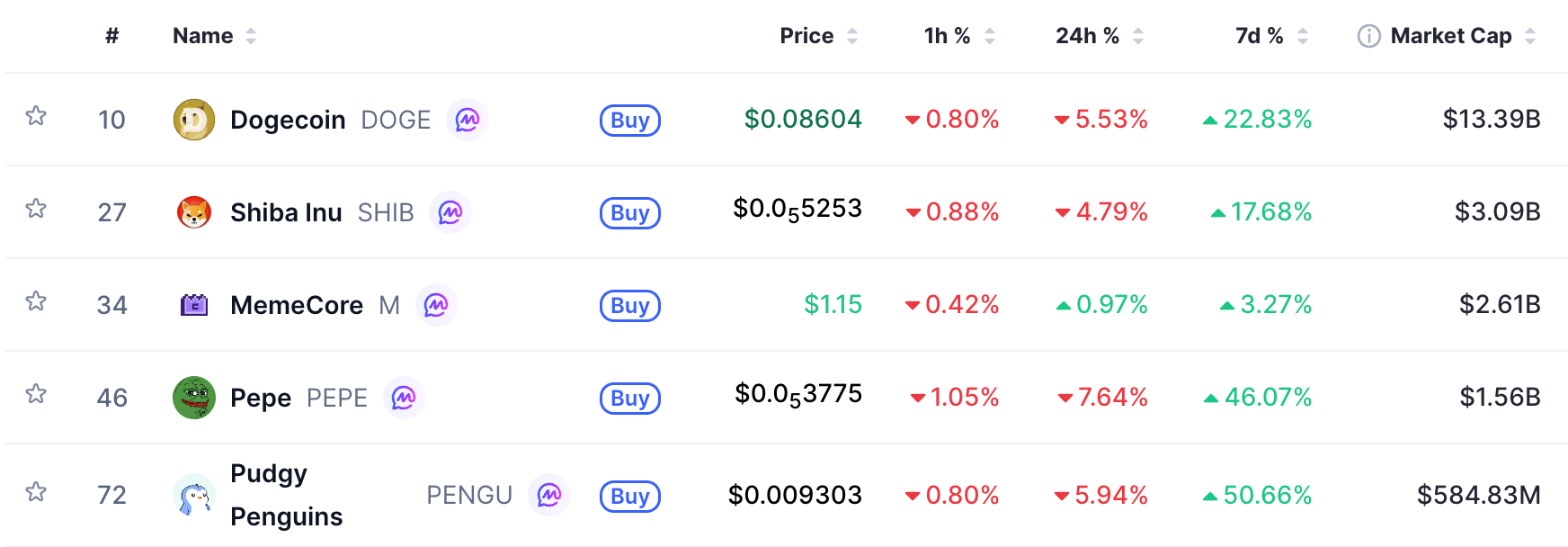
At $0.08604 per coin, DOGE has posted a 22.83% gain over the past seven days. The 24-hour figure tells a different story at negative 5.53%, a normal pattern for assets in this category where short-term volatility sits underneath broader weekly movement.
Palmer has since publicly distanced himself from the crypto industry. In a July 2021 tweet, he wrote:
"Cryptocurrency is a right-wing, hyper-capitalistic technology built primarily to amplify the wealth of its proponents through a combination of tax avoidance, diminished regulatory oversight and artificially enforced scarcity."
That statement has aged awkwardly for a coin now worth $13 billion.
What keeps Dogecoin relevant is less about technology and more about cultural staying power. Elon Musk's public endorsements between 2020 and 2021 pushed the coin to an all-time high of approximately $0.73 in May 2021. The collapse that followed erased 88% of that value. Some retail buyers never recovered those losses. That experience shaped how long-term DOGE holders now treat drawdowns differently from newer market participants. Several of those 2021 buyers are still underwater at current prices.
Dogecoin has no hard supply cap. New coins enter circulation at a fixed rate of roughly 5 billion DOGE per year. That detail often disappears beneath price discussions but has direct implications for long-term value retention. The Dogecoin Foundation, revived in 2021 after years of dormancy, has published updated roadmaps with utility improvement goals, but adoption metrics have not matched the marketing.
PEPE and PENGU are the week's real story
The biggest movers on this list are not the assets with the largest market caps. Pepe (PEPE) posted a 46.07% gain over seven days. Pudgy Penguins (PENGU) went further at 50.66%, according to CoinMarketCap data. Both come from very different places.
PEPE launched in April 2023 with no official team listed and no formal roadmap. The token used the image of Pepe the Frog, the character created by comic artist Matt Furie in 2005. Furie spent years in legal disputes to reclaim the image from groups that had co-opted it online, with documented victories including a 2019 settlement with InfoWars. PEPE itself has no formal affiliation with Furie. By May 2023, less than a month after launch, PEPE had crossed a $1 billion market cap. That pace was almost unprecedented for a coin without a backing team or stated utility.
Shortly after launch, on-chain analytics platform Lookonchain reported that several early wallets moved large positions near the May 2023 peak. Those exits created visible liquidity pressure for smaller buyers, and most retail participants who entered at that peak are still holding losses.
At $0.000003775 with a $1.56 billion market cap today, PEPE runs on sentiment. Listings on Binance and OKX in May 2023 drove a major volume spike at the time. That 46% weekly surge reflects how fast momentum returns to these assets when broader crypto sentiment improves.
PENGU has a different backstory. Pudgy Penguins began as an NFT collection of 8,888 images on Ethereum in July 2021. The project hit serious trouble early. The original founder, known online as "Shroom," faced community backlash over perceived mismanagement. Luca Netz purchased the intellectual property rights in April 2022 for 750 ETH, roughly $2.5 million at the time. Netz rebuilt the brand and secured a licensing arrangement with Walmart to sell physical Pudgy Penguins toys, a deal that placed a crypto-native brand into mainstream retail at a scale few NFT projects have matched. The PENGU token launched in December 2024, with an airdrop that rewarded NFT holders and early community members.
At $0.009303 today with a $584.83 million market cap, PENGU is the smallest cap on this list. Its 50.66% weekly move represents fewer total dollars than a similar percentage move in DOGE would. The NFT-to-token trajectory here is a model other collections have already tried to replicate.
Where Shiba Inu and MemeCore fit
Shiba Inu (SHIB) carries $3.09 billion in market cap. The token launched in August 2020 from an anonymous developer using the name Ryoshi. The initial supply was 1 quadrillion SHIB. Half of that total was sent to Ethereum co-founder Vitalik Buterin without prior arrangement. Buterin donated a portion to a COVID relief fund in India and then burned the remainder, an action that eliminated approximately $6.7 billion worth of tokens at May 2021 prices, according to Forbes. The burn reduced circulating supply in a way the project team had not planned for, and that episode remains one of the stranger chapters in memecoin history.
The project has since developed ShibaSwap, its decentralized exchange, and Shibarium, a Layer-2 network on Ethereum that launched in August 2023. Shibarium has processed hundreds of millions of transactions since its launch, according to data from the project's own chain explorer. Both are genuine technical products. Even so, SHIB's price movement still tracks sentiment across the memecoin space more than any specific on-chain metric. Its 17.68% seven-day gain is the most modest figure among the five assets here.
MemeCore (M) is the least familiar name on this list for most retail holders. At $1.15 per token with a $2.61 billion market cap, it sits between SHIB and PEPE in the overall crypto rankings. The project describes itself as a Layer-1 blockchain built around meme culture and decentralized content distribution. Its 3.27% seven-day gain is the flattest of the five, yet the market cap places it above PEPE and well above PENGU. The gap between its flat weekly price movement and its top-35 market cap position has not corresponded with any widely reported catalyst in the same period.
What the spread in weekly gains actually tells you
The combined market cap of these five tokens sits above $21 billion, a total that reflects a broader period where Bitcoin crossed $100,000 for the first time in late 2024. That milestone shifted risk appetite across the crypto market, and memecoin charts moved with it.
The performance gap between DOGE at 22.83% and PENGU at 50.66% follows a pattern that repeats across memecoin cycles. Smaller market caps tend to produce larger percentage moves in both directions. PENGU at $584 million gained more in percentage terms over seven days than DOGE at $13 billion. That same ratio flips during selloffs, where smaller caps shed value faster and recover more slowly.
The early PEPE experience from 2023 and the DOGE collapse from 2021 both illustrate what that downside looks like in practice. Retail traders who bought DOGE near its 2021 peak of $0.73 are still at roughly an 88% loss at current prices. The weekly data is real. So is that loss.
 Matvii Diadkov
Disclaimer: All materials on this site are for informational purposes only. None of the material should be interpreted as investment advice. Please note that, despite the nature of much of the material created and hosted on this website, HODL FM operates as a media and informational platform, not a provider of financial advisory services. The opinions of authors and other contributors are their own and should not be taken as financial advice. If you require advice, HODL FM strongly recommends contacting a qualified industry professional.