


When US and Israeli forces struck Iran on February 28, most global markets had no way to respond. The Chicago Mercantile Exchange (CME) was closed. Price discovery paused across traditional systems. Hyperliquid did not stop. Its onchain derivatives engine continued to operate and pushed the WTI crude perpetual to $111.531 in real time.
By the time legacy markets reopened on March 2, oil had already adjusted. WTI moved above $110, and the gap between CME pricing and Hyperliquid had closed. The sequence matters. Hyperliquid priced the shock nearly 48 hours earlier. That event now anchors a broader shift in how traders approach market access during geopolitical stress.
Always-on trading gains traction
21Shares has tied that moment directly to investor demand. The firm said its Hyperliquid ETF drew more than $5 million in inflows within days of its US launch on May 12. Eli Ndinga, global head of research at 21Shares, pointed to the Iran event as evidence that always-on infrastructure fills a gap that traditional exchanges cannot cover when markets shut.
Ndinga said Hyperliquid’s appeal extends beyond crypto. Traders access oil, silver, and gold markets without interruption. He described the platform as “beyond a crypto story,” and positioned it as financial infrastructure that attracts traditional market participants.
The ETF debuted on Nasdaq alongside a leveraged version under the ticker TXXH. Within days, competition arrived. Bitwise launched a rival product, BHYP, on the NYSE on May 15 and committed 10% of its management fee to HYPE token purchases. Combined inflows into both products have exceeded $5.6 million since launch.
Volume shifts redefine the platform
Trading data shows that Hyperliquid no longer operates as a crypto-only venue. Bitcoin remains the most traded asset, but traditional markets now dominate a large share of activity. The S&P 500, Nasdaq-100, silver, and oil contracts sit among the top traded instruments. On some days, single equities such as Micron Technology Inc. enter the top 10.
Oil trading alone accounts for roughly $0.5 billion in 24-hour volume. Commodities represent a growing share of open interest, which reached $1.7 billion in mid-May. Oil contributes around 20% of that figure. The shift has reduced crypto’s share of total volume from about 90% to roughly 65%.
HIP-3, the protocol’s permissionless framework for launching perpetual markets, now drives 35% to 37% of total activity. That marks a sharp increase from late 2025 levels. The model allows users to create new markets with locked HYPE collateral, which removes tokens from circulation and supports demand.
Revenue growth and capital efficiency stand out
Hyperliquid has processed $4.22 trillion in cumulative trading volume. About $2.9 trillion came in 2025 alone. That figure approaches CME Group’s $3 trillion in crypto derivatives trading over a similar period. The protocol has generated $1.15 billion in cumulative revenue, with $873 million recorded in 2025.
The platform channels 97% to 99% of fees into token buybacks through its Assistance Fund. Buybacks have surpassed $1.5 billion to date. At current levels, the implied yield stands near 13% of circulating market cap. CME’s buyback yield sits near 1% based on its recent program.
Efficiency metrics highlight the difference in operating structure. Hyperliquid generated $873 million in revenue in 2025 with 11 employees. That equals roughly $79.36 million per employee. CME produced $6.5 billion with 3,875 employees, or about $1.7 million per employee.
ETF flows reinforce the narrative
The early success of the 21Shares product adds a new layer to the story. The fund recorded about $8 million in trading volume on a single day last week. The earlier spot product launch posted $1.8 million in first-day volume with $1.2 million in net inflows.
Ndinga said demand reflects interest in uninterrupted access to both crypto and traditional markets. He also pointed to pre-IPO activity linked to AI chipmaker Cerebras as an example of traders using Hyperliquid to gauge sentiment before public listings.
Risks remain under scrutiny
Despite rapid growth, risks have not disappeared. The platform faced stress during the JELLYJELLY and POPCAT token incidents in 2025. Validators intervened to delist assets and protect liquidity. That decision raised questions about decentralization under pressure.
Regulation presents another challenge. Hyperliquid restricts US users and operates in a legal gray area for onchain commodities. CME Group and Intercontinental Exchange have urged regulators to examine potential market manipulation and sanctions compliance risks tied to offshore derivatives platforms.
Ndinga pointed to proposed legislation such as the CLARITY Act as a possible path toward clearer rules. Until then, access remains limited in key jurisdictions.
A market driven by utility, not ideology
Hyperliquid’s rise does not rely on a narrative about decentralization alone. The oil market moved onchain during the Iran strike because no alternative existed at that moment. The distinction shapes how traders and investors view the platform today.
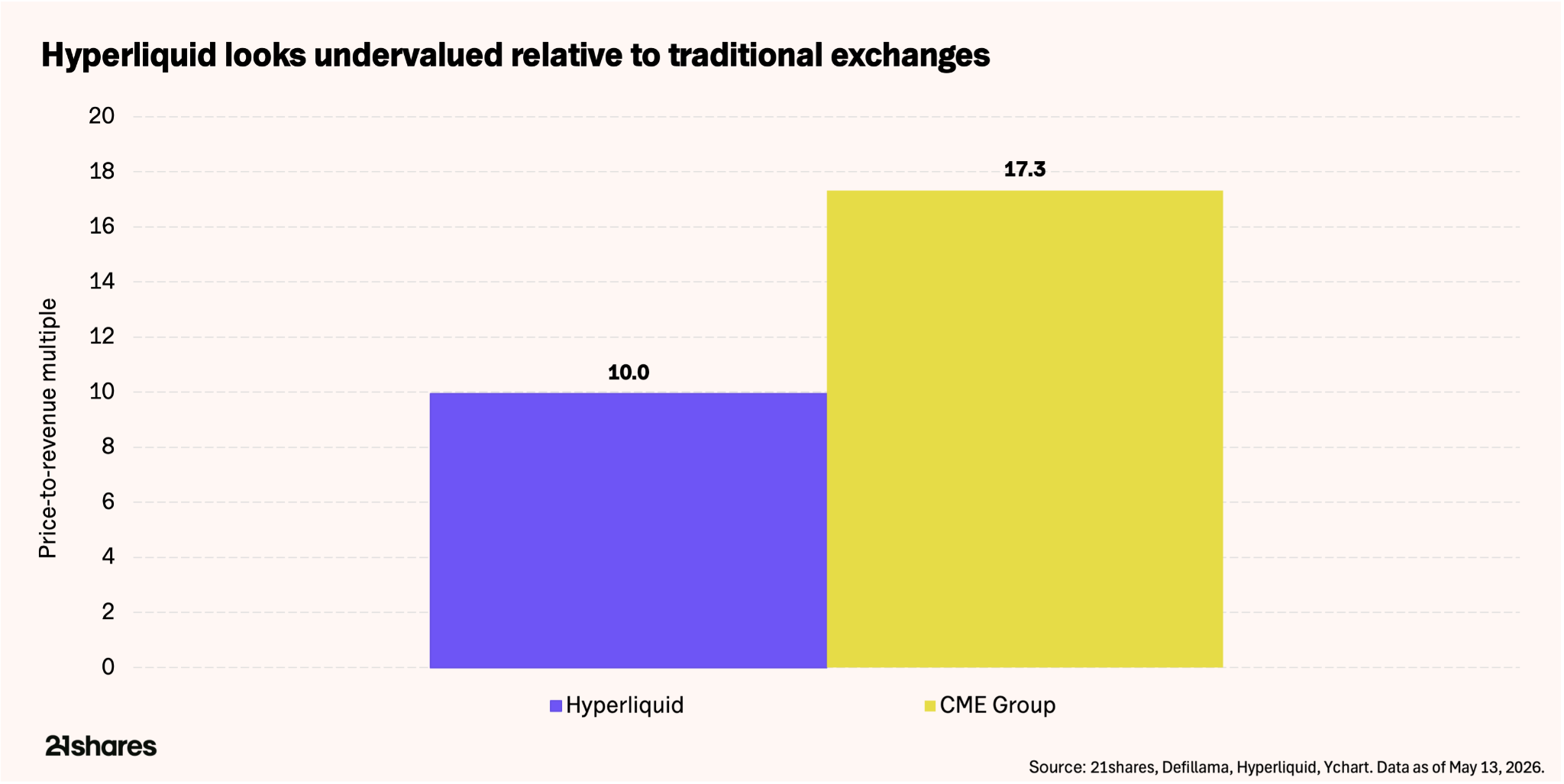
HYPE trades at a circulating market cap near $11.5 billion, with a price-to-revenue ratio around 10x. CME trades at a higher multiple, near 17x. The comparison suggests that markets already treat Hyperliquid as a functional exchange business rather than a speculative token.
Bitcoin has fallen about 9% year-to-date, while HYPE has gained more than 50%. That divergence reflects a shift in revenue sources. Hyperliquid depends less on crypto cycles and more on macro volatility and cross-asset demand.
The outcome now depends on whether that demand holds. Commodity trading volumes, regulatory clarity, and continued product expansion will determine whether Hyperliquid sustains its position as a 24/7 alternative to traditional markets.
 Anastasiia G
Disclaimer: All materials on this site are for informational purposes only. None of the material should be interpreted as investment advice. Please note that, despite the nature of much of the material created and hosted on this website, HODL FM operates as a media and informational platform, not a provider of financial advisory services. The opinions of authors and other contributors are their own and should not be taken as financial advice. If you require advice, HODL FM strongly recommends contacting a qualified industry professional.