





Robinhood Markets announced the public mainnet of Robinhood Chain on Wednesday during a keynote event at the Old Royal Naval College in London, alongside the broader rollout of tokenized stock products, a decentralized lending product, and agentic crypto trading for US users.
HOOD shares rose approximately 8% on the day, according to Google Finance data. The company now serves nearly 28 million customers across 38 countries and three continents.
Robinhood Chain is a layer-2 blockchain built on the Arbitrum platform. The network went live on testnet in February, roughly four months before Wednesday's mainnet announcement. The chain is designed for real-world assets and decentralized finance applications, with fast block times and built-in DeFi primitives for lending and borrowing. Uniswap is deploying a dedicated automated market maker on the chain as its primary public liquidity protocol. Pleiades is deploying a separate proprietary AMM for prop trading. Alchemy, BitGo, and Chainlink are among the infrastructure integrations at launch.
"Decentralized finance unlocks possibilities beyond what traditional finance can offer, but historically, it has required technical expertise to navigate," said Johann Kerbrat, SVP and General Manager of Crypto and International at Robinhood. "We're bringing the best of traditional finance and DeFi together, and in doing so, expanding financial ownership to every corner of the globe."
Robinhood Chain mainnet is live.
— Robinhood (@RobinhoodApp) July 1, 2026
Fast, secure, AI-native, and purpose-built for real-world assets from day one.https://t.co/klNh8iHFPd pic.twitter.com/fvKcmSZPUo
Stock tokens go live in over 120 countries
Stock Tokens are now available through the Robinhood Wallet in more than 120 countries, though availability varies by jurisdiction. The products allow eligible users to trade tokenized equities around the clock directly on Robinhood Chain, deploy tokens into lending pools, and use them as trading collateral across the DeFi ecosystem. Spot trading is accessible through decentralized exchanges including Uniswap, Rialto, Lighter, Arcus, and 1Inch within the Robinhood Wallet.
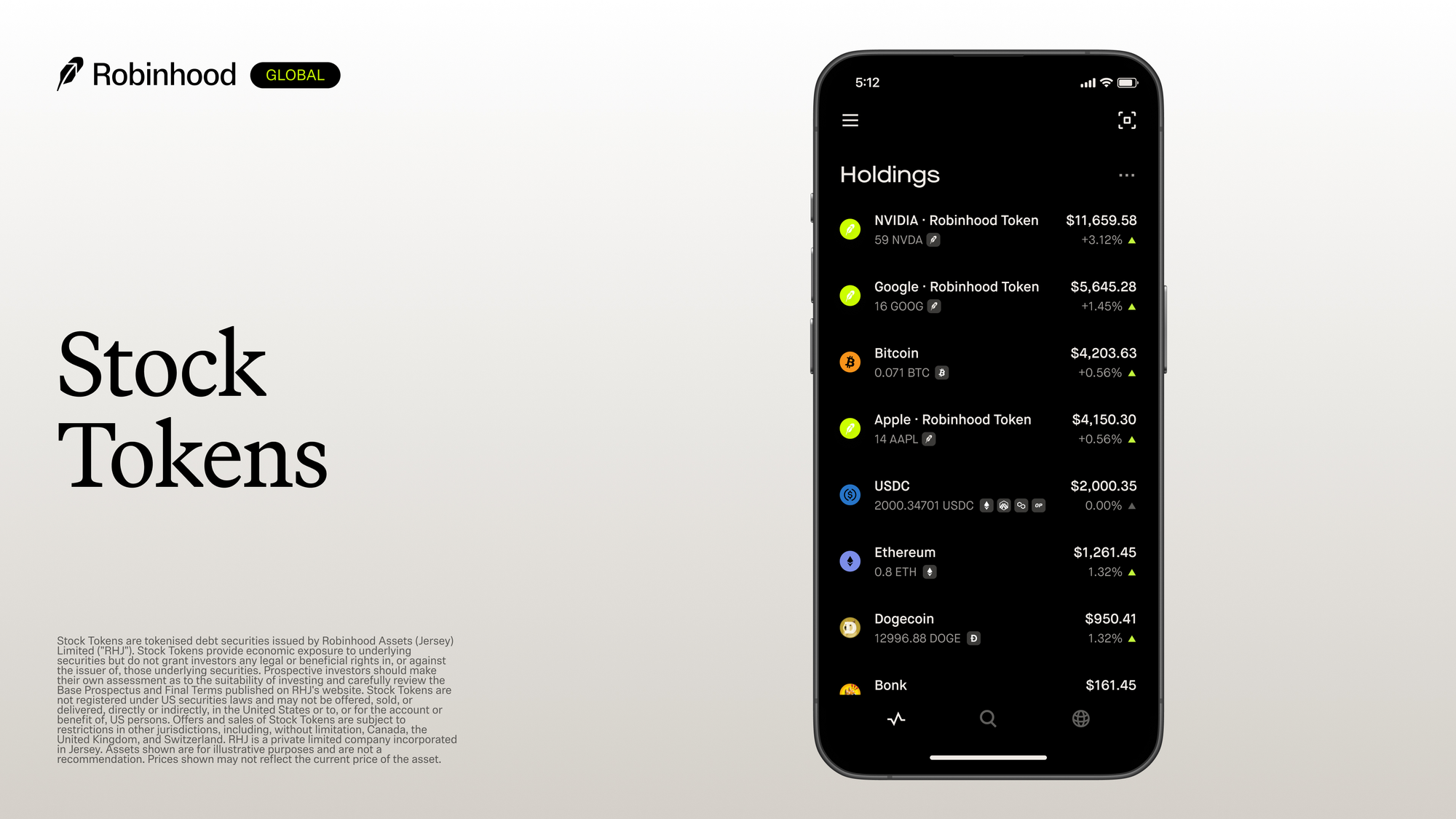
Robinhood CEO Vlad Tenev called tokenized stocks "inevitable" in January, arguing the products could prevent trading freezes that sometimes occur on traditional exchanges. A previous generation of stock tokens, now called Classic Stock Tokens, continues to be available in the Robinhood Europe app.
The chain launch follows a difficult earnings backdrop. Robinhood reported in April that crypto transaction revenue dropped nearly 50% year-on-year, from $252 million to $134 million. The company is expected to report second-quarter 2026 results on July 29. Separately, Tenev announced a 10% workforce reduction, approximately 290 employees, as part of a restructuring move in the weeks before the London event.
Robinhood Earn offers 7% APY through Morpho infrastructure
Robinhood Earn is now rolling out to eligible US users as a decentralized lending product built directly into the main Robinhood app. Users lend their dollar-backed USDG stablecoin through a self-custody wallet at an estimated 7% annual percentage yield. The product carries insurance procured through Lloyd's of London and RELM to cover losses from cyber or smart contract exploits. The underlying lending infrastructure runs on the Morpho protocol, with support from Steakhouse, Ethena, Spark, and Maple.
Robinhood also updated the Wallet with native Robinhood Chain integrations. Eligible users in selected jurisdictions can access perpetual futures on Lighter, a decentralized exchange, directly within the Wallet. Lighter committed $11 million of LIT to the Robinhood community. Users earn points on perpetual futures trades that convert to LIT, at 2x when traded through Robinhood Wallet and 1x when traded on Lighter's web application.
In Europe, Robinhood expanded perpetual futures beyond crypto to include commodity, ETF, and FX markets. Eligible European investors can now trade assets including gold, silver, QQQ, EUR/USD, WTI, Brent crude oil, and EWY with up to 10x leverage, available 24 hours a day across seven days a week. The rollout is proceeding in waves to eligible users.
For US crypto traders, Robinhood introduced maker order types with fees as low as 0% based on volume, aimed at professional and advanced traders who provide liquidity on the platform.
Agentic crypto trading arrives for US users
After launching agentic trading for equities and options in the US the previous month, Robinhood said it is preparing to bring the same technology to crypto. The Agentic Accounts product lets eligible US traders connect an AI model of their choice to Robinhood data sources and trading tools through its Trading MCP. Users retain control by setting capital limits and safety parameters. Robinhood said no additional cost is attached to the feature. The rollout to eligible users is described as upcoming.
At the London event, Robinhood set a Guinness World Records title for the most items purchased by an AI agent in three minutes using a single credit card. An AI agent used the Robinhood Agentic Credit Card to independently source and order gifts for event attendees, verified by a Guinness adjudicator on site.
Canada, Singapore, and a UK crypto launch on the way
On Canada Day, Robinhood announced its services are now available to Canadian residents following its acquisition of WonderFi. The company said Canadian customers will pay zero trading fees through September 30.
Robinhood Singapore received its capital markets services license from the Monetary Authority of Singapore, which the company described as a step toward offering brokerage services in that market in the future.
A UK crypto launch is also planned. Robinhood said it intends to launch crypto trading in the UK soon, which the company said would strengthen its position as an all-in-one investing platform for UK traders.
The mainnet launch places Robinhood in a competitive layer-2 market. Base, the Coinbase-backed L2 and the second-largest layer-2 network by total value secured at approximately $11 billion, experienced two outages within hours of each other in June. The engineering team reported that a sequencer bug caused both incidents.
 Matvii Diadkov
Disclaimer: All materials on this site are for informational purposes only. None of the material should be interpreted as investment advice. Please note that, despite the nature of much of the material created and hosted on this website, HODL FM operates as a media and informational platform, not a provider of financial advisory services. The opinions of authors and other contributors are their own and should not be taken as financial advice. If you require advice, HODL FM strongly recommends contacting a qualified industry professional.