



Coinbase reported a sharp reversal in fortunes for the first quarter of 2026, posting a $394 million net loss on $1.41 billion in revenue. The result stands in contrast to the $66 million profit recorded in the same period a year earlier, when optimism around pro-crypto political signals briefly lifted the market.
The earnings release triggered an immediate market reaction. Shares of COIN fell about 6% in after-hours trading on May 8, sliding from roughly $193 to $182. It is currently trading around $201. The stock has dropped approximately 55% from its July 18, 2025, high of $444.
Disclosures show CEO Brian Armstrong sold more than $540 million worth of company stock between May 2025 and January 2026. SEC filings indicate a total of 1,550,000 shares sold for $541,863,703 across multiple dates, often within a day of receiving stock-based compensation. The average sale price reached $349.58 per share, about double current trading levels.
Meanwhile, the CEO has dumped $550m of $COIN stock https://t.co/GS1J1vZ8ZZ pic.twitter.com/u0wbZwQc9S
— Crypto Bitlord (@crypto_bitlord7) May 8, 2026
Workforce cuts and declining trading activity
Coinbase paired its earnings release with a major workforce reduction. The company cut about 14% of its staff, or roughly 700 employees, on the opening day of the Consensus conference in Miami. The move reflects cost pressures as trading activity weakens across the crypto sector.
Transaction revenue, which forms the core of Coinbase’s business, fell 40% year-over-year to less than $756 million. Retail trading revenue accounted for $567 million, while institutional trading contributed $136 million, both showing declines. Industry-wide spot trading volume dropped more than 20% quarter-over-quarter, with overall activity nearly half of its late-2025 peak.
Low volatility and reduced participation weighed on fee generation. Long-tail crypto assets saw limited engagement, which further reduced trading incentives.
Loss driven by accounting adjustments
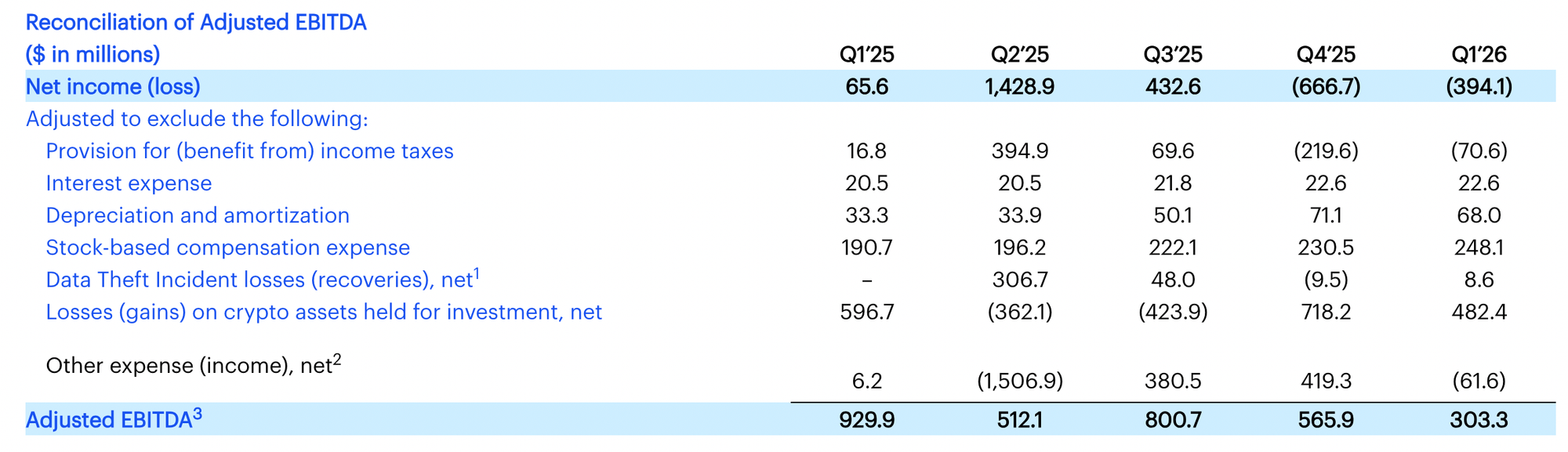
Despite the headline loss, a closer look at the numbers shows a different picture. Of the $394 million net loss, $482 million came from unrealized losses tied to crypto assets held on Coinbase’s balance sheet. An additional $35.2 million reflected losses on operating crypto assets.
Under U.S. accounting rules, the company must revalue these holdings at market prices at the end of each quarter. During Q1, Bitcoin fell from around $87,000 to $66,000, while Ethereum declined by roughly 41%. The broader crypto market lost about $600 billion in total capitalization.
No assets were sold. The losses exist on paper and could reverse if prices recover in future quarters.
When excluding these unrealized impacts, Coinbase reported adjusted EBITDA of $303 million. This marks the company’s 13th consecutive quarter of positive adjusted EBITDA. The firm ended the quarter with $10.2 billion in cash and cash equivalents, alongside $1.8 billion in crypto assets and tradable investments.
Shift beyond spot trading
The earnings report highlights a structural shift in Coinbase’s business model. Subscription and services revenue reached $584 million, accounting for 44% of total net revenue. Stablecoin-related income showed resilience, with USDC balances hitting a record average of $19 billion and generating $305 million in revenue, up 11% year-over-year.
New business lines continue to expand. Retail derivatives revenue exceeded $200 million on an annualized basis, while a recently launched prediction market reached $100 million annualized revenue in less than two months.
Armstrong emphasized this transition during the earnings call.
"We executed well on what was in our control in Q1," he said. "We saw huge growth in derivatives trading volume… We’re also leading on the next frontier with over 90% of onchain agentic stablecoin transaction volume happening on Base."
The company now operates 12 product lines that each generate more than $100 million in annualized revenue, with the prediction market expected to become the 13th.
Strategic repositioning amid competition
Coinbase has spent the past 18 months expanding beyond spot trading. The company acquired Deribit for $2.9 billion, entered derivatives markets, launched U.S. stock and ETF trading on its platform, and secured conditional approval for a national bank trust license.
This broader strategy aims to reduce reliance on cyclical trading fees. Competitors such as Binance, Kraken, and Robinhood continue to challenge Coinbase with lower fees and expanded offerings. Coinbase’s approach focuses on regulatory compliance, stablecoin infrastructure, and integration across asset classes.
The company refers to this direction as the “Everything Exchange,” a model that combines crypto, traditional finance, derivatives, and on-chain services within a single platform.
Market reaction and outlook
The market response to the earnings report focused on declining revenue, weaker earnings per share, and a second consecutive quarterly loss. EPS came in at a loss of $1.49 per share, compared to expectations of a $0.27 profit.
However, the underlying data points to a company that maintains liquidity and continues to generate operating income despite a downturn in crypto markets. The divergence between headline losses and operational metrics reflects the impact of accounting rules rather than immediate cash outflows.
Armstrong’s stock sales remain a focal point. His largest disposals occurred in late June and mid-July 2025, when COIN traded above $350. By the start of 2026, the sales had stopped, just as the company entered a period of declining profitability.
The contrast between executive stock sales and shareholder losses has raised questions among market participants, particularly as retail investors face a significantly lower share price.
 Tanya Petrusenko
Disclaimer: All materials on this site are for informational purposes only. None of the material should be interpreted as investment advice. Please note that, despite the nature of much of the material created and hosted on this website, HODL FM operates as a media and informational platform, not a provider of financial advisory services. The opinions of authors and other contributors are their own and should not be taken as financial advice. If you require advice, HODL FM strongly recommends contacting a qualified industry professional.