





A fresh comparison of Layer 1 blockchains has placed Toncoin at the top of the industry by transaction finalization time, with new data pointing to sub-second settlement after a recent network upgrade.
The April 2026 report, which reviewed top Layer 1 networks listed on CoinMarketCap, shows TON finalizes transactions in about 0.6 seconds. That figure includes confirmation across its masterchain and shardchain structure. Total confirmation time remains under one second, according to technical documentation cited in the study.
The results gained wider attention after Pavel Durov highlighted the findings in a public post. He stated that TON now leads all Layer 1 blockchains in finality speed, a claim supported by the dataset referenced in the report.
🏁 TON leads Layer-1 blockchains in finality time.
— Pavel Durov (@durov) May 6, 2026
Sources: https://t.co/HtleqZhHS2 pic.twitter.com/hrQbwC7XGK
The comparison presents a sharp contrast across networks. Bitcoin requires about one hour for practical finality, based on its six-confirmation standard and 10-minute block intervals. Cardano sits at the slowest end of the spectrum, with finality measured at roughly one day under its Ouroboros design.
Mid-tier networks cluster below five seconds
Several major networks fall into a narrow band of near-instant settlement. Avalanche and BNB Smart Chain both achieve finality in around one second. Sui completes transactions within a few seconds, depending on shared object consensus.
Other systems maintain slightly longer confirmation windows. Hedera reaches deterministic finality within two to three seconds. The XRP Ledger and Stellar finalize transactions in roughly three to five seconds.
This clustering highlights a competitive segment where speed differences shrink to seconds rather than minutes. The report draws a clear line between these networks and slower proof-of-work systems.
Legacy chains show longer confirmation windows
Older blockchain architectures continue to operate with longer settlement times. Ethereum requires about 13 minutes for checkpoint finality under its proof-of-stake model. Litecoin settles transactions in roughly 15 minutes, while Monero needs about 20 minutes due to its 10-confirmation standard.
TRON occupies a middle ground with full confirmation near one minute, based on its delegated proof-of-stake structure.
The gap between these systems and TON reaches several orders of magnitude. The dataset calculates a difference of roughly 6,000 times between TON and Bitcoin in finality speed.
Telegram strengthens role in TON validation
The speed milestone follows structural changes inside the TON ecosystem. Durov confirmed that Telegram has become the network’s largest validator, with a stake of about 2.2 million TON. He framed the move as a way to balance validator participation across the network.
“Telegram becoming TON’s largest validator strengthens decentralization. It lets other major players join the validator pool without centralizing the network — with Telegram as the counterbalance. More and more TON gets locked in validation as everyone competes for 20% plus APR.”
The validator shift marks a notable change in TON’s governance structure. The blockchain had operated under the TON Foundation after Telegram stepped back due to legal pressure from the U.S. Securities and Exchange Commission. The new arrangement brings the messaging company closer to the network’s core infrastructure.
Price volatility follows structural changes
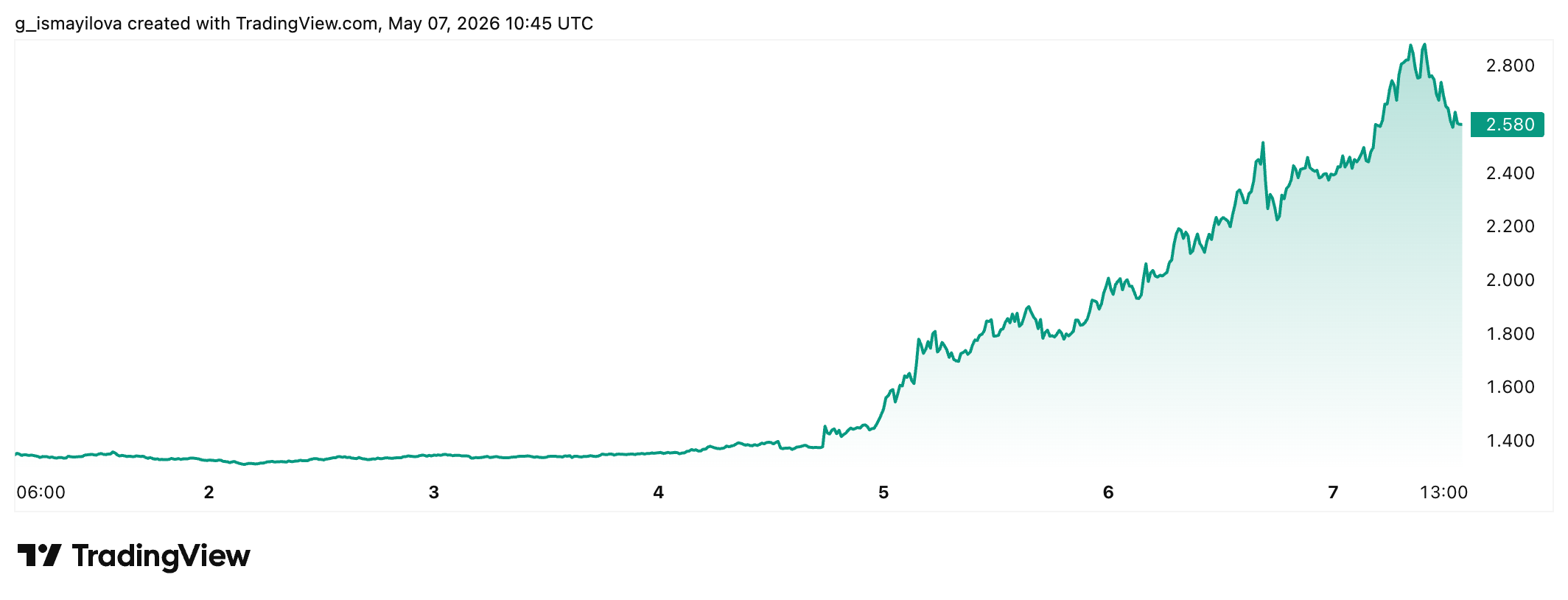
Market reaction to the update showed sharp movement. According to TradingView data, TON rose to $2.89, with a 32 percent gain within 24 hours. The rally did not follow a straight path. The increase followed earlier gains tied to a fee reduction and validator changes announced by Durov.
Fees in TON have dropped 6× — to nearly zero.
— Pavel Durov (@durov) May 4, 2026
Next step — Telegram replaces the TON Foundation as the driving force behind TON and becomes its largest validator.
The focus shifts to tech superiority.
New https://t.co/Me0w683UiK, new dev tools, new performance upgrades.…
The same dataset shows TON has gained more than 110 percent since those announcements. Its market capitalization reached $7.6 billion during the rally, placing it briefly among the top 20 digital assets.
Speed claims face broader adoption test
The report frames finality as a key benchmark for real-time financial use cases. Faster confirmation reduces settlement risk and supports applications such as payments and trading systems.
At the same time, validator concentration has drawn scrutiny. Telegram’s growing share of validator power raises governance questions, particularly as staking participation increases and circulating supply tightens.
The data provides a clear snapshot of technical performance across major blockchains. It also highlights a wider divide between legacy systems and newer architectures that prioritize speed.
Whether that advantage translates into sustained adoption remains tied to network usage, application demand, and regulatory clarity across global markets.
 Gunel Ismayilova
Disclaimer: All materials on this site are for informational purposes only. None of the material should be interpreted as investment advice. Please note that, despite the nature of much of the material created and hosted on this website, HODL FM operates as a media and informational platform, not a provider of financial advisory services. The opinions of authors and other contributors are their own and should not be taken as financial advice. If you require advice, HODL FM strongly recommends contacting a qualified industry professional.