


Crypto markets closed the week with mixed performance, as several altcoins posted strong gains while others declined modestly. At the same time, major industry moves, from Western Union’s stablecoin launch on Solana to Coinbase’s legal dispute and new institutional blockchain adoption in Switzerland, highlight continued growth and rising regulatory focus across the crypto sector.
Top gainers and losers
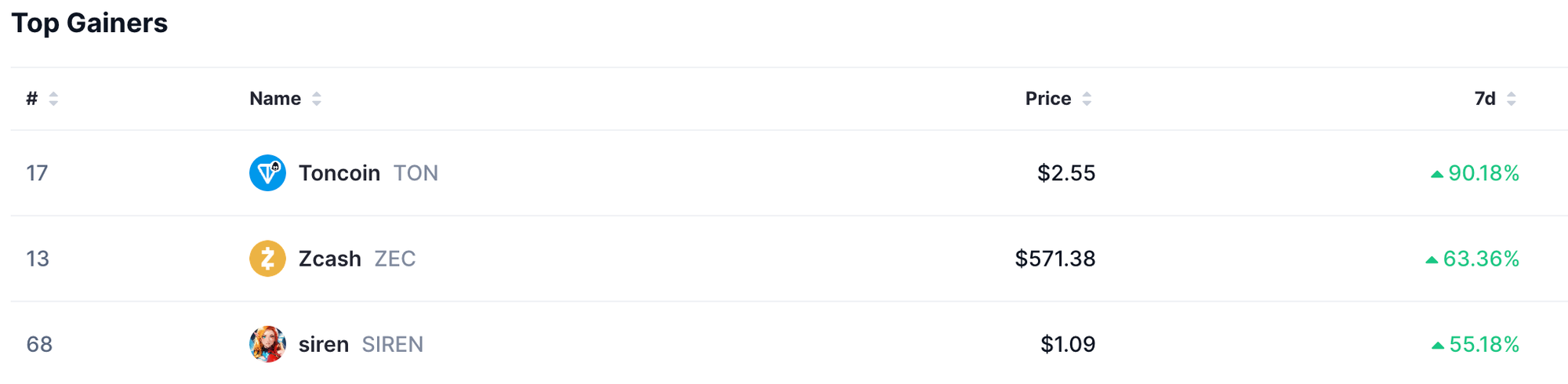
- Toncoin (TON) - jumped by 90.18% to $2.55 this week;
- Zcash (ZEC) - surged 63.36% during that time to reach a price of $571.38;
- Siren (SIREN) - The price went up 55.18% to $1.09.
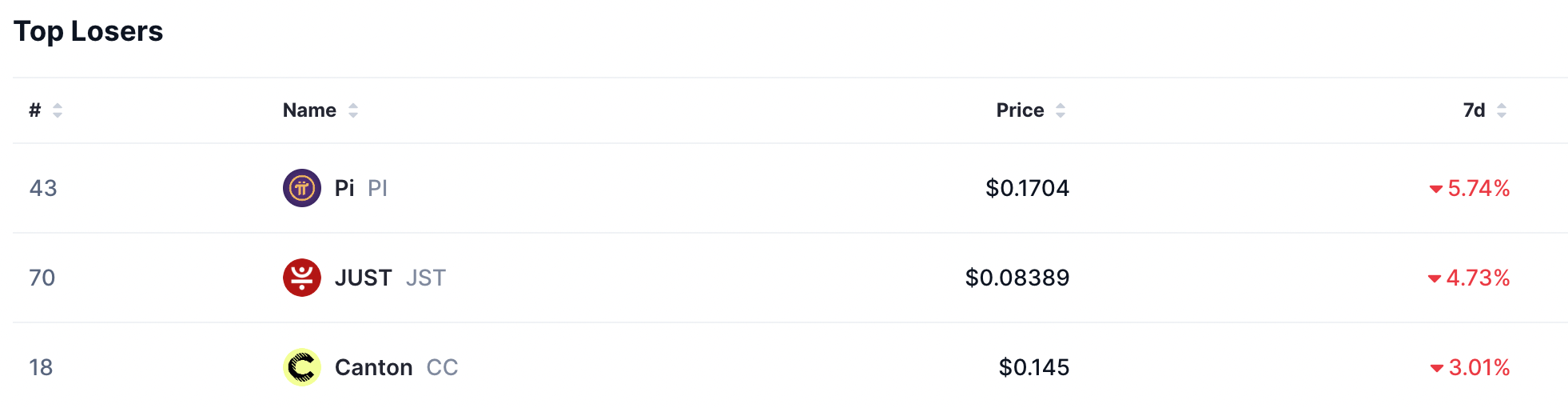
- Pi (PI) - end week price of $0.1704, falling this week by 5.74%.
- JUST (JST) - lost 4.73% to end the week at a price of $0.08389.
- Canton (CC) - finished the week down 3.01%, at $0.145;
Western Union launches USDPT stablecoin on Solana for global payments push
Western Union has launched its US dollar-denominated USDPT stablecoin on the Solana blockchain, marking its first major step into blockchain-based payments and onchain settlement for its global remittance network.
According to crypto infrastructure platform Fireblocks, which is involved in the rollout, USDPT is initially being introduced in Bolivia and the Philippines. Western Union said it plans to expand availability to more than 40 countries in 2026, targeting its large cross-border remittance base.
The stablecoin is issued by Anchorage Digital, the first federally regulated crypto bank in the United States, while Fireblocks provides wallet and settlement infrastructure supporting the system. Western Union also plans to make USDPT available on licensed crypto exchanges and integrate it into its broader liquidity and payments rails.
We’re happy to announce the launch of USDPT, Western Union’s USD‑backed stablecoin — issued by @Anchorage and built on @solana — bringing blockchain settlement into our global, regulated payments network. Follow @USDPT_ for updates. Learn more: https://t.co/t6h28rhbaz pic.twitter.com/aX6WNJIEoz
— Western Union (@WesternUnion) May 4, 2026
Western Union said the “launch of USDPT reflects a broader shift in how global payments are evolving,” adding that more financial institutions will adopt “regulated digital assets as core infrastructure going forward.”
The move comes as major remittance players expand stablecoin services following regulatory clarity from the GENIUS Act passed in July. MoneyGram launched USDC services in Colombia in September, while Zelle announced stablecoin-powered cross-border transfers in October.
The stablecoin market cap currently stands at $322.8 billion, with projections from the US Treasury and Citigroup suggesting it could exceed $1.6 trillion by 2030.
USDPT’s early rollout covers Bolivia and the Philippines, reaching a combined population of about 130 million people. Western Union, which serves over 150 million customers across 190 countries, continues to position itself in emerging crypto payment corridors across global remittance flows.
Coinbase faces lawsuit over frozen $55 million crypto theft funds
Crypto exchange Coinbase is facing a lawsuit from an anonymous crypto whale who claims the platform refused to return frozen assets tied to a 2024 phishing theft that drained roughly $55 million in DAI.
The plaintiff, identified only as “D.B.” in court filings, sued Coinbase and an unnamed “John Doe” attacker on Monday. The complaint closely matches an August 2024 incident in which a crypto whale lost about $55 million worth of DAI after falling victim to a phishing site.
According to the filing, the victim logged into a fraudulent page on Aug. 20, 2024, which granted attackers access to a crypto wallet. The attacker allegedly used “Inferno Drainer,” a tool designed to automate crypto theft, to move funds out of the wallet.
Blockchain security firm Zero Shadow is cited in the complaint as having traced part of the stolen assets to a Coinbase retail user account. The amount held in that account was not disclosed.
Coinbase froze the assets after being notified of the theft. However, the exchange refused to release the funds back to D.B. without a court ruling confirming ownership.
“While Coinbase acted reasonably in freezing the stolen cryptocurrency, its refusal to return the frozen funds to Plaintiff became unreasonable when Plaintiff provided sworn proof that he is the rightful owner and Coinbase refused to act,” attorneys for D.B. said in the filing.
The plaintiff is now seeking a court order requiring Coinbase to return the “traceable” funds, arguing he remains the lawful owner of the assets.
Crypto-related fraud continues to rise, with reported losses reaching $11.3 billion last year, according to FBI data.
Swiss bank Amina becomes first regulated bank to support Canton Coin
Swiss crypto bank Amina has added custody and trading support for Canton Coin, becoming the first FINMA-regulated bank to support the token tied to the institutional-focused Canton Network.
In a Wednesday announcement, Amina said clients can now access the Canton Network through a regulated banking channel. The network, developed by Digital Asset, is backed by major financial institutions including the Depository Trust & Clearing Corporation, Visa, BitGo, Goldman Sachs and Citadel.
AMINA is now the first regulated bank to support custody and trading for Canton Coin.
— AMINA Bank (@AMINABankGlobal) May 6, 2026
For institutional, corporate, and professional investors, digital assets are increasingly about infrastructure, scale, and execution discipline, not experimentation. @CantonNetwork… pic.twitter.com/04b9Urx1Er
The integration allows institutional clients to hold and trade Canton Coin without relying on crypto-native exchanges or independent custodians. Instead, access is provided through a Swiss Financial Market Supervisory Authority (FINMA)-regulated banking framework, which positions the token within traditional compliance structures used by financial institutions.
Amina said the move reflects its broader strategy in tokenized finance infrastructure. In March, the Zug-based bank became the first regulated banking participant on the EU-regulated 21X blockchain securities platform, which operates under the European Union’s DLT pilot regime for tokenized securities markets.
Canton Network is designed for institutional use cases, focusing on tokenized assets, settlement systems, collateral management and repo markets. Its native token, Canton Coin, trades at around $0.145 with a market capitalization of about $5.57 billion, according to CoinMarketCap data.
The ecosystem has seen expanding institutional participation. In April, BitGo extended its Canton Coin services beyond custody to include trading and onchain settlement. S&P Dow Jones Indices also integrated its US Treasury Index benchmark into the Canton Network, giving institutions access to fixed-income data through tokenized infrastructure.
Competition remains active in the institutional blockchain segment. R3’s Corda targets regulated financial markets with a permissioned design focused on privacy, while Hyperledger Fabric continues to see adoption across enterprise and banking environments.
Amina’s latest move signals growing alignment between regulated banking systems and blockchain-based settlement networks aimed at traditional capital markets infrastructure.
NEAR Protocol calls for faster blockchain verification amid quantum risk concerns
Blockchain protocols preparing for potential quantum computing threats should also focus on how to quickly verify ownership of funds onchain if assets are stolen, according to research and development teams behind NEAR Protocol.
Concerns around quantum computers breaking current cryptographic systems have mostly centered on private key exposure and wallet security. However, Near One’s chief technology officer Anton Astafiev said the challenge goes further than prevention.
“We won’t be able to tell if someone running a transaction is the rightful owner of the asset or not,” Astafiev said on Wednesday, adding that protocols may eventually need to decide whether to freeze compromised wallets or allow unrestricted activity.
“Protocols will face the challenge of deciding to either block all assets at this moment, or enter a wild west,” he said.
Astafiev suggested that zero-knowledge proof systems could help address the issue by allowing users to prove ownership of funds without revealing sensitive seed phrases. He said such tools could become essential as blockchain ecosystems prepare for uncertain quantum developments.
Quantum computing is a threat to every blockchain protocol. NEAR's architecture already makes accounts and assets more quantum-secure than most chains.
— NEAR Protocol (@NEARProtocol) May 6, 2026
The team is now adding post-quantum cryptography to secure NEAR and the wider Intents ecosystem.
Here's what's underway 🧵 pic.twitter.com/kugoUIlq24
The discussion follows research published in March by teams at Google and the California Institute of Technology, which suggested quantum computers may arrive sooner than expected and require less computing power to break encryption than previously assumed.
NEAR developers are also working on a post-quantum-safe signing system for the layer-1 network, which currently secures more than $137.6 million in user funds. One planned upgrade includes “FIPS-204,” approved by the US National Institute of Standards and Technology, with a testnet launch expected by the end of Q2.
Other ecosystems are also advancing quantum-resistant tools, including Ethereum’s Post-Quantum team and Solana validator experiments with Falcon signatures.
 Jordan V.
Disclaimer: All materials on this site are for informational purposes only. None of the material should be interpreted as investment advice. Please note that, despite the nature of much of the material created and hosted on this website, HODL FM operates as a media and informational platform, not a provider of financial advisory services. The opinions of authors and other contributors are their own and should not be taken as financial advice. If you require advice, HODL FM strongly recommends contacting a qualified industry professional.