



Kalshi has raised more than $1 billion in fresh funding, pushing its valuation to $22 billion and marking one of the fastest valuation climbs in digital finance. The round, led by Coatue Management, doubles the company’s valuation from $11 billion just months earlier, according to Bloomberg and company disclosures.
The scale of the raise reflects continued investor interest in prediction markets, even as legal and regulatory pressure intensifies across the United States.
Kalshi declined to comment publicly on the funding details, while Coatue also did not provide a statement. The deal was first reported by The Wall Street Journal and later confirmed through multiple outlets.
Growth accelerates across trading activity
Kalshi’s internal metrics show rapid expansion. The company reported an annualized revenue run rate of $1.5 billion. Trading activity has also surged. Annualized trading volume increased from $52 billion to $178 billion within six months, according to company figures. Institutional trading volume rose by 800% over the same period.
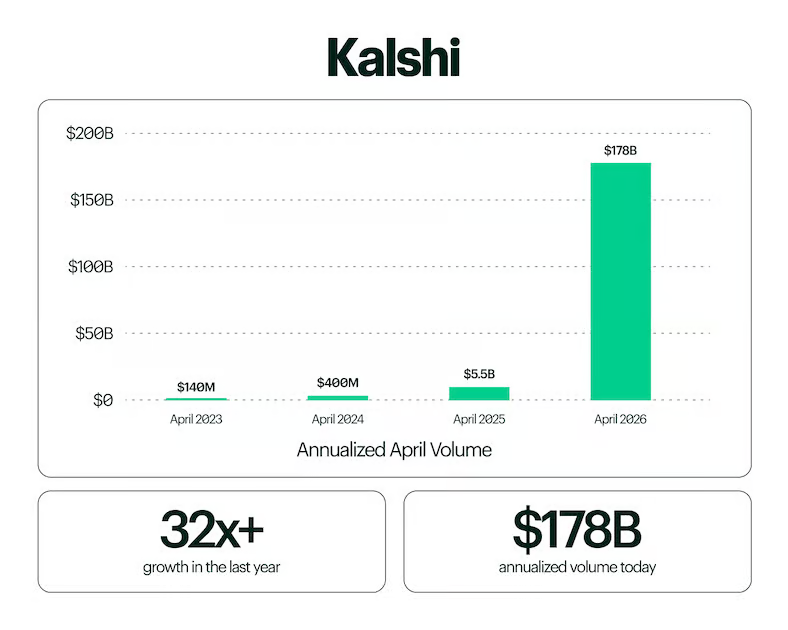
User activity followed a similar pattern. The platform now serves around 2 million monthly users and accounts for more than 90% of U.S. prediction market activity, based on Investing.com reporting.
Data compiled on Dune Analytics shows that trading volume on Kalshi exceeded $10 billion in February alone. That figure stands at roughly 12 times the level recorded six months earlier. Rival platform Polymarket has posted similar growth, though it operates primarily outside the United States.
Kalshi offers contracts tied to real-world outcomes. These include elections, economic indicators, and sports events. A court decision in 2024 allowed the company to expand into election-related contracts, which drove a sharp increase in user activity.
Institutional capital reshapes the business
The latest funding round includes participation from major firms such as Sequoia Capital, Andreessen Horowitz, Morgan Stanley, ARK Invest, and Paradigm. Earlier rounds had already drawn support from several of these investors.
Kalshi plans to use the new capital to expand adoption among hedge funds, asset managers, and proprietary trading firms. The company has introduced features such as block trading and is preparing additional risk products and broker integrations aimed at institutional users.
Co-founder and CEO Tarek Mansour described the market opportunity in direct terms:
"There are few categories in recent history that have scaled this quickly outside of AI." He added, "Event contracts could become a trillion-dollar market, and we're still in the early stages of that transition."
Coatue founder Philippe Laffont also emphasized institutional demand. He said,
"Kalshi is building the leading platform for trading in real-world events," and noted that institutional adoption may follow early retail interest.
Federal oversight contrasts with state challenges
Kalshi operates as a federally regulated exchange under the supervision of the Commodity Futures Trading Commission. This structure allows the company to offer contracts nationwide under federal rules, which differ from state-level gambling regulations.
That distinction has become a point of legal conflict. Several states have challenged Kalshi’s operations. Arizona filed criminal charges this week, accusing the company of running an “illegal gambling operation.” Other states, including New Jersey, Nevada, Illinois, and Massachusetts, have issued similar challenges or cease-and-desist orders.
Kalshi has rejected these claims and continues to argue that its federal oversight places it outside state jurisdiction in this context. The current chair of the CFTC has signaled support for prediction markets in disputes with state regulators, according to Bloomberg reporting.
The legal tension has influenced how financial firms approach the sector. Point72 Asset Management and Balyasny Asset Management have restricted employees from trading on prediction market platforms in personal accounts.
Early friction highlights risks of rapid growth
The rapid rise of prediction markets has exposed structural challenges. Lawmakers have raised concerns about insider trading and potential market manipulation, particularly in cases where traders appeared to profit from early access to information tied to corporate or government actions.
Kalshi’s expansion into sports-related contracts has added another layer of scrutiny. Sports betting activity now represents a significant portion of trading on the platform, which has drawn comparisons to traditional gambling products.
Despite these concerns, institutional participation continues to grow. Firms such as Susquehanna International Group and Jump Trading act as market makers on Kalshi, while Tradeweb Markets Inc. has partnered with the platform to provide prediction market data to its clients.
A fast-moving sector faces unresolved questions
Prediction markets now handle billions in weekly trading volume across platforms. Kalshi and Polymarket dominate much of that activity. The sector’s growth has created a new class of high-value startups and has turned Kalshi’s co-founders into billionaires.
At the same time, regulatory uncertainty remains unresolved. Federal agencies, state governments, and financial institutions continue to define how these markets fit within existing legal frameworks.
The latest funding round places Kalshi at the center of that shift. The company has secured capital, scale, and institutional backing. Legal clarity has not kept pace with that growth.
 Gunel Ismayilova
Disclaimer: All materials on this site are for informational purposes only. None of the material should be interpreted as investment advice. Please note that, despite the nature of much of the material created and hosted on this website, HODL FM operates as a media and informational platform, not a provider of financial advisory services. The opinions of authors and other contributors are their own and should not be taken as financial advice. If you require advice, HODL FM strongly recommends contacting a qualified industry professional.