


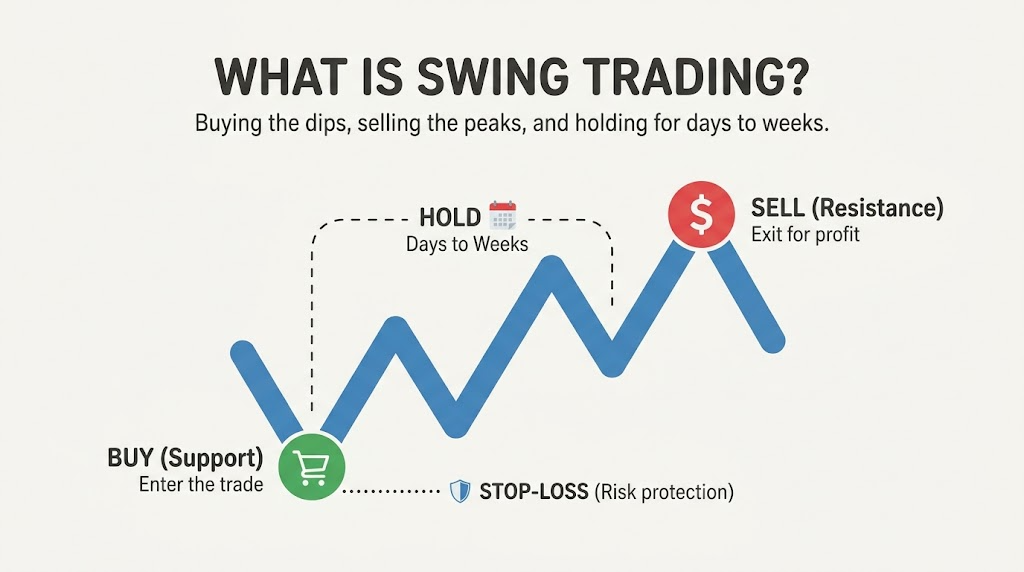
Swing trading is a style of trading that aims to capture short- to medium-term price moves, typically over several days to a few weeks. A swing trader might buy Bitcoin after it bounces off a support level on Monday and sell the following week once momentum fades. The goal is to profit from a meaningful part of a move without reacting to every intraday fluctuation and without holding through a multi-year cycle like a long-term investor.
Swing trading doesn't demand constant screen time, yet it still lets traders act on technical setups. But it isn't a shortcut to consistent profits. It involves substantial risk, and no setup guarantees a result.
How swing trading differs from other styles
Scalpers enter and exit trades within seconds or minutes, sometimes placing hundreds of trades in a single session. Day traders finish the session flat (in crypto, usually within hours). Long-term investors hold for months or years and mostly ignore the noise in between.
Swing traders hold for days to weeks. They read charts, follow the news, and check in once or twice a day. Bitcoin's climb from about $64,800 on August 7 to a high near $81,200 on September 4, 2026 is the size of move they're after: four weeks, one trade.
Shorter styles cost more time and attention, and retail trading's record is poor. ESMA, the EU's markets regulator, found in an analysis of CFD trading across EU countries that 74-89% of retail accounts typically lose money. That figure is for leveraged CFDs, and swing trading is slower, which helps, but it isn't safe. Positions stay open overnight, so price can move while you're away. In stocks and forex that shows up as gaps at the open. Crypto never closes, so it looks like a sharp move at 3 a.m. A stop-loss and a modest position size are your defense.
How swing trading works: process, analysis, and strategies
A swing trade usually starts with a watchlist. The trader scans it for a setup, such as a pullback in an uptrend, a breakout from a range, or a bounce off support, then checks whether the higher-timeframe trend, volume, and momentum back the idea up. If they don't, the trade gets skipped. The entry, stop-loss, and profit target are set before the order goes in, because decisions made mid-trade tend to be emotional ones. After that the trader waits and closes the position when the price hits the target or the stop, or when the original setup falls apart.
Swing traders lean on a handful of chart tools, and none of them works well alone. Support and resistance are price levels where the market has turned before, so they're natural spots for entries, stops, and targets. A trend of higher highs and higher lows says buy dips, and the reverse says sell rallies. Flags, double tops, and head-and-shoulders formations suggest whether a move will continue or reverse. Moving averages smooth out the noise and show the trend's direction, but they always trail price. Volume tells you how many traders are behind a move: A breakout on heavy volume is more trustworthy than one on thin volume. RSI and MACD measure momentum and can show when a move is stretched.
Four strategies come out of those tools. Trend-following means buying into an established uptrend (or selling into a downtrend), usually on a dip. Pullback trading is the patient version: you wait for the price to retreat inside the trend and enter at a better level. Breakout traders enter when the price clears support or resistance on strong volume. Range traders do the opposite and buy near support and sell near resistance while the market drifts sideways. None of these strategies work everywhere. Trend-following gets chopped up in a sideways market, and range trades fail the moment price breaks out, so figure out what kind of market you're in before you pick a strategy.
Beyond the charts, a few practical tools do most of the day-to-day work. A charting platform like TradingView, a screener, or an exchange's built-in tools helps a trader find and study setups. Price alerts send a notification when an asset hits a chosen level, so nobody has to sit and watch the screen. The trading journal matters most: writing down why each trade was taken and how it ended is the quickest way to see which mistakes keep repeating. None of these tools does the thinking for you.
Risk management, beginner mistakes, and a hypothetical trade
Protecting capital comes first. A trader who loses 50% needs a 100% gain just to break even, so avoiding big losses matters more than landing big wins. The stop-loss belongs where the trade idea is proven wrong, not at a dollar amount that feels tolerable. Position size follows from that stop: most traders risk a small, fixed share of their account, typically 1-3%, on each trade. Many also want at least two or three times as much potential reward as risk before they enter. Leverage is the dangerous one. It magnifies losses as well as gains, and in a fast move it can liquidate a position outright.
Most beginner mistakes are just the principles above, ignored. People trade out of boredom when there's no real setup on the chart. They enter without knowing where they'll get out. They lean on a single indicator. They move the stop further away because the losing trade "might still recover." They pile on leverage or put too much of the account into one position. In the end, it’s mostly about discipline, not analysis.
Take a simple example with round numbers. An asset is in an uptrend, pulls back to a support level, and prints a bullish reversal candle. The trader buys at $50 and puts the stop at $47, just under support. If the price falls that far, the idea is wrong and the trade closes. The target is $59: $9 of potential gain for $3 of risk, or 1:3.
Now the size. On a $10,000 account with a 2% risk limit, the trader can lose $200. At $3 of risk per unit, that's about 66 units. Once the price reaches $53, the stop moves up to $50, so the worst case becomes breakeven. If the price stalls or drops back below support before the target, the trader gets out early.
This scenario is an educational example, not a recommendation or trading signal. Setups like this fail often, and the stop is there for those times.
Applying swing trading to crypto markets
Crypto never closes, so nothing shields an open position overnight or over a weekend. Volatility is usually higher than in stocks or forex: Bitcoin gained about 25% in August alone. Liquidity is uneven. Major coins trade smoothly, but a modest order in a small token can slip badly. News lands within minutes, so crypto swing traders tend to use smaller positions and stops wide enough to survive normal noise.
Context can override a clean setup. In late August, hawkish Fed comments at Jackson Hole pushed Bitcoin below $78,000 intraday, and about $3.5 billion of US spot ETF inflows had helped fuel the month's rally. Listings, delistings, protocol upgrades, and new regulation all move price too. Token unlocks add supply on a known schedule, so check the calendar before entering. Sentiment swings between fear and greed, and a sudden drop in volume usually means a thin market that's easy to push around.
Advantages, disadvantages, and who it suits
Swing trading takes less time than day trading, works in most liquid markets, and doesn't ask you to predict every intraday wiggle. The costs are real, though. Positions stay open while you sleep, consistent results take skill, and discipline is hard to hold when a trade goes against you. Indicators and patterns fail all the time.
It suits people who can spare a few hours a week for research and monitoring, have moderate risk tolerance and some chart experience, and can stick to a written plan when emotions say otherwise. It's a poor fit if you can't afford to lose the money, if a losing position makes you panic, or if you tend to break your own rules once real money is at stake.
Swing trading carries substantial risk, however experienced you are. Historical patterns only tilt the odds: a setup that worked ten times can fail on the eleventh, and crypto's volatility makes the swings bigger in both directions. Start with money you can afford to lose, keep a journal, and treat the first few months as practice.
 Gunel Ismayilova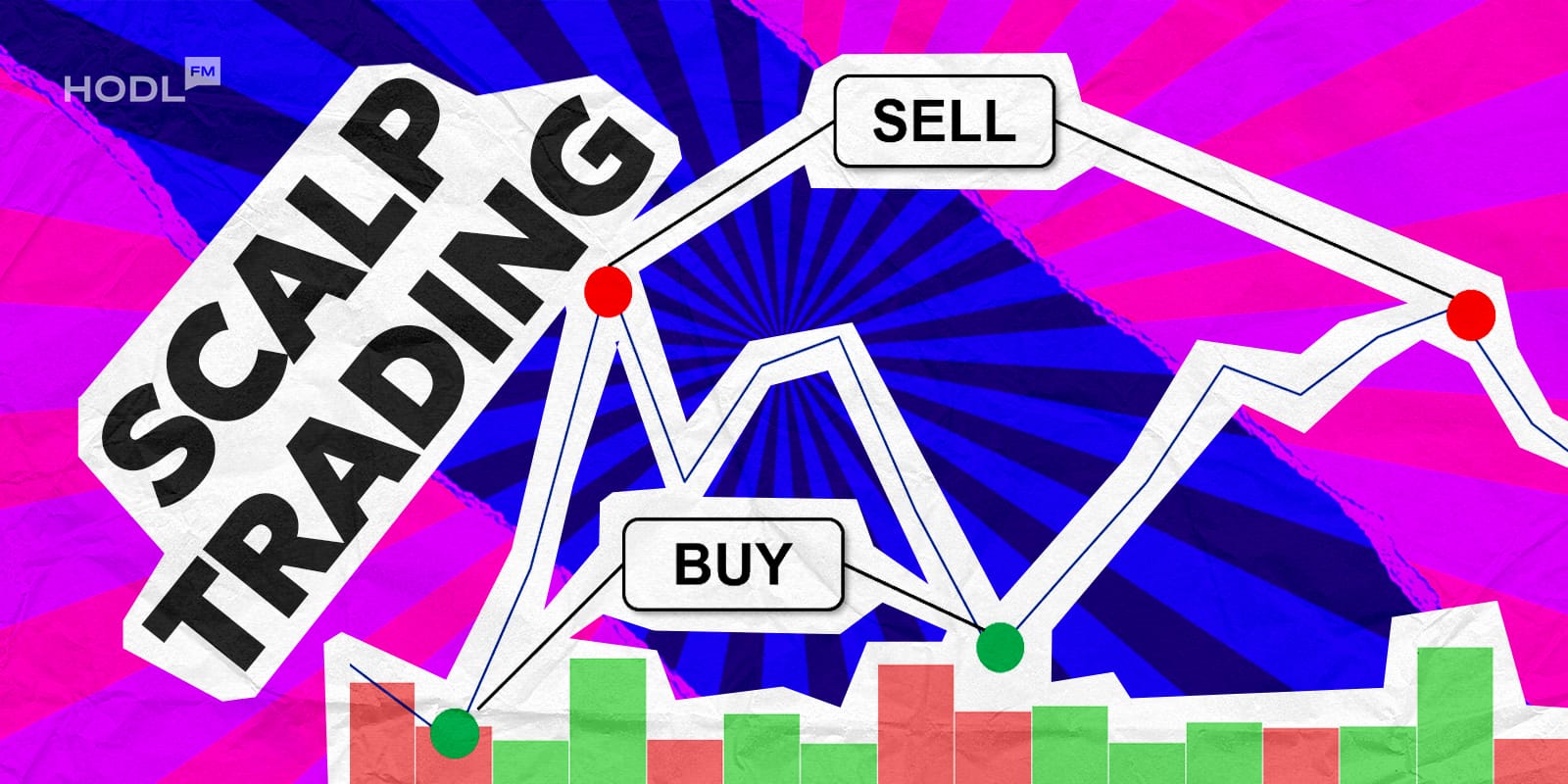
Disclaimer: All materials on this site are for informational purposes only. None of the material should be interpreted as investment advice. Please note that, despite the nature of much of the material created and hosted on this website, HODL FM operates as a media and informational platform, not a provider of financial advisory services. The opinions of authors and other contributors are their own and should not be taken as financial advice. If you require advice, HODL FM strongly recommends contacting a qualified industry professional.