


Scalping is one of the most active trading styles out there. It shows up in forex, crypto, and the stock market, and it attracts traders who would rather make 50 small wins in a day than wait weeks for one big one. This guide breaks down how it works, what tools scalpers use, and what risks come with it.
What is scalp trading?
Scalp trading or scalping is a short-term strategy, where traders open and close positions within seconds or minutes to capture tiny price movements. Instead of waiting for a large move, scalpers collect a high volume of small gains throughout the day.
A true scalper might execute dozens or even hundreds of trades per session; some are in and out before a candle on a one-minute chart even closes. It is that high trade frequency, repeated throughout the session, that makes scalping work.
In crypto scalping, leverage is key. It lets you trade with more money than you actually have. Using 10x leverage turns a $100 budget into a $1,000 position, so even a $10 move in Bitcoin can bring a quick $10 profit instead of pennies. Do this ten times a day and those small wins add up fast. Trading with leverage is one of the main reasons retail traders lose money, according to a study by Harvard University. Just a small move against you can wipe out your whole deposit, because brokers automatically close leveraged positions to prevent losses. When this happens to many traders at once, it pushes prices down even faster, triggering more forced closures in a chain reaction
None of that works without the right market conditions. Scalpers need extremely liquid markets to enter and exit positions quickly without significant price slippage. Wide spreads eat directly into profit, and even a tiny delay between clicking Buy and getting a fill can turn a winning trade into a loss.
Common scalp trading strategies
Scalping trading is a dynamic and fast-paced trading style that enables traders to take advantage of short-term market opportunities.
Market-making scalping
This strategy involves placing buy and sell orders simultaneously in an attempt to profit from the bid-ask spread, which is the small gap between what buyers will pay and what sellers will accept. Since you are competing with banks and professional market makers, It is the most difficult strategy, as you are up against much larger and faster institutions.
Breakout scalping
Breakout scalping means entering a trade the moment a price breaks past a key support or resistance level on heavy volume. Scalpers try to jump in right as the move begins and exit at the first sign of a reversal. This is often the most approachable approach for newer traders, since similar setups appear across other trading styles too.
Trend-following scalping
Some scalpers identify a short-term directional trend using tools like moving averages or momentum indicators, then trade in that direction. The goal is to enter early and exit before the move fades, a mix of quick decision-making and basic technical analysis.
Range-bound scalping
When price bounces predictably between a support level and a resistance level, range-bound scalpers buy near the bottom and sell near the top. This works best in steady, liquid markets with clearly defined boundaries.
News-based scalping
Major economic releases, such as jobs reports, inflation data, and central bank decisions, can make prices move suddenly. News scalpers position around these events to catch the sharp swing that often follows a big announcement.
Tools and indicators used by scalpers
Scalping is almost entirely driven by technical analysis. Scalpers do not spend time on earnings reports or fundamentals; they focus on price action, momentum, and order flow.
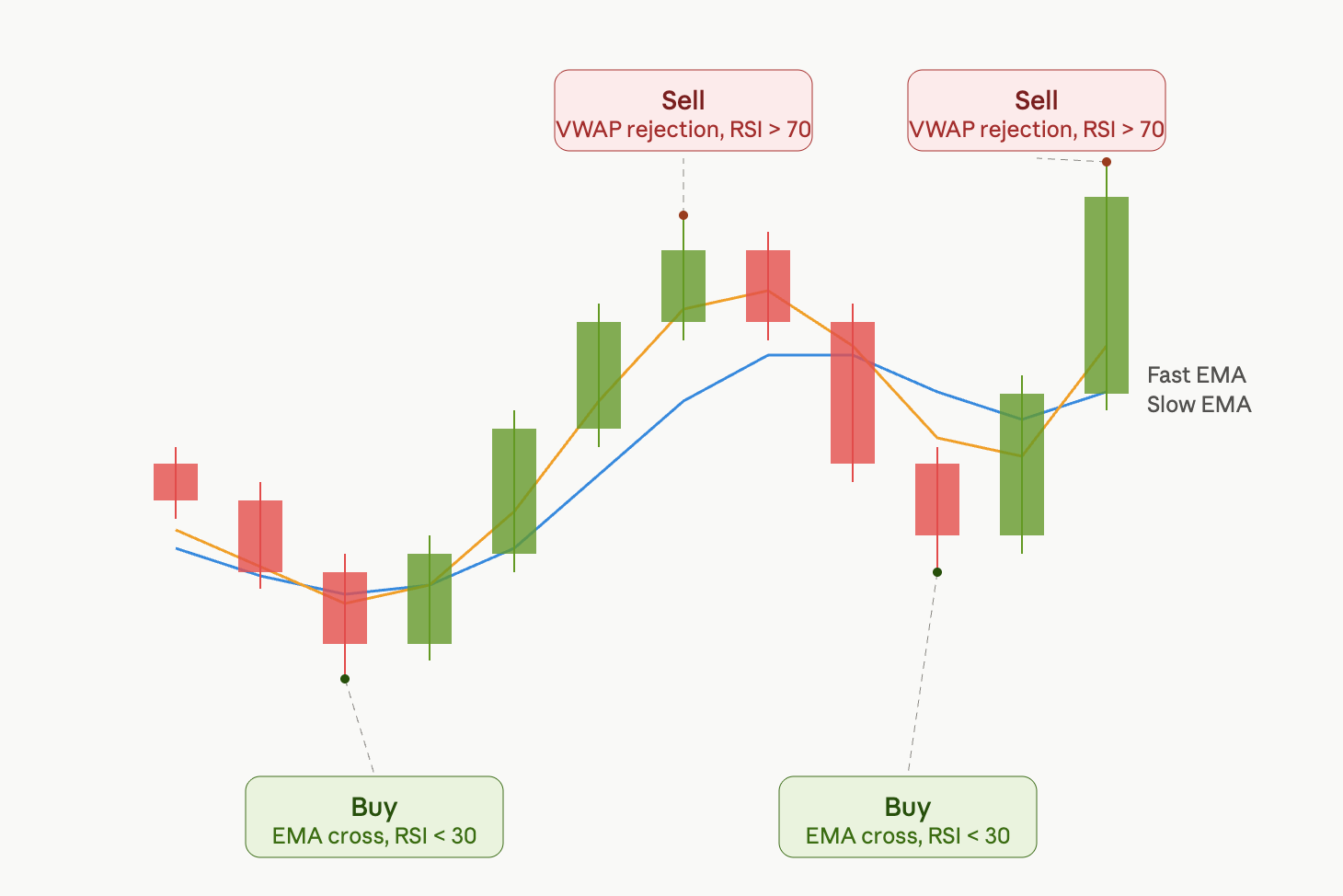
The RSI (Relative Strength Index) is one of the most common tools. It measures recent price momentum on a scale from 0 to 100, with readings above 70 signaling overbought and below 30 signaling oversold. Scalpers typically use a shorter period, like 5 or 7, to generate signals faster than the standard 14-period setting.
Alongside RSI, short-period EMAs (like the 5 or 9-period) help scalpers track trend direction. The classic signal is a shorter EMA crossing above a longer one as a buy trigger, or dropping below it as a sell trigger. Many scalpers also run MACD on shorter settings such as 6, 13, and 5, so it keeps pace with their timeframe.
Volume matters too. Indicators like VWAP or On-Balance Volume show whether a breakout has real momentum behind it or is likely to stall. A price move without volume confirmation is one of the more common traps in volatile markets.
Level 2 order book data adds another layer, showing where large buy and sell orders sit at different price levels. That information reveals short-term price magnets and walls where price is likely to reverse. Most scalpers work primarily from 1-minute and 5-minute candlestick charts, though some prefer tick charts that update by trade count rather than time.
Advantages of scalp trading
One of the clearest benefits is that all positions close before the end of the session, which cuts out overnight risk entirely. No surprise earnings calls, no geopolitical headlines overnight, whatever happened during the trading day is settled.
The strategy also creates a constant flow of opportunities. In volatile, liquid markets, valid setups appear throughout the day, so a scalper does not have to wait days or weeks for a trade to develop. Because each position lasts seconds or minutes, exposure per trade stays narrow. For traders who prefer systems over intuition, scalping also lends itself well to automation; algorithms can execute orders faster than any human can click, keeping execution consistent and emotions out of the equation.
Risks and challenges
Transaction costs are often the first thing that surprises new scalpers. When you trade dozens of times per day, every spread and commission multiplies. Due to the volume of trades being made each day, every expense associated with a scalping trade is significant.
The margin for error is also much tighter than in longer-term styles. A longer-term trader can absorb several losses and recover with one strong position. Scalpers do not have that buffer, one trade left open too long can erase an entire session's gains.
Then there is the psychological side. The constant, rapid decision-making leads to decision fatigue, a real deterioration in judgement that builds quietly over a session. Fear and greed worsen it: fear exits winners too early, and greed holds losers too long. Due to the experience required and the ability to make knowledgeable, quick decisions, scalping is generally not recommended for beginners.
Scalp trading vs other trading styles
Scalp trading vs day trading
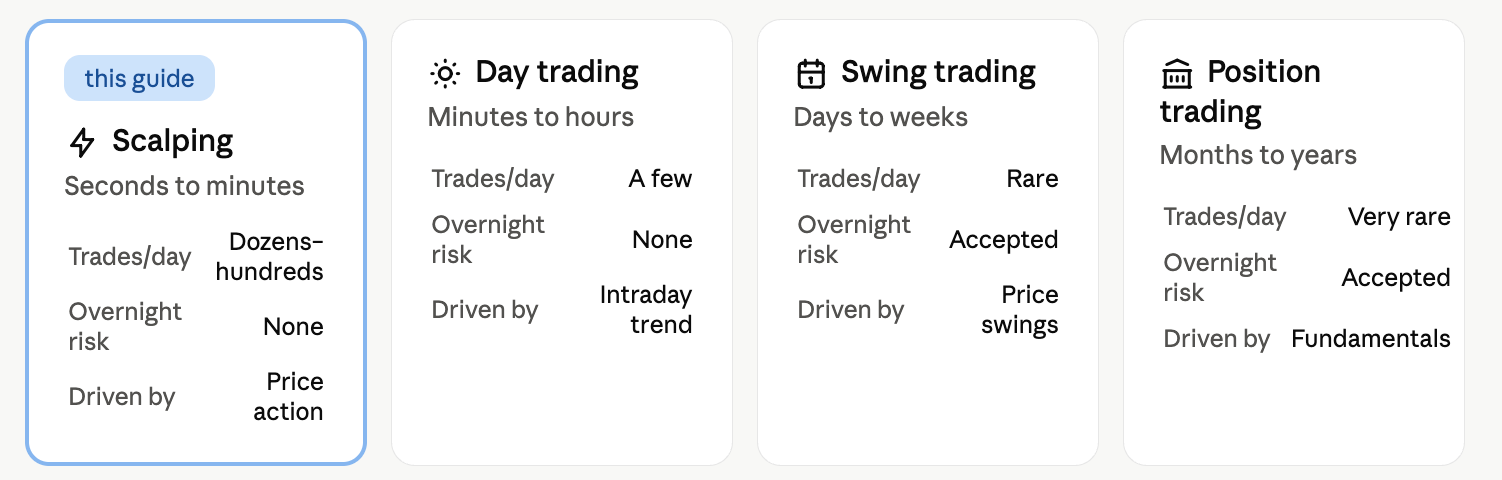
Day traders and scalpers both close positions before the session ends, but day traders hold for minutes to hours, not seconds, and target bigger moves on fewer trades. Making numerous tiny profits in brief amounts of time is the goal of scalping. Profiting from intraday price changes is the goal of day trading.
Scalp trading vs swing trading
Swing traders hold positions for several days or weeks, targeting larger price swings. They accept overnight risk in exchange for bigger potential rewards and do not need to monitor charts continuously through the day.
Scalp trading vs position trading
Position traders hold assets for months or years, with decisions driven more by fundamentals than by price action on a one-minute chart. It is the opposite end of the trading spectrum from scalping.
Key takeaways
Scalp trading requires technical accuracy and real-time discipline. Traders are drawn to the frequency of opportunities and the fact that they do not carry positions over to the next day. But so are the challenges. Transaction costs eat into thin margins, and a single hesitation can turn a winning setup into a loss.
Successful traders know the market well and manage risk effectively. They have the discipline to stick to a plan even under pressure. If you want to scalp, start on a demo account, find out your broker costs, and spend real time learning how the market you want to trade really behaves. Scalping rewards preparation more than almost any other style.
 Tanya Petrusenko
Disclaimer: All materials on this site are for informational purposes only. None of the material should be interpreted as investment advice. Please note that, despite the nature of much of the material created and hosted on this website, HODL FM operates as a media and informational platform, not a provider of financial advisory services. The opinions of authors and other contributors are their own and should not be taken as financial advice. If you require advice, HODL FM strongly recommends contacting a qualified industry professional.