




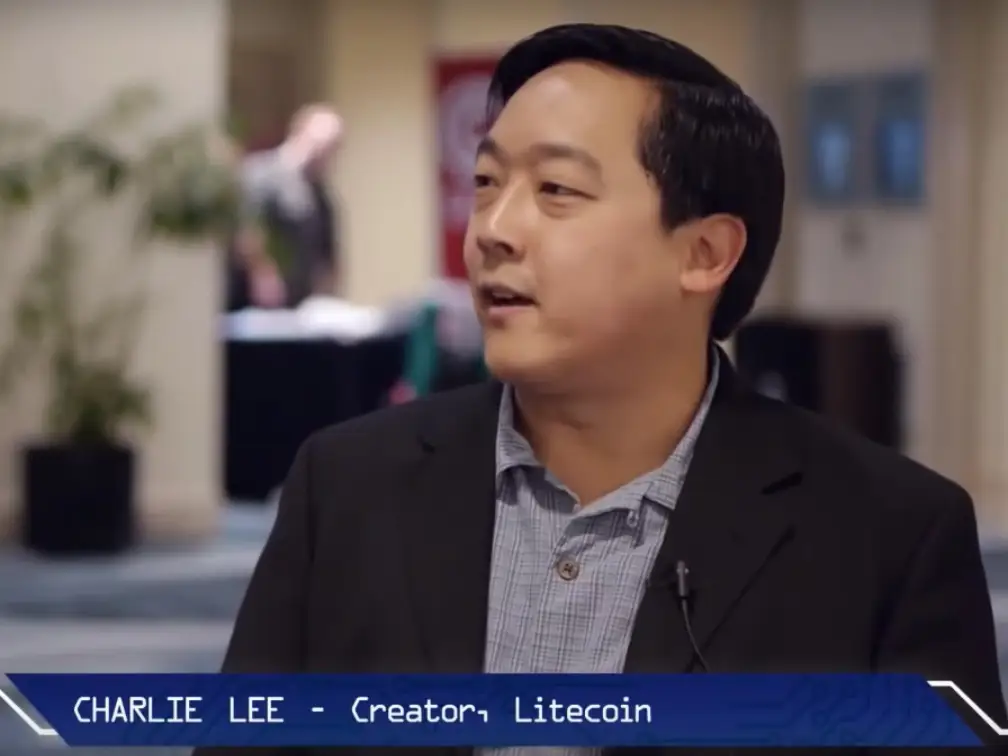
Charlie Lee is the computer scientist behind Litecoin (LTC), one of the oldest cryptocurrencies still active today. He launched the project in October 2011, just two years after Bitcoin went live, and it has survived every market cycle since. For anyone who got into crypto after 2017, Lee is a quieter name than Vitalik Buterin or CZ, but he's the starting point for the entire concept of "altcoins".
Lee was born in Ivory Coast to Chinese parents and moved to the United States as a teenager. He studied computer science at MIT, earning both a bachelor's and a master's degree, then spent close to a decade in mainstream tech, including a stint at Google working on Chrome OS and infrastructure projects. That background shaped him: building software at Google meant working under strict standards for code quality, security, and scalability, and Lee carried that discipline directly into Litecoin's codebase.
Lee came across Bitcoin in 2011 and was drawn to its blend of computer science, cryptography, and decentralised money. He's described buying his first bitcoin and experimenting with mining before trying to build cryptocurrencies of his own. What hooked him wasn't the price potential but the idea of moving value without a bank or central authority. He dug into Bitcoin's open-source code and got involved in the small community forming on BitcoinTalk, experiments that eventually produced two projects: Fairbrix, then Litecoin.
Building Litecoin
That period also coincided with a shift in mining, as GPUs began replacing consumer CPUs and pricing regular users out of rewards. Lee first joined an effort to fork Tenebrix, an early coin using the memory-hard scrypt algorithm to keep CPU mining viable, but Tenebrix carried a bloated 7-million-coin premine. His fix, Fairbrix, inherited bugs from earlier forks and had no issuance cap.
So Lee started over. He forked directly from Bitcoin's codebase and made only a few changes: faster block confirmations, a fixed supply cap, and Scrypt mining to make it fairer. He posted the code publicly, let the community pick the launch date, and mined only a small batch of coins beforehand to test the network avoiding premines, token sales, or VC backing entirely. The genesis block referenced Steve Jobs's recent death. The original announcement went up on BitcoinTalk on October 9, 2011, titled "[ANN] Litecoin – a lite version of Bitcoin. Launched!" The network went live on October 13. Archived copies of that BitcoinTalk launch thread, the early client, and the genesis block message still exist as a historical record on Litecoin's GitHub history and blockchain explorers.
Lee never framed Litecoin as a Bitcoin replacement. He wanted to preserve Bitcoin's core monetary design while tweaking parameters to make it better suited to smaller, faster payments: giving CPU and GPU miners a real shot, avoiding a large founder premine, producing blocks faster, keeping a predictable supply schedule, and creating a network where Bitcoin-adjacent tech could be tested. Scrypt didn't block specialised hardware forever, Litecoin ASICs showed up in 2014, but it delayed them long enough to give ordinary miners years of viable participation.
The numbers reflect that design: a 2.5-minute block target versus Bitcoin's 10 minutes, an 84 million coin cap against Bitcoin's 21 million, and halvings every 840,000 blocks instead of 210,000, scaled roughly 4x to mirror Bitcoin's issuance timeline. Litecoin uses scrypt instead of SHA-256, positioning itself as a faster, complementary payment network rather than Bitcoin's core settlement layer. Faster blocks don't automatically mean more security, though; that also depends on hash rate and mining economics, and Bitcoin still holds a clear edge in liquidity and proof-of-work security overall.
Litecoin gained traction early in part because the launch felt fair and in part because scrypt mining allowed people with ordinary hardware to participate. Its close resemblance to Bitcoin also made it easy for miners, wallet developers, and exchanges to integrate, and the BitcoinTalk community helped distribute the software and catch early bugs. Listings on exchanges like BTC-e helped establish a real LTC/BTC market, and in 2014 Litecoin began merged mining with Dogecoin, letting scrypt miners secure both chains with the same work.
Coinbase, the Litecoin Foundation, and key milestones
Lee developed Litecoin alongside his day job. In 2013, he joined Coinbase as engineering manager, later becoming director of engineering, a period overlapping with Coinbase's rise as the top regulated US exchange, which gave Litecoin outsized retail visibility. He left in 2017 to work on Litecoin full-time through the Litecoin Foundation, a Singapore nonprofit funding development and adoption alongside the separate Litecoin Core developer team. Neither Lee nor the Foundation unilaterally controls the network: core developers maintain the software, miners choose which blocks to produce, and node operators enforce the rules, so the Foundation can fund and promote but can't dictate consensus changes.
Litecoin has also served as a testing ground for Bitcoin itself. It activated Segregated Witness in 2017 before Bitcoin, paving the way for layer-2 tools like the Lightning Network, and hosted the first cross-chain atomic swap (10 LTC for 0.1167 BTC). In May 2022, it rolled out MimbleWimble Extension Blocks (MWEB), an optional privacy feature letting users conceal transaction amounts while standard transactions stay public. Other milestones include the 2015, 2019, and 2023 halvings, the last dropping the block reward to 6.25 LTC.
The 2017 sell-off and the decentralisation debate
In December 2017, near the peak of the bull run, Lee sold or donated nearly all his personal LTC. He stated in an original Reddit announcement that the move was meant to eliminate a perceived conflict of interest, as his tweets about Litecoin frequently sparked accusations that he was manipulating prices for personal gain.
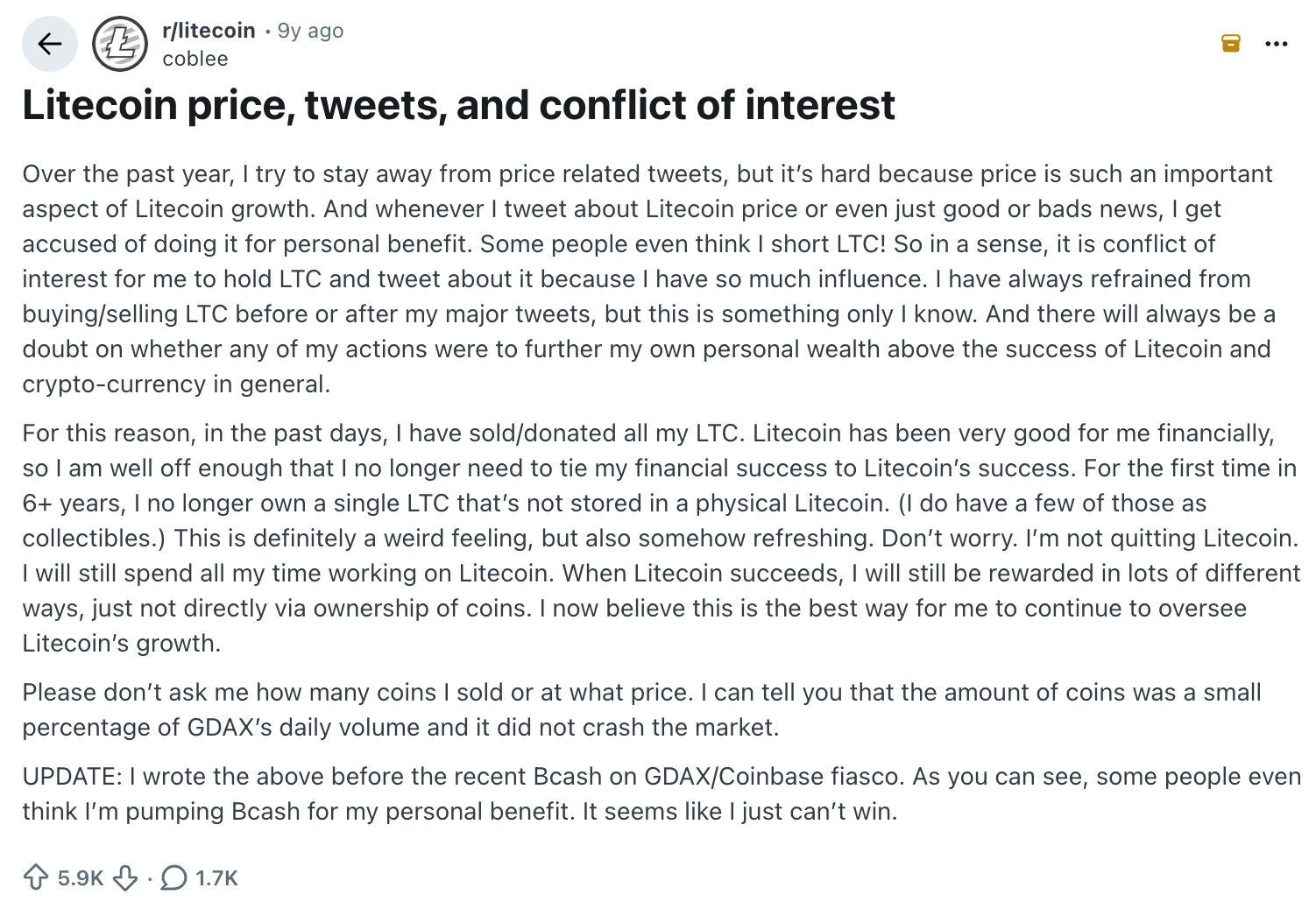
Public reaction was mixed: some viewed it as a step toward neutral leadership, while others interpreted it as a loss of confidence, prompting ongoing speculation about his net worth. Lee never disclosed exact amounts or sale prices, noting only that he kept a few physical Litecoin collectibles and no longer held enough LTC to create a personal financial conflict.
The episode became a case study in founder decentralisation more broadly, touching on how coins are distributed, how mining and development are spread out, and whether one person can dominate public messaging. Selling his stake addressed Lee's personal financial exposure, but it didn't by itself prove Litecoin was fully decentralised; he remained its best-known public face, so his influence became reputational rather than ownership-based.
Lee's views and where Litecoin stands today
Lee's own views, separate from any protocol fact, are that Bitcoin remains the dominant decentralised cryptocurrency while Litecoin plays a complementary role, his "silver to Bitcoin's gold" framing. He's emphasised payments, exchange support, and compatibility over building a separate smart-contract ecosystem and has framed his support for MWEB as giving users optional privacy without forcing it on everyone. None of this is a Litecoin protocol rule; changes still require developer work, miner buy-in, and node acceptance.
Litecoin is still producing blocks roughly every 2.5 minutes with no permanent outage since 2011: a max supply of 84 million LTC, a current block reward of 6.25 LTC, about 576 blocks and 3,600 new LTC per day, and an issued supply near 77 million LTC, over 91% of the cap. In a September 2025 CoinDesk Spotlight appearance, Lee reflected on losing personal anonymity and facing physical security risks, sometimes called "$5 wrench attacks", while confirming he still attends weekly Litecoin Foundation board meetings.
🎥 SPOTLIGHT: Charlie Lee@SatoshiLite on his journey from a "gold bug" at Google to the creator of Litecoin, the challenges of public life in crypto, and why he believes anonymity is priceless.
— CoinDesk (@CoinDesk) September 30, 2025
01:11 Charlie's Early Crypto Journey
02:41 The Allure of Gold
05:10 Why Google… pic.twitter.com/0xYPm97nek
Litecoin has also picked up institutional interest, with companies like MEI Pharma holding $110.4 million in LTC as a treasury asset. Fourteen years in, Lee remains involved as an advisor and spokesperson, not as someone with unilateral technical control, which still rests with independent developers, miners, exchanges, and node operators.
 Tanya Petrusenko
Disclaimer: All materials on this site are for informational purposes only. None of the material should be interpreted as investment advice. Please note that, despite the nature of much of the material created and hosted on this website, HODL FM operates as a media and informational platform, not a provider of financial advisory services. The opinions of authors and other contributors are their own and should not be taken as financial advice. If you require advice, HODL FM strongly recommends contacting a qualified industry professional.