



Crypto markets are open all day. That structural reality, along with big price changes that happen often, has made digital assets the best place for day traders to work. Day traders open and close positions in the same session, often several times, and look for short-term price movements that the rest of the market either ignores or is afraid of. Tradeciety’s research shows that approximately 80% of day traders quit within their first two years, and only 1.6% are consistently profitable in any given year. This highlights that day trading is a high-skill profession rather than a "get rich quick" hobby.
In this guide, we aim to provide a comprehensive introduction to day trading for beginners.
What is day trading?
Day trading is when you buy and sell an asset in the same trading session and don't leave any positions open overnight. That sets it apart from both swing trading and long-term investing. A long-term investor buys Bitcoin because they think it will be worth more in three to five years. A swing trader keeps a position for days or weeks to take advantage of a medium-term trend. A day trader is interested in what happens in the next few hours or even the next few minutes.
Almost everything depends on technical analysis. Day traders aren't buying Solana because they trust its ecosystem roadmap. They are looking at a 15-minute chart for a certain price pattern, seeing if volume backs up a move, and then deciding whether to enter or pass.
How the crypto market behaves intraday
Crypto prices don't change randomly during the day. The busiest time is when Europe and the U.S. overlap, which is between 8 a.m. and noon EST. This is when volume and volatility are at their highest. Other than that, liquidity drops, especially for Western coins during Asian hours.
Prices change faster than any other indicator when news comes out. A regulatory headline can move markets in a matter of minutes. When there isn't much liquidity in a coin, one market order can fill several percentage points from the target price, which means the position is already losing money before it even starts.
Day trading strategies
Day trading crypto involves several key approaches.
Trend following
Newer traders start by following trends. The idea is simple: find an asset that makes higher highs and higher lows on shorter time frames, and then bet on that direction. The strategy doesn't work in sideways markets, where trend signals change often and cause losses on both sides.
Momentum trading
Momentum trading goes after assets that are already moving quickly in one direction, usually because of a news event or a spike in volume. The timing of the entry is one of the most important day trading rules. If you enter too early, the signal is wrong. If you enter too late, the move has already happened.
Range trading
When a crypto bounces back and forth between support and resistance levels that have been set, range trading works. Traders buy close to the lower boundary, sell close to the upper boundary, and set stop-loss orders just outside the range. The risk is a breakout, which happens when the price moves quickly and decisively past the limit.
Scalping
Scalping is the most intense method. Scalpers make dozens of trades in a single session on 1- to 5-minute charts, looking for small price changes that add up over the course of the day.
Indicators for day trading
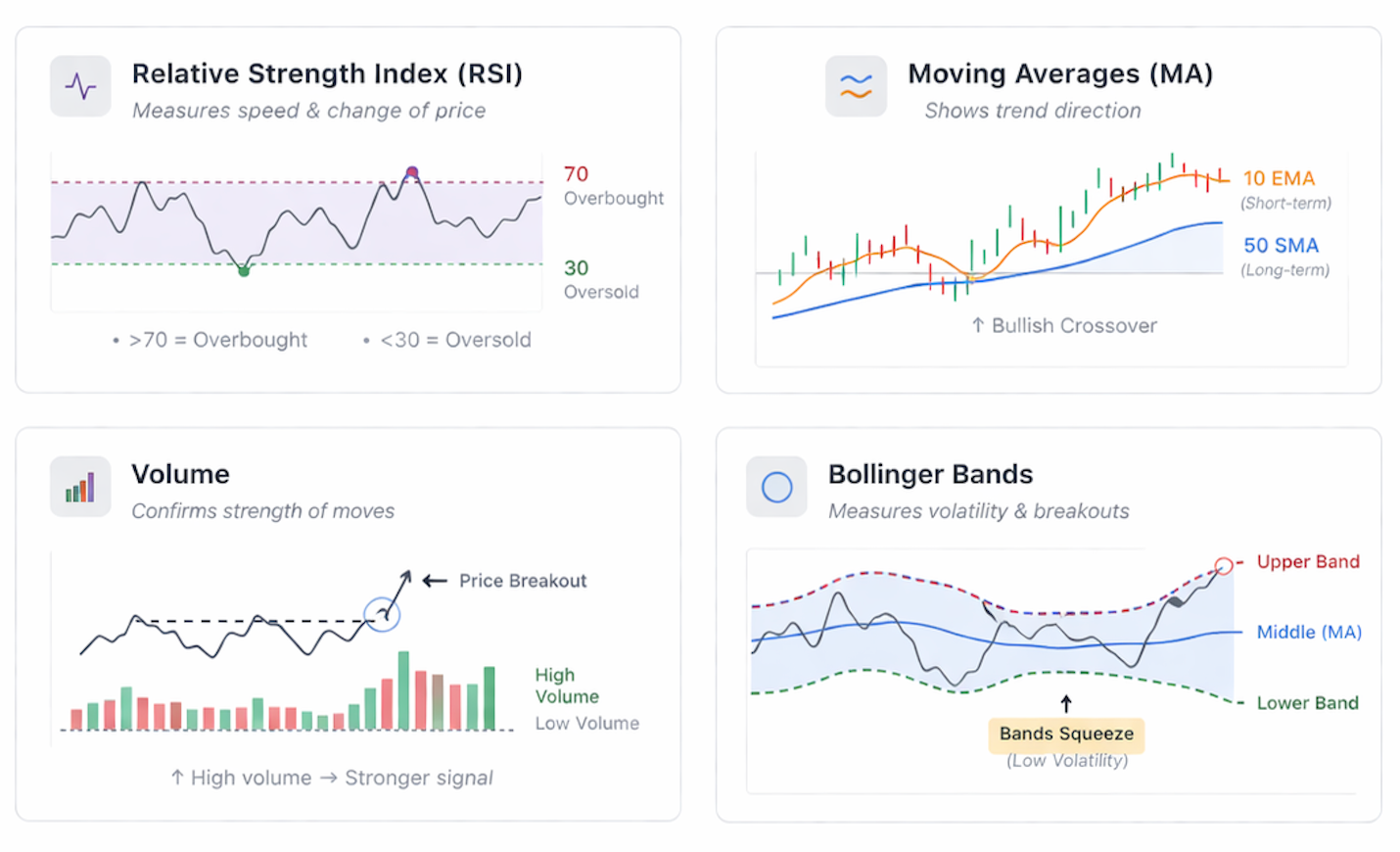
No single indicator can be trusted on its own. Putting together signals from different groups gives you a better picture.
Relative Strength Index (RSI)
RSI is a scale from 0 to 100 that shows how fast and how big recent price changes have been. If the reading is above 70, it means the market is overbought. If it's below 30, it means the market is oversold. Traders use it to find the right time to enter range-bound markets and to look for divergence, which is when the price and RSI move in opposite directions, as a possible sign of a reversal.
Moving averages (MA)
Moving averages smooth out price data to show which way the trend is going. Traders look for crossovers between shorter- and longer-term averages to tell when trends are changing. If a 10-period exponential moving average crosses above a 50-period simple moving average, it could mean that the market is going up.
Volume
Volume either backs up or questions what the price is doing. A breakout with a lot of volume means more than the same move with low volume. Traders use it as a filter; they are more skeptical of a technically sound setup that happens on very low volume.
Bollinger Bands
Bollinger Bands show bands that are two standard deviations above and below a moving average. When the price touches or breaks the outer bands, it means that something big is happening. When the market is calm, bands often get narrower before a breakout.
Risk management: the difference between profit and loss
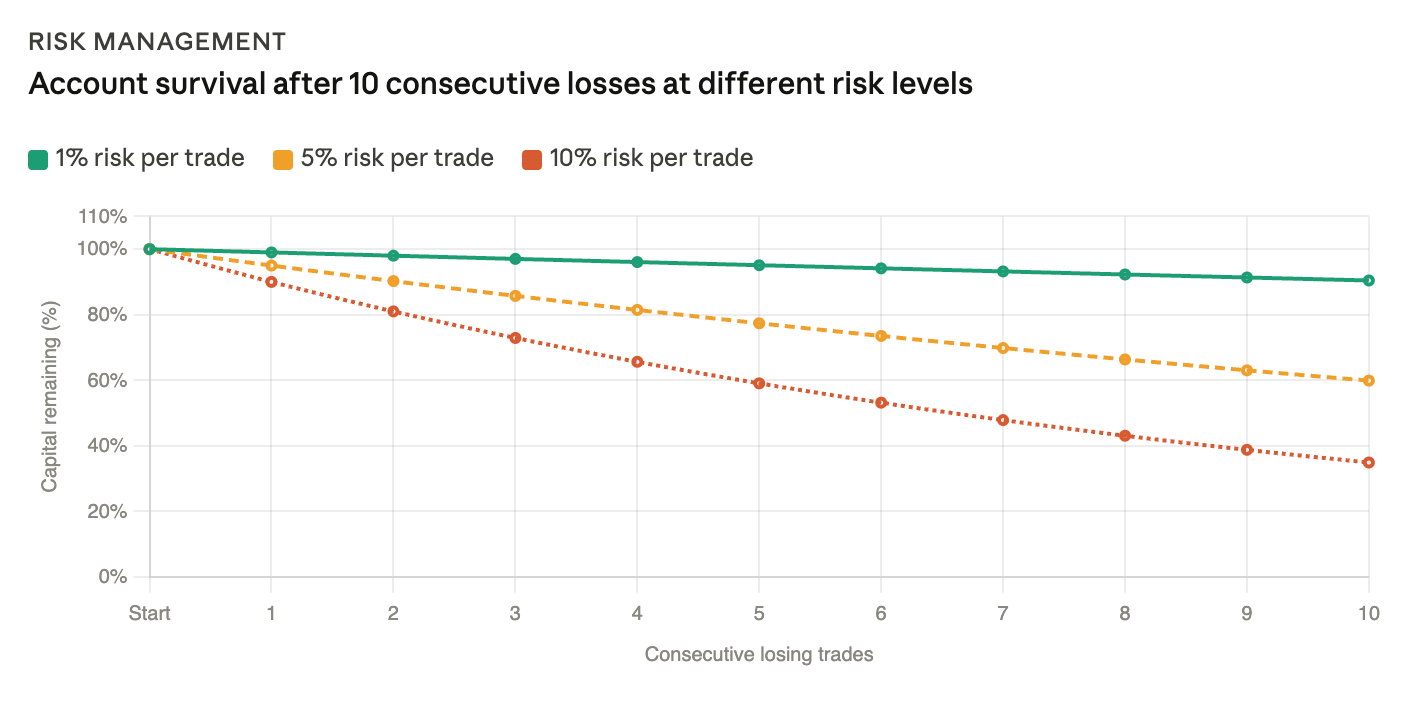
Risk management represents a critical component of successful trading. Most experienced traders only risk 1–2% of their total capital on each trade. That means you can lose no more than $100 to $200 on each position with a $10,000 account. Five losses in a row at 1% risk costs 5% of the account. The same streak at 10% risk costs almost half.
When a trade goes against the position, stop-loss orders automatically close the trade. Without them, traders have to deal with the mental stress of being in a losing position, such as hoping it will get better, not wanting to take the loss, and wanting to hold on for a little longer. That urge is what causes most of the big losses.
Leverage makes everything bigger. If a 10x leveraged position goes down by 5%, the investor loses 50% of their capital. Beginners who use leverage to make money faster always find that it also speeds up losses.
Common mistakes beginners make
The most common mistake is overtrading. For beginners, every change in price looks like a chance. Traders with experience don't react to every candle; they wait for certain conditions that fit their strategy.
When you lose, you want to get it back right away, which makes you make decisions based on emotion instead of analysis. You can't get recoveries on demand in the market.
Ignoring fees is an invisible drain. Trading fees and withdrawal costs reduce net returns substantially in high-frequency approaches. A strategy that looks profitable on gross figures may barely break even after all costs are factored in.
Is day trading worth it?
A report from the Bank for International Settlements in 2023 found that most short-term retail traders in highly volatile markets, like crypto, tend to do worse over time, with losses happening more often during times of high volatility. That doesn't mean you can't make money day trading; it means that the base rate of failure is high enough that anyone who wants to do it should have realistic expectations.
Also, the time commitment is harder to keep up with than most beginners think it will be. Paper trading does not prepare traders for the demands of watching markets for 8 to 12 hours a day, and making quick decisions when they are losing.
Conclusion
Day trading in crypto is a skill-based activity with a clear learning curve, and many people who try it without enough preparation fail. The strategies, indicators, and risk principles that are talked about here are what professionals use. The trader's ability to consistently and honestly apply them, as well as their ability to quickly recognize when a trade is wrong instead of waiting for the market to prove it, will determine whether they work.
 Tanya Petrusenko
Disclaimer: All materials on this site are for informational purposes only. None of the material should be interpreted as investment advice. Please note that, despite the nature of much of the material created and hosted on this website, HODL FM operates as a media and informational platform, not a provider of financial advisory services. The opinions of authors and other contributors are their own and should not be taken as financial advice. If you require advice, HODL FM strongly recommends contacting a qualified industry professional.