




This week in crypto, Paraguay's banking crisis triggered political fallout, India's cyber agency warned of AI-assisted attacks on crypto exchanges, and SpaceX challenged plans to tokenize its shares. Meanwhile, South Korea is pushing exchanges to strengthen cold-wallet security following the Binance hack. Here are the latest developments shaping the crypto market.
Top gainers and losers of the week
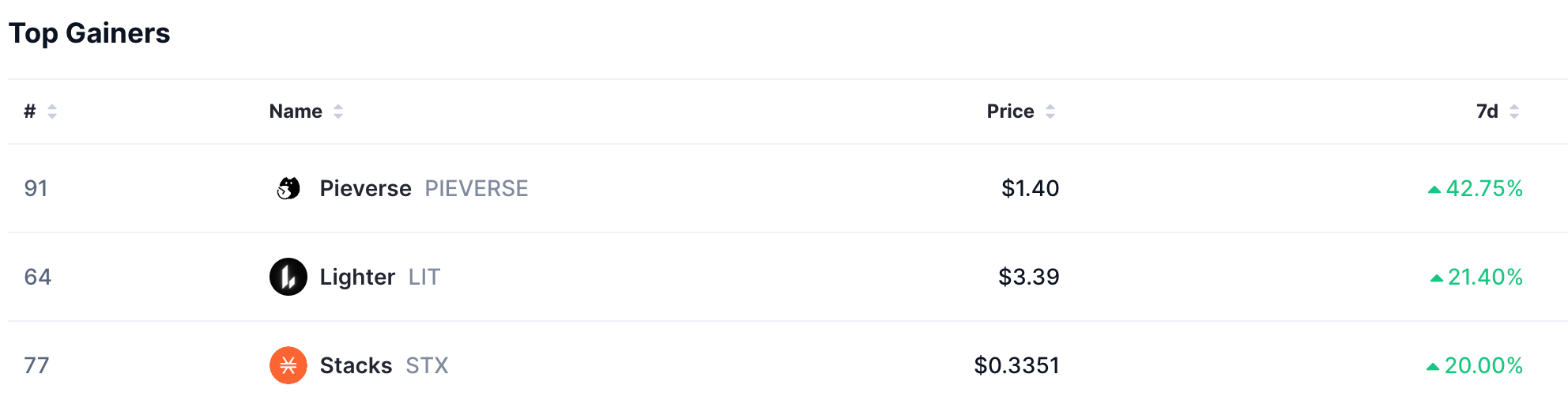
- Pieverse (PIEVERSE) – spearheaded this week's upside movers with a strong rally, surging 42.75% over the last seven days to hit $1.40;
- Lighter (LIT) – picked up solid buying momentum, advancing 21.40% across the weekly stretch to lock in at $3.39;
- Stacks (STX) – posted a steady upward push, climbing 20.00% over the seven-day period to settle at $0.3351.
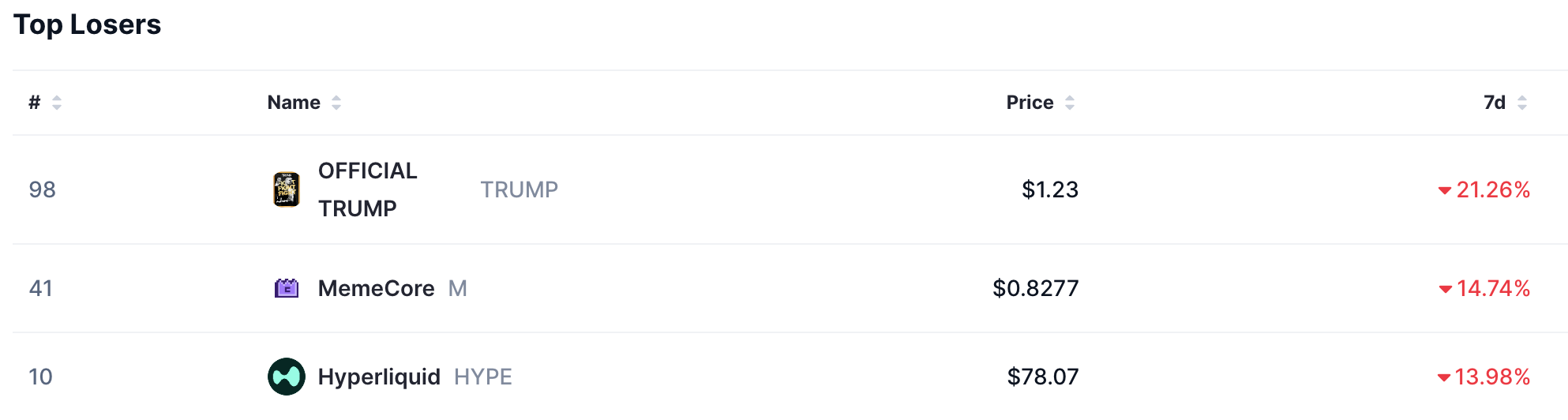
- OFFICIAL TRUMP (TRUMP) – led the weekly decliners under heavy selling pressure, falling 21.26% to drop down to $1.23;
- MemeCore (M) – experienced a notable pullback throughout the week, sliding 14.74% of its value to close at $0.8277;
- Hyperliquid (HYPE) – edged lower after its previous week's gains, dipping 13.98% across the seven-day period to finish trading at $78.07.
Paraguay's president resigns after collapse of Ueno Bank
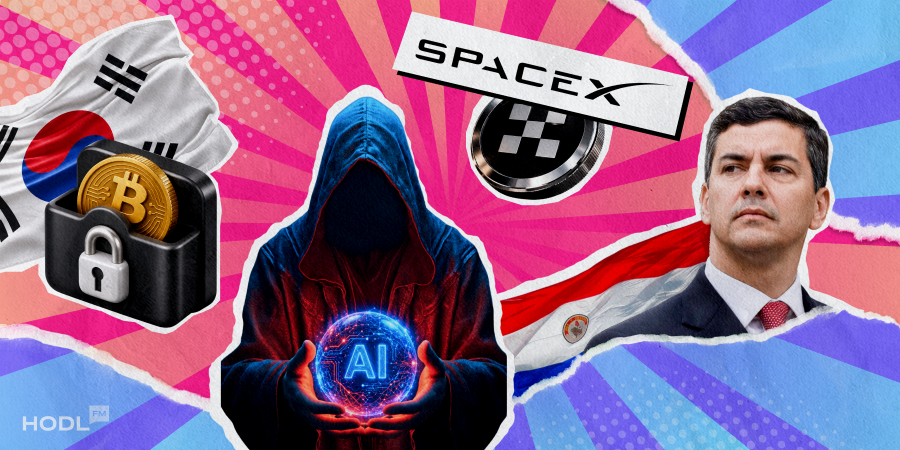
Paraguayan President Santiago Peña announced his resignation Thursday amid a political crisis triggered by the collapse of digital lender Ueno Bank. In a video posted to X, he said he was stepping down to preserve stability, social peace and democratic institutions, and to protect Paraguayans who had entrusted their savings to the financial system.
Mensaje del Presidente de la República, Santiago Peña, al pueblo paraguayo. pic.twitter.com/RBz6IfFV9L
— Santiago Peña (@SantiPenap) November 5, 2026
The central bank began resolution proceedings for Ueno on Nov. 2 after its solvency ratio fell to 5.56%, less than half the 12% regulatory minimum. Operations were suspended, which restricted customers' access to deposits. Ueno had more than 3 million customers in a country of roughly 6.5 million people.
Peña faced scrutiny over former business ties to Grupo Vázquez, the conglomerate that controls Ueno. According to AP, he remained a business partner of the group until March 2025. He has denied wrongdoing. Lawmakers were debating impeachment proceedings. If Congress accepts the resignation, Vice President Pedro Alliana would serve the rest of the term, which ends in 2028.
On Thursday, the central bank said it would start paying guaranteed deposits of up to 10 million guaraníes (about $1,630) to eligible clients. Eight Ueno executives were detained on Nov. 3, according to ABC Color.
Crypto demand has risen. David Eisenmann, CEO of exchange X4T, said stablecoin prices in guaraníes have climbed about 8% in recent weeks, though not entirely because of the bank's collapse.
India's cyber agency warns AI-assisted hacker group is targeting crypto exchanges
India's national cybersecurity agency says an AI-assisted threat actor has stepped up attacks on crypto exchanges and other financial firms, stealing wallet keys and draining funds. The Indian Computer Emergency Response Team (CERT-In) named the group "CRAFTY FALCON" on Wednesday, in an update to a campaign it first flagged in October.
"The threat is active and ongoing," CERT-In said, adding that its financial-sector response team continues to receive reports of successful attacks, including from firms that had already remediated after earlier advisories.
CERT-In says the group "surveys its targets with machine intelligence, operates at machine speed and strikes by invoking the victim's own payment and disbursement APIs." Attackers used vulnerable applications and exposed testing environments to reach production systems, and some attacks were timed for weekends and holidays. In some cases they used small test transactions before moving larger sums.
The agency did not name affected exchanges or give loss figures. It urged companies to treat the campaign as "active and escalating" and to raise round-the-clock monitoring.
SpaceX objects to tokenized share trading on OKXICE
SpaceX has objected to the proposed listing of tokenized versions of its shares on OKXICE, the joint venture between crypto exchange OKX and NYSE parent Intercontinental Exchange. A Nov. 2 public notice from the venture shows SpaceX has joined Tesla and Amazon among 56 companies that have objected.
Under the SEC's five-year Innovation Exemption, introduced in September, platforms such as OKXICE can offer tokenized versions of US stocks without registering as national securities exchanges. Companies have 30 days to object to third-party tokenization of their shares, which effectively keeps those tokens off the venue.
The objection comes even though tokenized SpaceX shares have traded outside the US since the company's June public offering. Backpack's SPCX token recorded $1.08 billion in onchain volume in June, and Kraken's SPCXx token recorded $852 million. Both are designed to be backed by actual shares.
OKXICE would open this kind of trading to US investors. Nasdaq warned issuers in September that they "must be cautious about their participation," arguing that tokenized trading could fragment liquidity and undermine long-term shareholder value.
OKXICE co-chair Andrew Cuomo said on Oct. 30 that as people see the benefits of tokenization, "you'll see more and more companies participate."
South Korea urges crypto exchanges to hold more assets in cold wallets after Binance hack
South Korea's Financial Services Commission (FSC) has urged domestic crypto exchanges to raise the share of assets held in cold wallets after the $6.3 billion attack on Binance last week. In a statement Monday, the regulator said it held an emergency meeting with the Financial Supervisory Service, the Financial Security Institute, the Digital Asset eXchange Alliance and major crypto providers.
The FSC reviewed exchanges' IT access controls, wallet withdrawal approval and signing procedures, and administrator privileges. It also asked providers to monitor deposits and withdrawals continuously, add incident response staff and promptly report unusual access attempts. Operators were asked to set aside additional reserves.
TRM Labs says attackers took the funds from Binance's internet-connected hot wallets and moved most of them in about 20 minutes. Binance has said most user assets are held in cold storage.
South Korean law already requires exchanges to keep at least 80% of user crypto in cold storage. At the end of September, Upbit's ratio was 99.17%, Bithumb's 94.76% and Coinone's 85%. Digital X reported 82.79% and GOPAX 80.54%, according to Financial Supervisory Service data cited by local media.
Separately, the Bank of Korea is surveying 18 banks and 13 brokerages about their crypto-related risks. That review began before the Binance attack.
 Anastasiia G
Disclaimer: All materials on this site are for informational purposes only. None of the material should be interpreted as investment advice. Cryptocurrency investments involve significant risk of loss. Please note that, despite the nature of much of the material created and hosted on this website, HODL FM operates as a media and informational platform, not a provider of financial advisory services. The opinions of authors and other contributors are their own and should not be taken as financial advice. If you require advice, HODL FM strongly recommends contacting a qualified industry professional.