


Bitcoin traded close to $66,000 early Monday after US President Donald Trump declared that a peace agreement with Iran had been finalized and that the Strait of Hormuz would reopen to global shipping. The move followed weeks of geopolitical tension that had weighed on risk assets, including crypto.
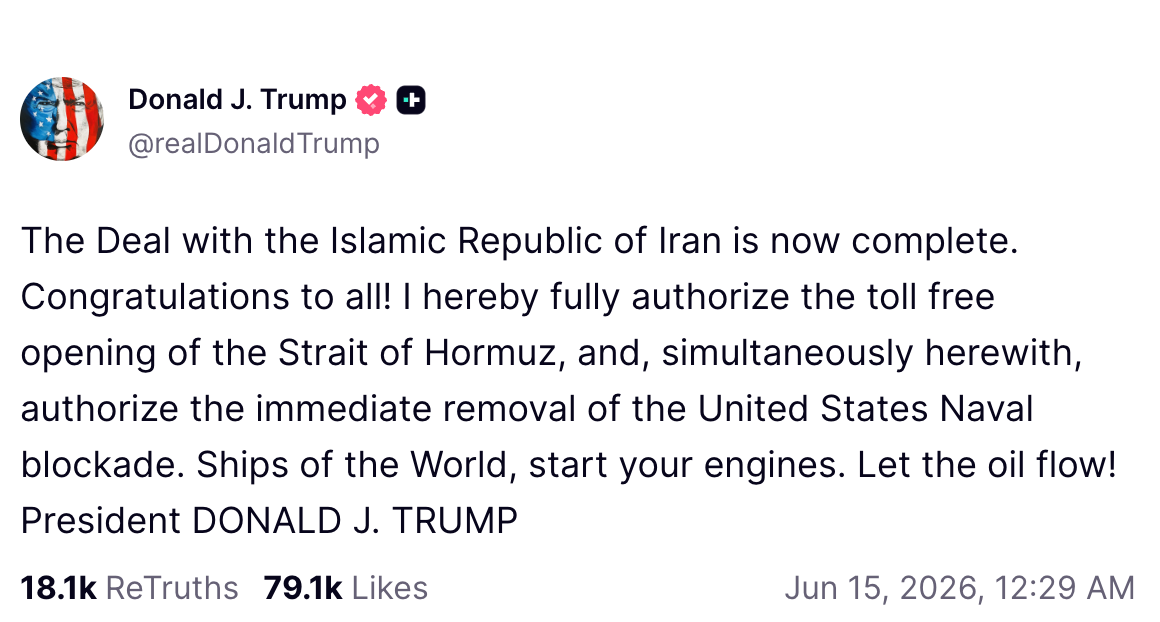
Trump shared the announcement late Sunday on Truth Social, stating:
“The deal with the Islamic Republic of Iran is now complete. Congratulations to all!” He added that he authorized “the toll-free opening of the Strait of Hormuz” alongside “the immediate removal of the United States Naval blockade.”
He wrote:
“Ships of the World, start your engines. Let the oil flow!”
Markets react to geopolitical shift
Crypto markets responded within hours. Bitcoin climbed above $65,000 for the first time in roughly two weeks, reaching $65,950, during Monday morning trading, according to Hodlfm data. The asset had not crossed the $66,000 level since June 3. The rally followed a volatile stretch that saw Bitcoin fall below $60,000 on June 6 amid escalating conflict tied to US-Israeli strikes in late February.
The broader crypto market also moved higher, with total capitalization gaining about 2% on the day. Several altcoins posted stronger performances. Hyperliquid (HYPE), Zcash (ZEC), and Near Protocol (NEAR) recorded double-digit gains in some cases. Ether returned above $1,700, while Solana approached the $70 mark.
Traditional markets reflected similar sentiment. Oil prices declined sharply after the announcement. West Texas Intermediate crude dropped roughly 5% to just above $80 per barrel, its lowest level since early March. Brent crude mirrored the trend, falling 4.4% to $83. Lower energy prices tend to ease inflation pressure, which can improve conditions for risk assets such as cryptocurrencies.
Deal details remain limited
Despite the market reaction, full details of the agreement have not been disclosed. Implementation depends on formal signing by Iran, which is expected Friday under mediation by Pakistan, according to the Wire.
Iranian officials signaled alignment with the announcement. Deputy foreign minister Kazem Gharibabadi confirmed the agreement on state television. The secretariat of Iran’s Supreme National Security Council stated that the war across all fronts “will end immediately and permanently beginning tonight” and that the US blockade “will be terminated immediately and in full.”
The diplomatic push marks a shift after more than 100 days of conflict. US Ambassador to the United Nations Mike Waltz said on June 14 that a preliminary framework could be signed imminently, with the administration targeting mid-June for progress. He stressed the importance of verifiable terms, particularly regarding Iran’s nuclear program and regional activity.
Bitcoin tracks risk sentiment
The recent price movement highlights Bitcoin’s sensitivity to macro and geopolitical developments. During the escalation phase of the conflict, Bitcoin declined alongside global markets. The latest rebound reflects improving sentiment rather than a confirmed trend reversal.
Prediction markets show a cautious outlook. Odds for a permanent US-Iran peace deal in June have risen to 87%.
Bitcoin remains significantly below its October peak above $126,000. The current recovery follows a series of sharp swings driven by headlines from Washington and Tehran. Price action suggests a relief rally tied to reduced uncertainty rather than a structural breakout.
Focus shifts to Federal Reserve decision
Attention now turns to monetary policy. The Federal Reserve is set to announce its interest rate decision on Wednesday, marking the first meeting under new chair Kevin Warsh. The outcome may influence the next phase of crypto market movement.
The CME FedWatch tool indicates a 96.6% probability that rates will remain unchanged in the 3.5% to 3.75% range. Inflation has moved above 4% again, which complicates the outlook. A steady rate decision could support current momentum, while unexpected changes may introduce fresh volatility.
Volatility risk remains
The trajectory of Bitcoin in the coming days depends on two key variables: confirmation of the Iran deal and signals from the Federal Reserve. A signed agreement may extend the current rally by removing a major geopolitical overhang. A breakdown in talks could reverse gains quickly, especially if tensions return.
For now, markets reflect cautious optimism. Crypto traders respond to the prospect of stability in global trade routes and energy markets. The Strait of Hormuz remains a critical artery for oil flows, and its reopening carries implications beyond the crypto sector.
 Gunel Ismayilova
Disclaimer: All materials on this site are for informational purposes only. None of the material should be interpreted as investment advice. Please note that, despite the nature of much of the material created and hosted on this website, HODL FM operates as a media and informational platform, not a provider of financial advisory services. The opinions of authors and other contributors are their own and should not be taken as financial advice. If you require advice, HODL FM strongly recommends contacting a qualified industry professional.