






Bitcoin fell below $77,000 late Thursday after Binance said a security breach had affected about $6.3 billion in assets. Earlier in the session, bitcoin had reached a 24-hour high of $81,890.
Long traders take most of the losses
CoinGlass data showed $1.59 billion in liquidations over 24 hours, hitting 244,472 traders. Longs accounted for $1.34 billion. The largest single order was an $11.09 million BTCUSDT position on Binance. The totals by coin are $529 million in bitcoin and $363 million in ether.
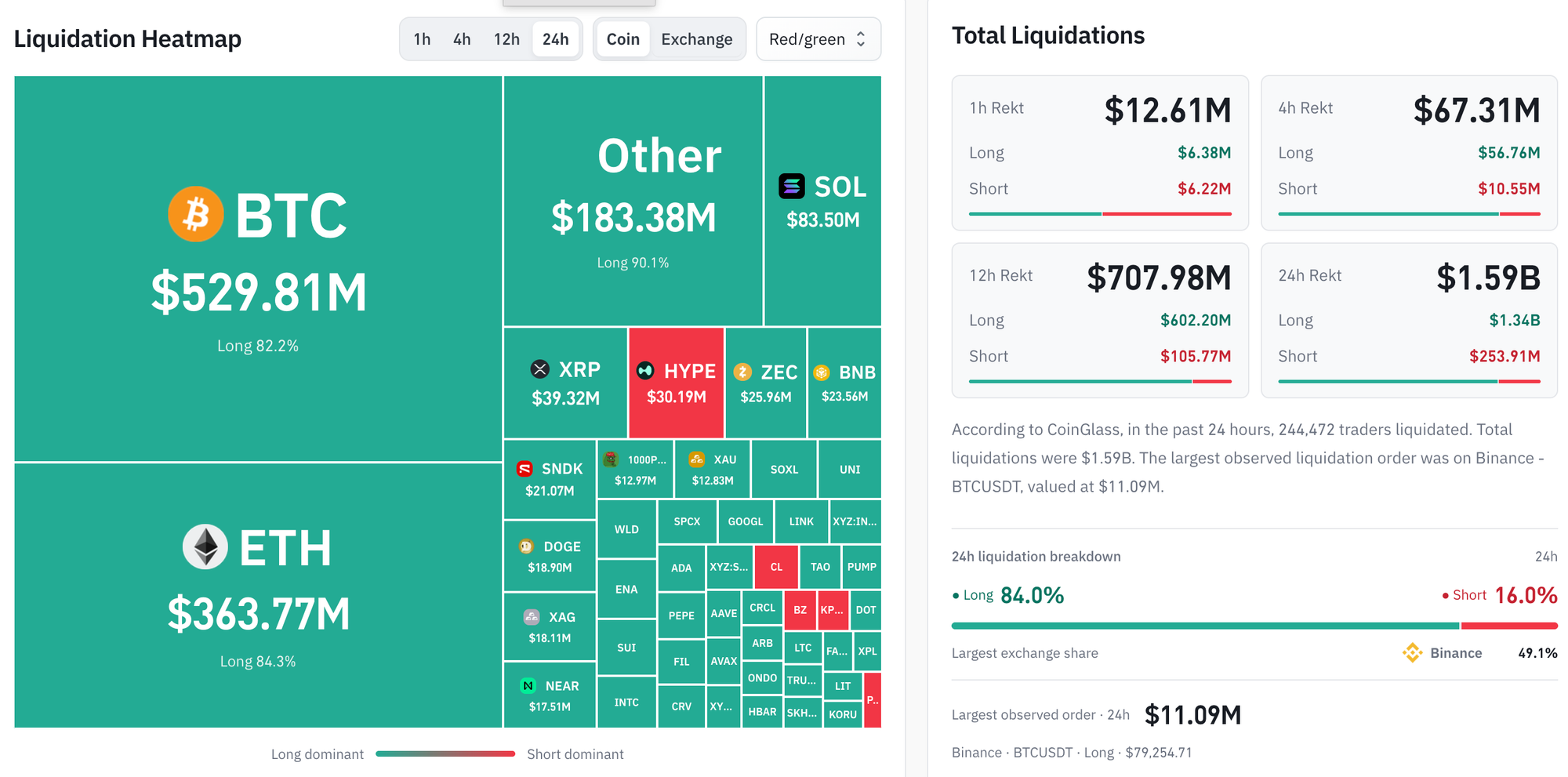
BNB, the token tied to the exchange, lost 7.5% to $680, according to TradingView data. Ether fell 5.5% to $2,174. XRP dropped 7% to $1.21. At the time of reporting, Bitcoin is trading around $77,630, after a brief dip toward $76,500.
What Binance and the stablecoin issuers did
Binance put the total impact at about $6.3 billion and said roughly $3 billion has been frozen on-chain. The exchange says it will cover all losses from its SAFU fund and company money. "User funds are safe," it wrote on X.
Tether CEO Paolo Ardoino said the company froze more than 1.567 billion USDT. Circle CEO Jeremy Allaire said Circle froze more than $800 million in USDC. First Digital's Vincent Chok said stolen FDUSD had also been frozen.
Aave reportedly froze lending markets so the attacker could not borrow against stolen assets. Binance.US said the incident does not affect its platform. Coinbase CEO Brian Armstrong said the company is blocking transfers to compromised wallets and added: "Moments like this call for the industry to work together."
Analysts disagree on how long the pain lasts
Dominick John of Zeus Research said,
"Market recovery hinges on Binance restoring confidence in exchange security and customer funds."
Rick Maeda of Laevitas called the reaction "fairly contained" and the drop in BNB "quite modest for possibly the largest exchange theft ever." He pointed to Binance's $144 billion in assets under custody and the fast freezes by Tether and Circle.
Jeff Ko of ViaBTC said:
"I don't expect the stolen BTC to add much selling pressure." He added that the market was already leaning bearish.
Standard Chartered's Geoffrey Kendrick was more cautious.
"I suspect the negative price action still has some way to go. Only after assets are unfrozen and more detail of the hack emerges will we find a new base," he said in an email to CoinDesk.
DEX tokens fall, but Hyperliquid's HYPE jumps
Kendrick argued that the breach should push more trading toward decentralized exchanges.
"At that time I would encourage investors to re-engage with Uniswap," he said, and he kept his $100 UNI target for 2030.
The market did not follow that logic on Thursday. UNI fell more than 3%, and Aster, PUMP, JUP and LIT also slid. HYPE gained 15% after Intercontinental Exchange and Trade.xyz announced a plan to bring Hyperliquid-based perpetual futures to US traders, pending regulatory approval.
Self-custody removes exchange risk but not smart contract risk, so a DEX is not a safe harbor on its own.
Polymarket suspended international trading after hackers drained more than $2.6 million from user accounts earlier Thursday.
 Gunel Ismayilova

Disclaimer: All materials on this site are for informational purposes only. None of the material should be interpreted as investment advice. Cryptocurrency investments involve significant risk of loss. Please note that, despite the nature of much of the material created and hosted on this website, HODL FM operates as a media and informational platform, not a provider of financial advisory services. The opinions of authors and other contributors are their own and should not be taken as financial advice. If you require advice, HODL FM strongly recommends contacting a qualified industry professional.