






Standard Chartered has initiated coverage on Uniswap’s UNI token with an aggressive long-term forecast that places the asset at $100 by the end of 2030. The projection implies roughly a 40x increase from current levels.
The call comes from Geoffrey Kendrick, global head of digital assets research at Standard Chartered, who tied the outlook to a broader shift toward tokenized assets and decentralized finance infrastructure.
"This would see UNI outperform both ETH and BTC through end-2030," Kendrick wrote in the report.
NEWS: Standard Chartered has initiated coverage on Uniswap ethereum:0x1f9840a85d5af5bf1d1762f925bdaddc4201f984 with a $100 price target by 2030.
— Roundtable Network (@RTB_io) June 15, 2026
The bank says UNI could outperform both Bitcoin and Ethereum as tokenized assets flood into DeFi and on-chain markets continue to… pic.twitter.com/aATk3UnHuJ
Tokenized assets thesis drives the forecast
The bank’s projection rests on the rapid expansion of tokenized assets across financial markets. According to the note, tokenized assets on-chain could rise from about $340 billion today to $4 trillion by the end of 2028. At the same time, the share of those assets used within decentralized finance could increase from roughly 3.5% to 30% by 2030.
“I estimate that the amount of tokenised assets active in DeFi will 37x by the end of 2030,” Kendrick said.
That shift would push total value locked in DeFi protocols to approximately $2.7 trillion. The bank links that growth directly to Uniswap’s position as a liquidity hub, where higher asset inflows would translate into deeper pools and increased trading activity.
Uniswap positioned as core infrastructure
Standard Chartered describes Uniswap as a foundational layer within decentralized markets. The report points to its scale, brand recognition, and role in facilitating trading between highly correlated assets such as stablecoins and tokenized instruments.
Kendrick framed the comparison in simple terms:
"Uniswap is like YouTube, while Coinbase is like Netflix."
The analogy highlights the open structure of Uniswap, where users supply liquidity and create markets, versus centralized platforms that manage trading internally. The model reduces capital requirements for the protocol while expanding the range of assets available for trading, including niche tokens and tokenized real-world assets.
The bank argues that traditional financial institutions cannot replicate this structure without relying on DeFi-native infrastructure, which places Uniswap in a strategic position as Wall Street experiments with blockchain-based settlement and tokenized funds.
Price path and milestones through 2030
Standard Chartered outlined a step-by-step trajectory for UNI over the next five years. The bank expects the token to reach $6.50 by the end of 2026, followed by $20 in 2027, $40 in 2028, $65 in 2029, and $100 by 2030.
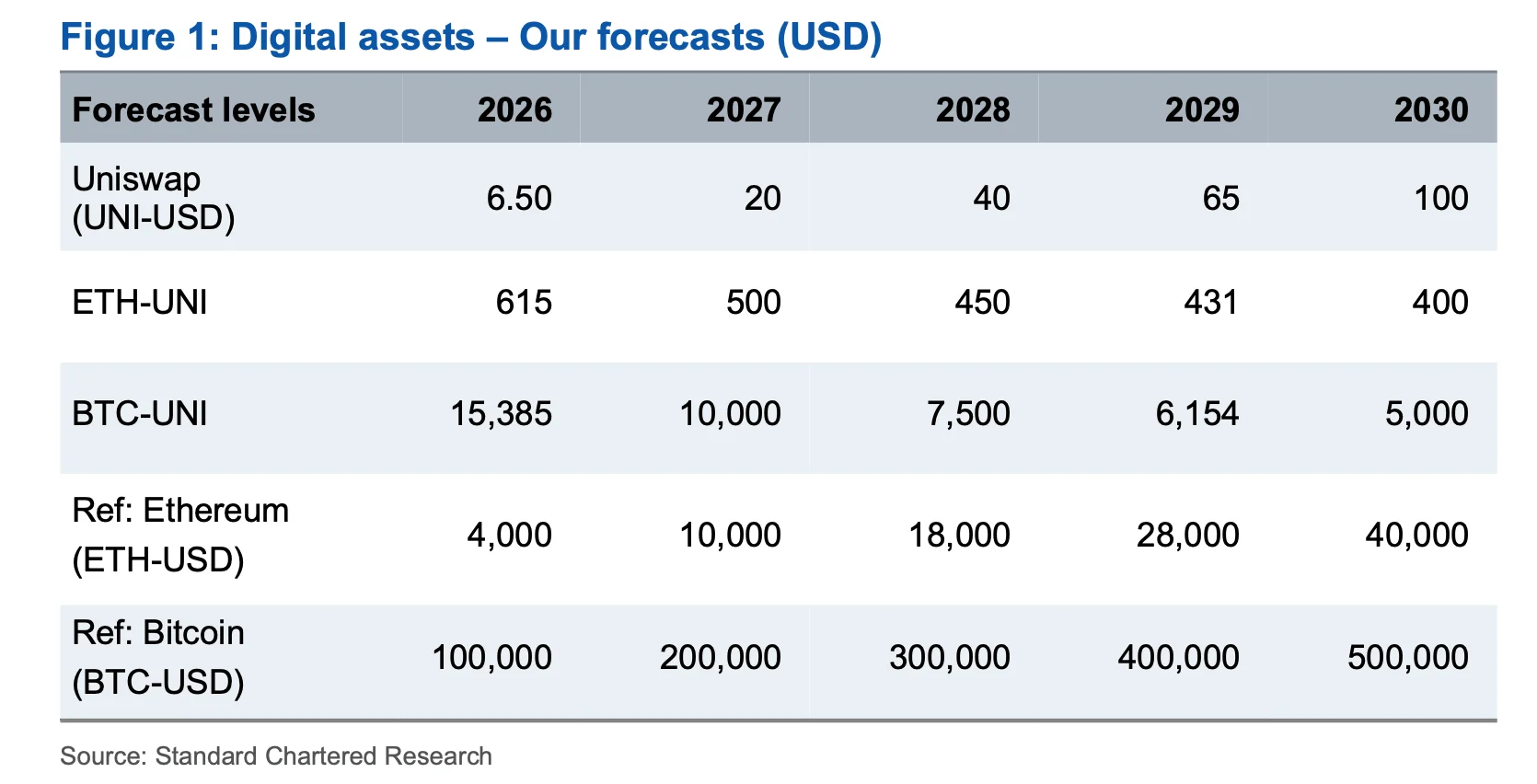
The projection assumes that Uniswap captures a meaningful share of tokenized asset flows and strengthens its commercial ties with traditional finance firms.
"If Uniswap can commercialize enough and create significant enough TradFi partnerships to scale, its market cap-to-transaction fees multiple is likely to increase, narrowing the gap with Coinbase," Kendrick said.
The report also notes that Uniswap currently trades at a lower valuation multiple compared to Coinbase despite handling comparable transaction volumes.
Fee changes and token supply dynamics
Recent protocol updates form part of the investment case. A December 2025 upgrade introduced protocol-level fees and a mechanism for UNI token burns. Governance decisions later expanded fee coverage across more liquidity pools.
Since the update, Uniswap has generated about $21 million in protocol fees and burned around 5 million UNI tokens. The total supply has declined from 1 billion to 895 million, with circulating supply at approximately 622 million, according to figures cited in the report.
Kendrick views these changes as a step toward aligning token value with platform activity.
Risks remain despite bullish outlook
The report outlines several constraints that could affect the forecast. Smaller decentralized exchanges may develop more specialized products for specific use cases. Competition for tokenized real-world asset trading could intensify as both decentralized and centralized platforms target the same market.
Execution also matters. The bank notes that Uniswap’s ability to secure partnerships with traditional financial institutions will influence its long-term valuation. Regulatory clarity in the United States, including potential legislation such as the Clarity Act or guidance from the Securities and Exchange Commission, could also shape adoption.
Kendrick added that Uniswap V4’s hook system has not yet faced testing at the scale expected by 2030.
Market context and investor response
The forecast arrives during a period of mixed sentiment in crypto markets. UNI remains significantly below previous highs, with recent prices around $3, according to CoinGecko data. The gap between current levels and the $100 target highlights the scale of the assumptions embedded in the bank’s model.
The thesis depends on multiple factors. Tokenized assets must expand rapidly. Participation in DeFi must increase sharply. Uniswap must retain or grow its market share while executing on commercialization.
The report frames UNI as a direct exposure to the growth of tokenized finance rather than a standalone asset play.
A broader shift toward on-chain finance
Standard Chartered positions its Uniswap coverage within a wider transformation of financial infrastructure. The bank expects real-world assets, stablecoins, and crypto-native instruments to converge on blockchain networks over the coming years.
That convergence forms the basis of its long-term outlook.
“I think the next opportunity for generational wealth in digital assets is going to come via the DeFi protocols,” Kendrick said.
The statement captures the central argument behind the $100 target. The outcome depends on whether decentralized systems become the primary venue for trading tokenized assets at scale.
 Gunel Ismayilova
Disclaimer: All materials on this site are for informational purposes only. None of the material should be interpreted as investment advice. Please note that, despite the nature of much of the material created and hosted on this website, HODL FM operates as a media and informational platform, not a provider of financial advisory services. The opinions of authors and other contributors are their own and should not be taken as financial advice. If you require advice, HODL FM strongly recommends contacting a qualified industry professional.