




Huobi showed up in 2013, and for years it was pretty much one of the liveliest exchanges in Asia, you know. After China’s crypto ban made it move offshore in 2021, it rebranded into HTX and sort of tried to reposition itself as a global platform. Then Justin Sun came in, he bought his way in and grabbed the Global Advisor label, so in practice he became the visible face of the exchange’s whole new direction. The users are still there, though: more than 45 million registered accounts and around $1.48 billion in daily volume. Still, the last few years have added more real regulatory baggage than it had before, and it shows.
What is HTX?
Huobi was founded in 2013 by Leon Li in China. It grew fast and became one of the most active exchanges for retail crypto traders across Asia. When Beijing effectively shut down domestic crypto trading in 2021, the exchange moved its operations to Seychelles and started focusing on international markets. The September 2023 rebrand to HTX was partly a naming exercise: H for the exchange's Huobi origins, T for TRON, and X for exchange.
Justin Sun had already bought a controlling interest in 2022 using About Capital Management. He is officially the Global Advisor for the company; however, most people consider him the true owner and decision-maker.
This exchange operates in over 130 countries. U.S. users are banned from using it. As per CoinGecko, the total number of listed coins amounts to 603, while 623 trading pairs exist with $1.48 billion exchanged on it daily.
Features of HTX
HTX's product range goes fairly deep and covers more than most retail traders will actually use.
Spot and derivatives trading
Spot trading is the foundation, with hundreds of available pairs. Margin trading goes up to 5x leverage. For derivatives, perpetual futures are available alongside coin-margined swaps with a maximum of 200x leverage. That puts HTX ahead of Coinbase's limited derivatives offering and roughly in line with what Binance provides.
Copy trading and automation
Copy trading is built right into the platform. You just choose a lead trader, look at their performance record, and set it so it mirrors their positions automatically. Grid bots handle range-bound automated strategies without you needing any manual input or extra effort. According to HTX’s May 2026 performance report, the lead trader volume hit $150 million last month, which is up 66% from April. Meanwhile, grid trading landed at $260 million.
HTX Earn
"Earn Zone" refers to the section that has flexible savings along with staking services. It also comprises some lending options. According to sources, the average daily annualised yield of SmartEarn during May 2026 was 2.33%, while the one-day peak yield reached 4.11%.
HTX app
Available on iOS and Android. It covers spot, futures, and copy trading as well as earn products. It gets the job done.
Trading experience and interface
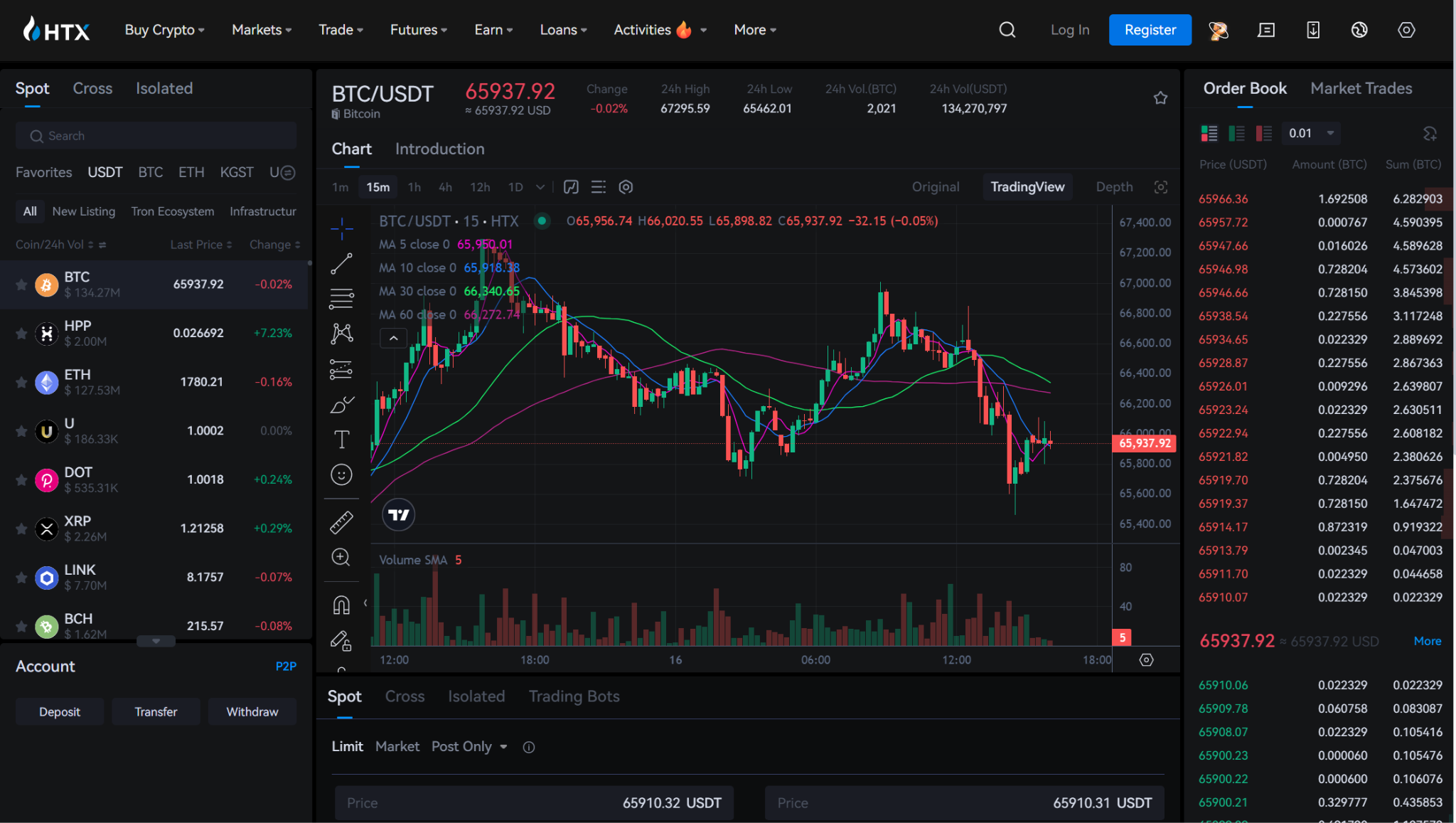
Navigation is straightforward. There's a simplified view for beginners and a full-featured one for active traders, and they share the same account. Switching between them isn't a hassle.
It should not be so surprising since customer service appears to be another ball game altogether. Customers have reported repeatedly that support responses are slow and that problems with withdrawals go unresolved. This trend seems to have existed for many years now.
Fees and pricing structure
The typical fee for the spot trade is 0.2%. This figure is twice as high as the base rate charged by Binance and even exceeds the maker fee of 0.08% on OKX.
Volume discounts help. Once 30-day spot volume crosses million, the rate drops to 0.1% maker and 0.08% taker. Holding or paying with the platform's Huobi Token gets you somewhere between a 10% and 65% discount.
When it comes to futures fees, these come at 0.02% for makers and 0.05% for takers, which is even lower than the average in the industry. Trading via the peer-to-peer system is completely free. The deposit fee is zero, but withdrawal rates are coin-dependent.
Pros and cons of HTX
Pros
- 600+ listed assets
- Futures fees that sit below the industry average
- Copy trading and grid bots built into the platform
- P2P trading with no exchange fee
- Track record going back to 2013
- Accessible in 130+ countries
Cons
- Blocked for US users
- UK sanctioned a connected entity in May 2026
- $100 million lost in the November 2023 HECO bridge hack
- Customer support is slow and hard to reach
- Governance transparency is a real concern given Justin Sun's involvement
- Regulatory risk is growing, not stabilising
HTX vs other crypto exchanges
HTX holds its own on futures fees and asset selection. On regulatory standing, it's a different picture.
Fee data as of June 2026, sourced from Binance's fee schedule, OKX's fee schedule, and Coinbase Advanced Trade.
HTX would be a good choice for any non-US user who requires extensive altcoins and derivatives. However, if regulation is a concern for you, Binance and OKX provide much the same functionality with far fewer problems.
Final thoughts
The HTX platform is alive and kicking. The liquidity is actual. The list of assets is among the most comprehensive ones out there, and features such as copy trading or grid bots come included and at no additional charge. From a mere product standpoint, it is an efficient trading venue.
A far greater difficulty lies in ignoring its recent history. The HECO Chain bridge attack that took place in November 2023 saw losses amounting to roughly $100 million. In May 2026, the United Kingdom imposed sanctions on Huobi Global SA, claiming that some $1.5 billion worth of transactions had been executed using the HTX platform in the interest of entities previously sanctioned. This past week saw the exchange delist USD1 following a lawsuit involving Justin Sun and his issues with World Liberty Financial.
One can trade via HTX and be safe. But the dangers they are taking upon themselves do not exist in other venues, and they certainly do not disappear over time.
 Tanya Petrusenko
Disclaimer: All materials on this site are for informational purposes only. None of the material should be interpreted as investment advice. Please note that, despite the nature of much of the material created and hosted on this website, HODL FM operates as a media and informational platform, not a provider of financial advisory services. The opinions of authors and other contributors are their own and should not be taken as financial advice. If you require advice, HODL FM strongly recommends contacting a qualified industry professional.