


Kevin Warsh will take the oath as chair of the U.S. Federal Reserve on Friday in a ceremony at the White House hosted by President Donald Trump. The setting breaks with recent tradition. Federal Reserve chairs usually take office through internal proceedings. Alan Greenspan was the last to be sworn in at the White House in 1987. Trump’s role signals a close link between the administration and the next phase of central bank policy.
Warsh replaces Jerome Powell at a difficult moment. Inflation remains above the Fed’s 2% target. Treasury yields have climbed, with longer-term rates near multi-year highs. Market pricing shows reduced expectations for near-term rate cuts. CME FedWatch data points to a 98.9% probability of no change at the June meeting and more than 94% odds of no move through July. The next Federal Open Market Committee meeting will take place on June 16–17.
A different policy mix without a return to QE
Warsh has outlined a framework that departs from the playbook used over the past decade. He has criticized large-scale asset purchases and their effect on asset prices and wealth distribution. His approach favors balance sheet reduction alongside the option of lower interest rates if inflation slows.
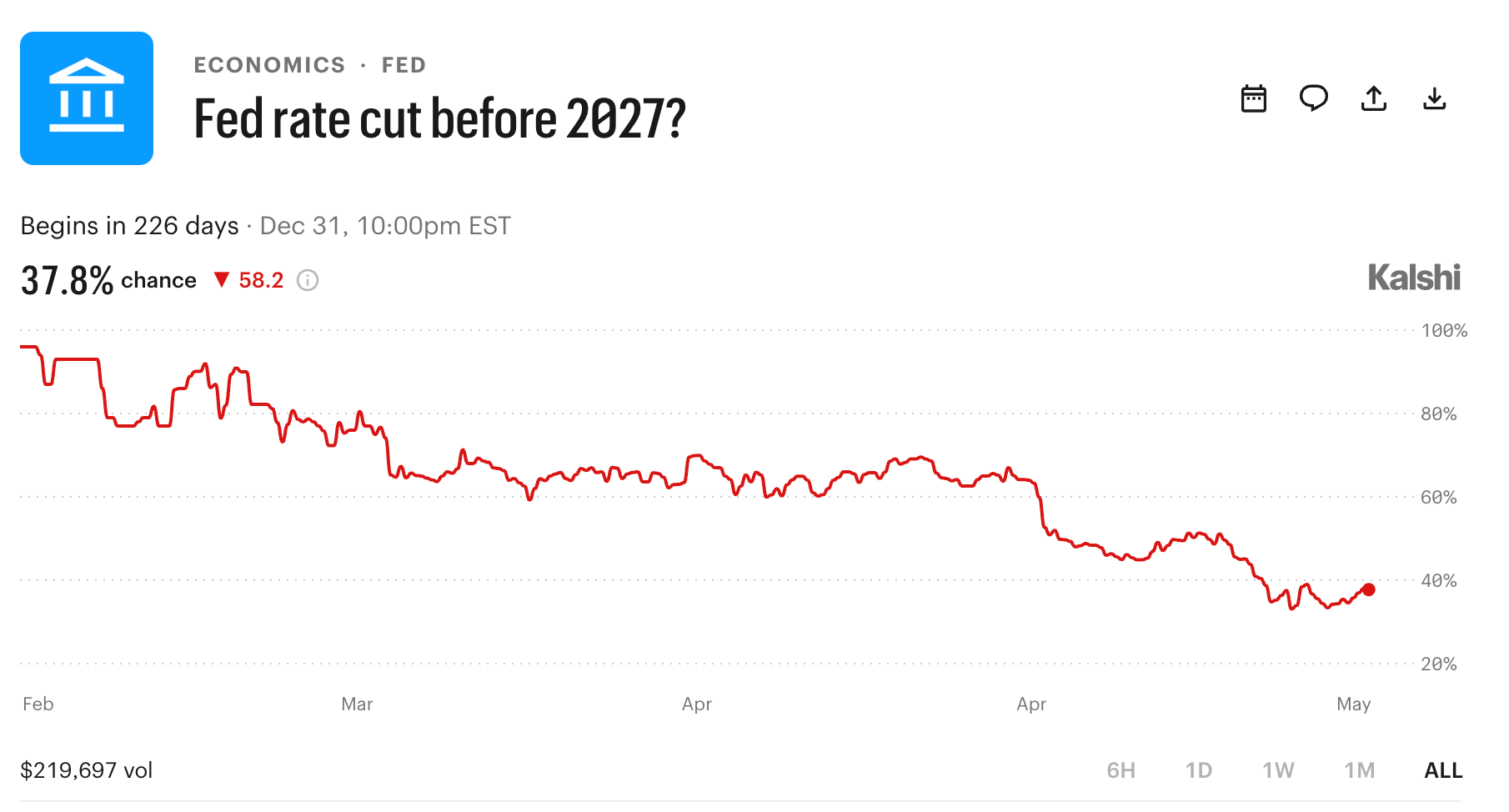
That stance implies continued quantitative tightening rather than a restart of bond-buying programs. The objective centers on reducing excess liquidity while leaving room to ease borrowing costs later. Markets have not priced in a rapid shift. Kalshi data shows a 37.8% chance of a rate cut before 2027, down from 96% in February.
The mix carries trade-offs. Continued balance sheet shrinkage can tighten dollar liquidity across markets. That dynamic has often weighed on risk assets. A later move toward rate cuts without renewed asset purchases could support a recovery if inflation stabilizes.
Internal dissent sets the tone for early decisions
Warsh assumes leadership of a divided committee. The April FOMC meeting produced dissent from three members over language that investors read as a signal toward future easing. Several officials have emphasized the need to keep the option of rate hikes on the table if inflation persists.
Loretta Mester, former president of the Cleveland Fed, described the challenge in remarks, CNBC reported.
“I saw him in action. He does base his decisions on his view of the economy, and even his arguments for why he would favor rate decreases in general were based on his read of what’s happening structurally in the economy,” she said. “I just don’t think right now he can make those arguments in a credible way, because we have an inflation problem.”
Warsh has acknowledged the likelihood of disagreement. During his Senate confirmation hearing, he referred to a potential “family fight” over policy. The phrase may define his early tenure if he presses for cuts while colleagues resist.
Consensus-building will shape credibility
Former officials have stressed the importance of consensus. Mester noted that chairs typically consult members ahead of meetings to gauge positions and build agreement. Public dissent from the chair could weaken institutional credibility.
Bill English, a former head of monetary affairs at the Fed, offered a similar view.
“Good at working with people, and I think he’ll try to find a reasonable consensus,” he said, according to CNBC News. “My guess is he’s going to want to continue to be a chair who’s going to try to find consensus and move the committee over time with arguments and with data.”
Warsh has also questioned several communication tools used in recent years, including forward guidance and the “dot plot.” A shift toward less explicit signaling could follow if he secures support within the committee.
Political pressure adds another layer
The White House has made its preference clear. Trump has called for lower rates for months and has linked economic policy to borrowing costs. A failure to deliver cuts could revive tensions that marked the relationship between the administration and Powell.
Senator Elizabeth Warren raised separate concerns during the confirmation process. She warned that the Fed could face pressure to support political or financial interests. Warsh disclosed more than $100 million in assets, including investments tied to technology and digital assets, ahead of his hearing.
Lawmakers have urged the administration to fill vacancies at the Commodity Futures Trading Commission. A letter from House Agriculture Committee leaders cited “urgent regulatory issues” tied to market structure and digital assets.
Markets watch the first moves
Warsh’s first meetings will test his ability to balance competing forces. Inflation data, bond market pressure, and internal dissent will shape immediate decisions. Market participants expect stability in rates in the near term, with attention on any changes to communication or balance sheet policy.
The path forward remains constrained. A push for cuts without clear progress on inflation could raise questions about independence. A refusal to ease could trigger friction with the administration. Warsh enters office with limited room for error and a committee that demands persuasion rather than direction.
 Kristian Koch
Disclaimer: All materials on this site are for informational purposes only. None of the material should be interpreted as investment advice. Please note that, despite the nature of much of the material created and hosted on this website, HODL FM operates as a media and informational platform, not a provider of financial advisory services. The opinions of authors and other contributors are their own and should not be taken as financial advice. If you require advice, HODL FM strongly recommends contacting a qualified industry professional.