


This week in crypto markets saw mixed momentum, with several altcoins posting strong gains while others recorded notable declines amid shifting sentiment. Major industry developments highlighted the growing link between crypto, AI, and regulation, from Binance’s AI-driven fraud prevention efforts to Crypto.com’s new UAE licensing milestone and OpenAI’s multi-billion-dollar employee share sale. Here’s a quick look at the top gainers, losers, and key headlines shaping the week.
Top gainers and losers of the week
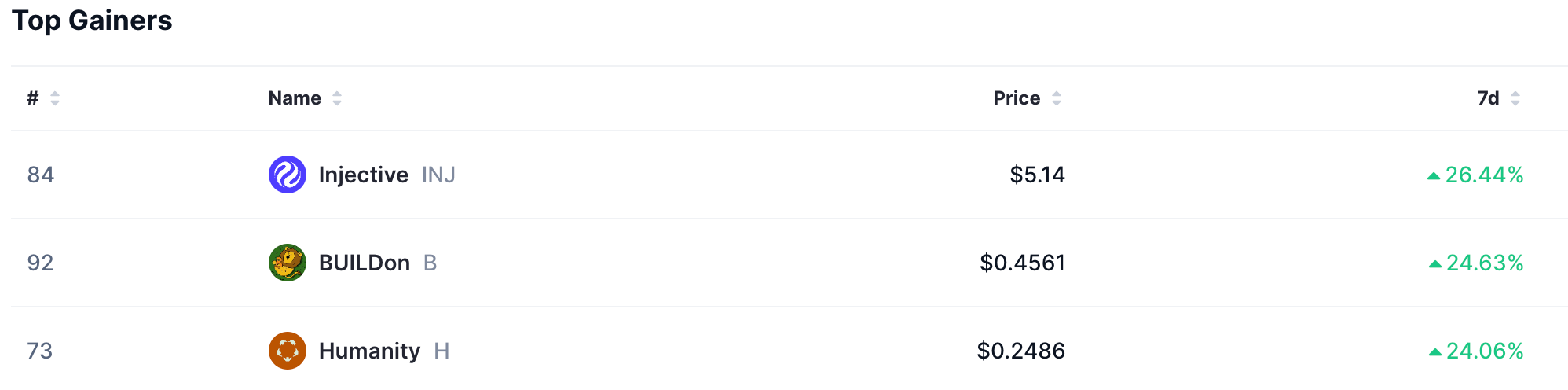
- Injective (INJ) - jumped by 26.44% to $5.14 this week;
- BUILDon (B) - surged 24.63% during that time to reach a price of $0.4561;
- Humanity (H) - The price went up 24.06% to $0.2486.
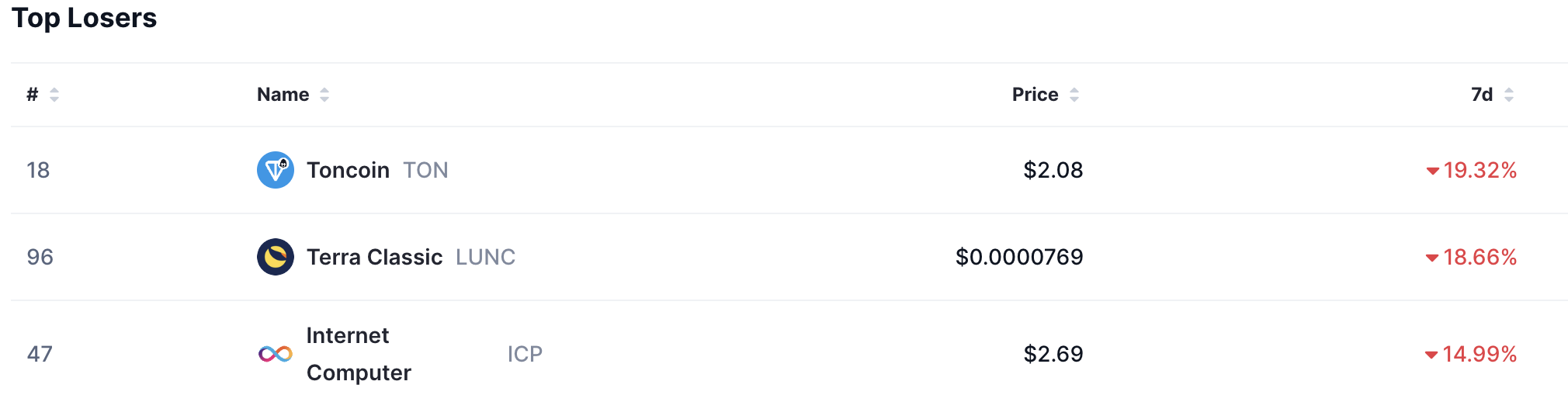
- Toncoin (TON) - end week price of $2.08, falling this week by 19.32%.
- Terra Classic (LUNC) - lost 18.66% to end the week at a price of $0.0000769.
- Internet Computer (ICP) - finished the week down 14.99%, at $2.69;
Crypto.com secures UAE SVF license and expands Dubai payment plans
Crypto.com has received a Stored Value Facilities (SVF) license from the Central Bank of the United Arab Emirates, becoming the first Virtual Asset Service Provider in the Emirates to secure this approval, according to the company.
The license moves Crypto.com from earlier in-principle approval, in October 2025, into a fully licensed position for stored-value payment services after the completion of technical and compliance requirements.
The approval enables Crypto.com to activate its partnership with the Dubai Department of Finance. The initiative allows UAE residents to pay Dubai government fees using virtual assets through Crypto.com’s regulated platform.
All settlements under the SVF framework will be processed in UAE dirhams or Central Bank of the UAE-approved dirham-backed stablecoins. This structure ensures government entities receive payments in local currency while users fund transactions using supported digital assets.
Crypto.com said users must be onboarded through its VARA-licensed platform to access the service. The company also stated it is the only VASP in the UAE holding an SVF license at the time of announcement.
Eric Anziani, President and COO of Crypto.com, said the approval reflects the company’s “strong commitment to compliance.”
The license may also support future integrations with Emirates Airlines and Dubai Duty Free, pending regulatory approvals. Emirates previously signed an MoU with Crypto.com in July 2025 to explore crypto payments via Crypto.com Pay.
OpenAI employee share sale hits $6.6B amid rising AI valuations
OpenAI completed a secondary employee share sale totaling $6.6 billion, according to The Wall Street Journal, giving current and former staff a rare opportunity to cash out holdings in one of the most closely watched artificial intelligence companies.
The report said about 75 employees sold up to $30 million each, while the broader group averaged roughly $11 million per seller. The figures came from people familiar with the transaction, and OpenAI has not publicly confirmed the individual allocations.
The sale followed a roughly two-year holding period for employees who joined during and after the launch of ChatGPT. Earlier restrictions limited share sales to $10 million per employee, but investor demand pushed the company to raise that cap to $30 million, allowing more liquidity for staff while private-market interest in OpenAI continued to grow.
The transaction reflects rapid shifts in valuation expectations. The deal valued OpenAI at about $400 billion, while an earlier secondary sale in October 2025 placed the company closer to $500 billion, showing how quickly private AI pricing has moved across late-stage funding rounds.
OpenAI has also been preparing for a potential public listing. Recent reporting indicates the company has crossed $25 billion in annualized revenue and is considering an IPO process that could begin with filings in the second half of 2026. The company remains unprofitable and continues to face high capital requirements.
OpenAI equity exposure is expanding into crypto-linked structures. Robinhood Ventures Fund I previously acquired about $75 million in OpenAI common stock to support tokenized products that track private company valuations. OpenAI has clarified that “These ‘OpenAI tokens’ are not OpenAI equity.”
The broader AI market continues to widen, with tokenized pre-IPO platforms pricing competitors like Anthropic at valuations reaching about $1.2 trillion in some markets. OpenAI is also expanding into financial workflows through integrations with FactSet, Third Bridge, Excel, and Google Sheets, positioning its tools closer to market analysis and data infrastructure.
SEC considers new rules for on-chain markets and AI financial systems
SEC Chair Paul Atkins said last Friday that the agency is evaluating updates to securities regulations to address blockchain-based trading systems and AI-driven financial applications as digital asset markets continue shifting toward on-chain infrastructure.
Speaking at the AI+ Expo in Washington, Atkins said the SEC is reviewing potential rulemaking for onchain trading platforms, blockchain settlement layers, automated financial tools, and crypto vault structures that combine multiple financial functions in a single system.
He said existing securities rules were built around traditional intermediaries such as brokers, exchanges and clearinghouses. In contrast, modern blockchain systems often merge those roles into one protocol.
“A single protocol can execute a trade, manage collateral, route liquidity, execute trading strategies through vault structures and settle the transaction,” Atkins said.
Atkins added that onchain financial markets increasingly combine elements of traditional finance and decentralized finance.
“We should clarify how the Commission views the spectrum of models that may implicate our statutes through notice and comment rulemaking, using our exemptive authorities where necessary and prudent,” he said.
The remarks signal a continued shift in the SEC’s approach under the current administration away from enforcement-led oversight toward formal guidance and rulemaking for digital asset firms. The agency has already issued staff guidance, no-action relief and public statements aimed at reducing uncertainty for crypto businesses.
Atkins also tied the discussion to broader technological change, noting that AI agents are expected to take a larger role in financial decision-making while blockchain systems enable instant settlement and value transfer.
“Our job is to set the rules of play and referee the game, not to pick the winning team,” he said.
He further supported congressional efforts such as the CLARITY Act, which aims to define a shared regulatory framework between the SEC and the Commodity Futures Trading Commission for digital assets.
Binance says AI tools prevented $10.5B in Crypto fraud losses
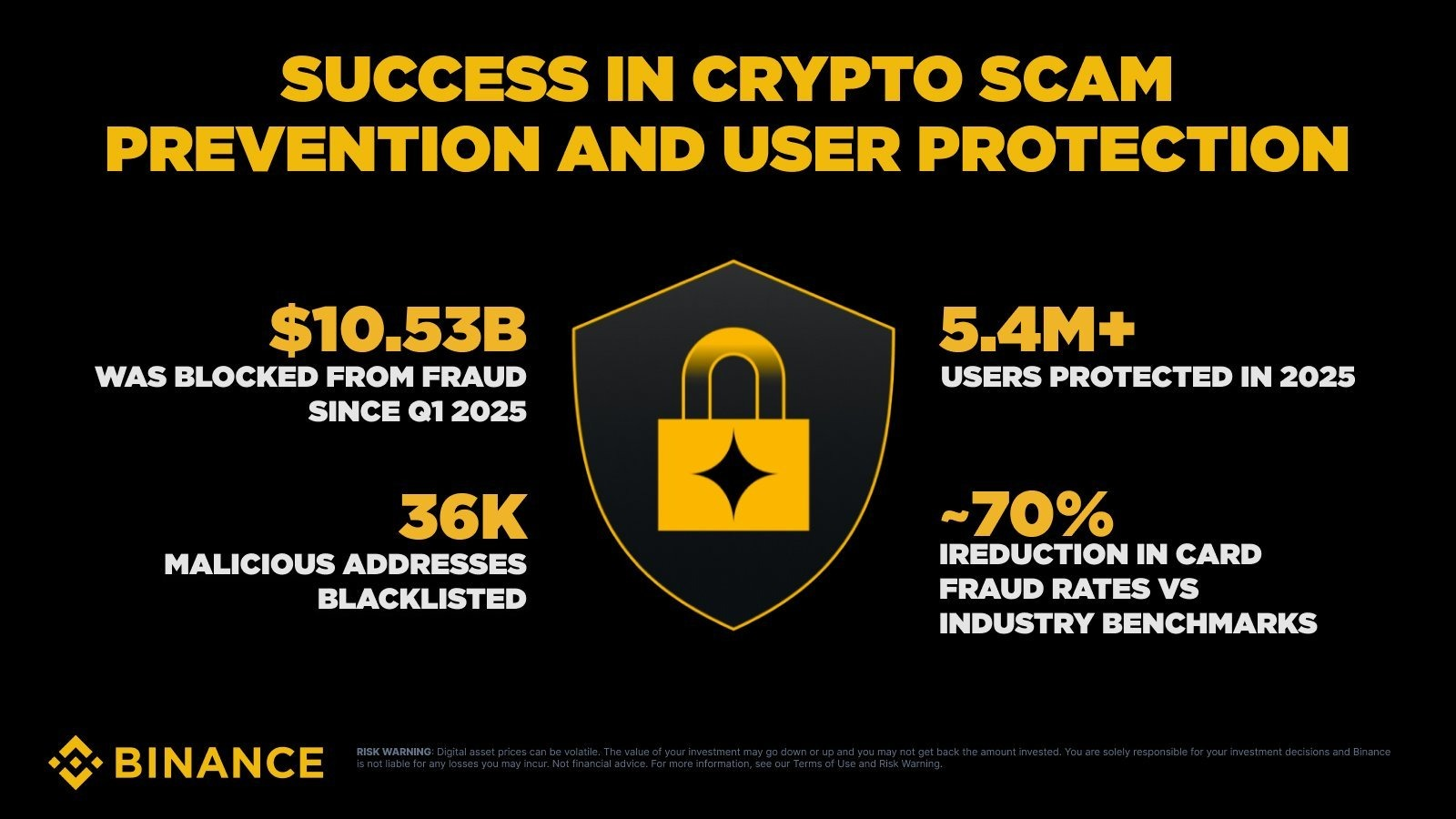
Crypto exchange Binance said its artificial intelligence security systems helped prevent more than $10.5 billion in user losses from scams and fraud between early 2025 and March 2026, as AI-driven attacks continue to grow across the digital asset sector.
In a blog post published Monday, Binance said it protected over 5.4 million users during the period after deploying more than 24 AI-based security initiatives and over 100 machine learning models across its platform.
“AI-powered scams and exploits are accelerating,” Binance said. “The barrier to entry for scam perpetrators is falling fast, with AI accelerating the drop. What once required technical expertise can now be executed for next to nothing and at scale.”
The company said cybercriminals increasingly rely on AI tools to scale phishing campaigns, impersonation schemes, fake platforms and deepfake content. Binance added that fraud tactics now include voice cloning, automated chat-based scams and synthetic identity creation designed to bypass user trust systems.
Binance also referenced external data, noting that the FBI reported in April that US citizens lost $11 billion worth of crypto to scams, with impersonation of government officials and crypto firms remaining a major attack vector.
Between Q1 2025 and Q1 2026, Binance said its systems blacklisted 36,000 malicious addresses. In the first quarter of 2026 alone, the exchange said it blocked 22.9 million scam and phishing attempts and prevented $1.98 billion in potential losses.
The exchange said its AI stack includes computer vision tools to detect fake payment proofs, real-time language analysis to identify scam patterns, and identity verification systems designed to counter deepfakes and synthetic identities.
“AI-driven decisioning now powers 57% of fraud controls, contributing to a 60%-70% reduction in card fraud rates compared to industry benchmarks,” Binance said, highlighting the growing role of automation in exchange security infrastructure.
 Gunel Ismayilova
Disclaimer: All materials on this site are for informational purposes only. None of the material should be interpreted as investment advice. Please note that, despite the nature of much of the material created and hosted on this website, HODL FM operates as a media and informational platform, not a provider of financial advisory services. The opinions of authors and other contributors are their own and should not be taken as financial advice. If you require advice, HODL FM strongly recommends contacting a qualified industry professional.