



Crypto markets have never been short of ways to lose money fast or, for those who get it right, to build returns that traditional markets rarely match. This is often where margin trading comes in. It is one of the most talked about, least understood, and most often misused tools that crypto traders have. Volume on leveraged crypto products has gone up a lot on all platforms, but traders' understanding of how they work hasn't grown at the same rate.
According to Coinlaw’s report, in January 2026, derivatives volume, which includes margin and futures, regularly accounts for over 70% of total crypto market activity, dwarfing spot buying of assets.
What is margin trading?
Margin trading is when you borrow money to open a position that is bigger than what you could afford with your own money. The trader puts up collateral, which is called the margin, and the exchange gives them a loan on top of that.
In spot trading, the most you can lose is the money you have. If you have $500 and buy Bitcoin at $78K, you own 0.000013 BTC.
Trading on margin makes things different. You can control a $5,000 position with that same $500 and 10x leverage. The upside scales, and so does the downside.
According to the SEC's Office of Investor Education and Advocacy, a margin account is one "in which the broker-dealer lends the investor cash, using the account as collateral, to purchase securities." The logic is the same in crypto, even though the rules are different on each platform.
Institutional adoption has accelerated this trend; in 2025, 78% of institutional OTC trades were dominated by stablecoins, often used as the primary collateral for these high-stakes margin positions.
How margin trading works
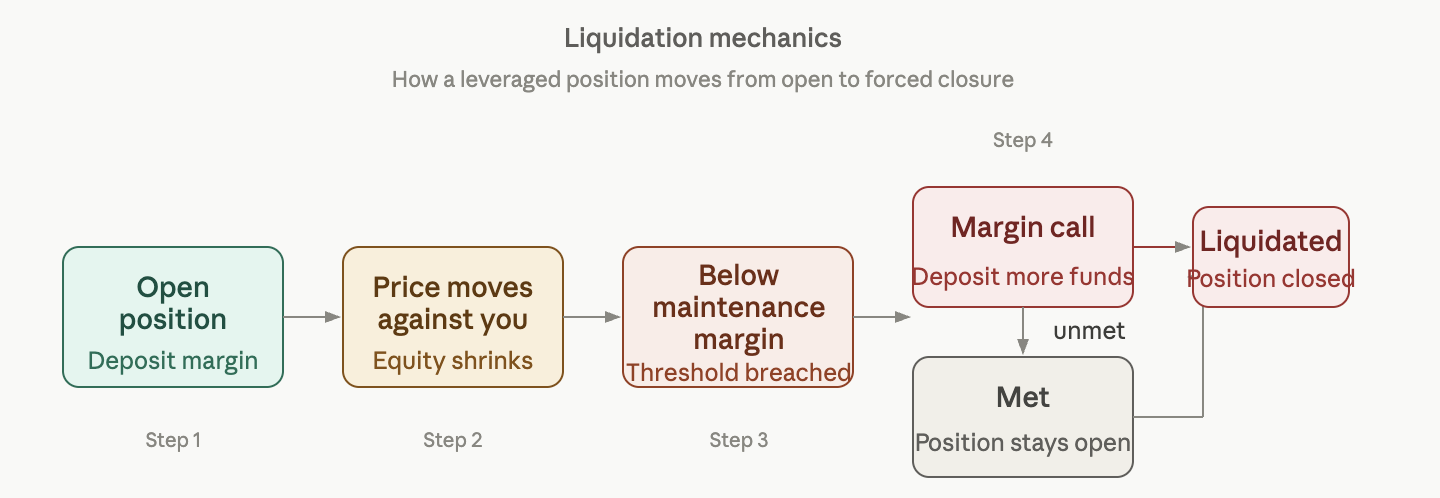
There are only a few components that make up the mechanics. The initial margin is the amount of money you need to put down to open a position. The maintenance margin is the lowest amount of money you need in your account to keep it open. If equity falls below that floor, the exchange steps in.
When the price goes up, people with long positions make money. When the price goes down, short positions make money because the trader borrows an asset, sells it, and plans to buy it back at a lower price. Most crypto margin platforms offer both, which gives traders more options than spot markets do.
Understanding leverage in trading
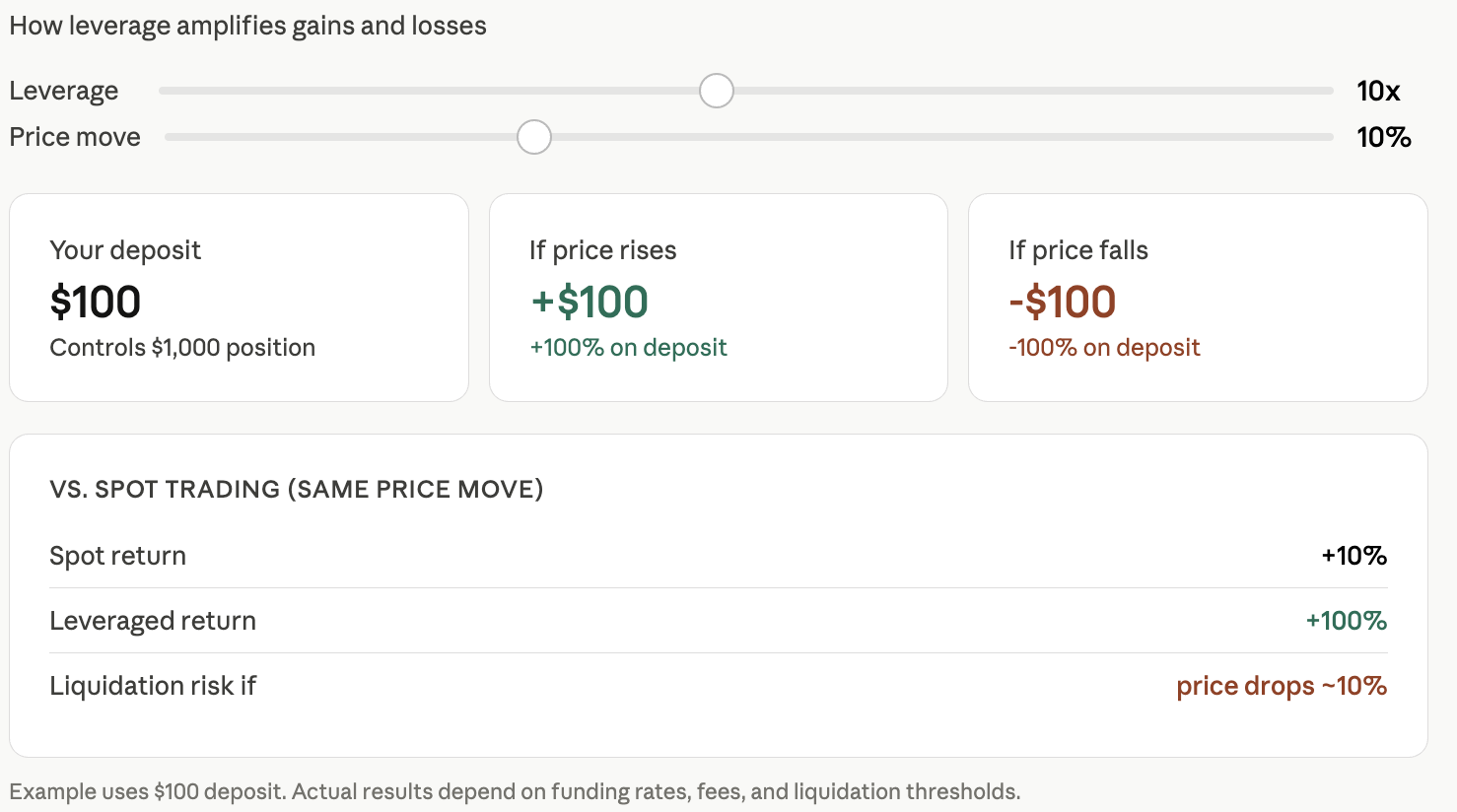
Leverage is expressed as a ratio: 5:1, 10:1, 50:1. At 10:1, a trader controls ten dollars of exposure for every dollar of their own capital. The amplification on returns is real. If a $100 asset rises $15, a cash investor earns 15%. A trader at 10x leverage on the same move earns 150% on their deposit.
When the price goes the other way, the math stays the same. A $15 drop at 10x wipes out 150% of the deposit, which means that the losses are more than the original stake. Nick Theodorakos, who is in charge of margin risk at Schwab, has said:
"Generally, forex rules allow for the most leverage, followed by futures, then equities."
Crypto sits beyond all of them, with leverage options sometimes reaching 100:1 and fewer universal guardrails in place. This lack of guardrails led to a catastrophic "deleveraging event" in October 2025, where a sudden market panic triggered over $19.5 billion in forced liquidations in a single day.
Liquidation explained
Liquidation is when a position is forced to close because losses have lowered collateral below the maintenance threshold. The exchange doesn't wait; it sells the position right away to get back the money it lent.
There is a liquidation price for every leveraged position. The price is closer to the entry, the more leverage there is. At 20x, a 5% drop can completely wipe out the collateral. The SEC has said that "some investors have been shocked to find out that the brokerage firm has the right to sell their securities that were bought on margin, without any notification and potentially at a substantial loss." In crypto, this dynamic is even more compressed by volatility. A liquidation can happen within minutes of a big move, so there isn't enough time to put in more money.
Margin trading vs spot trading
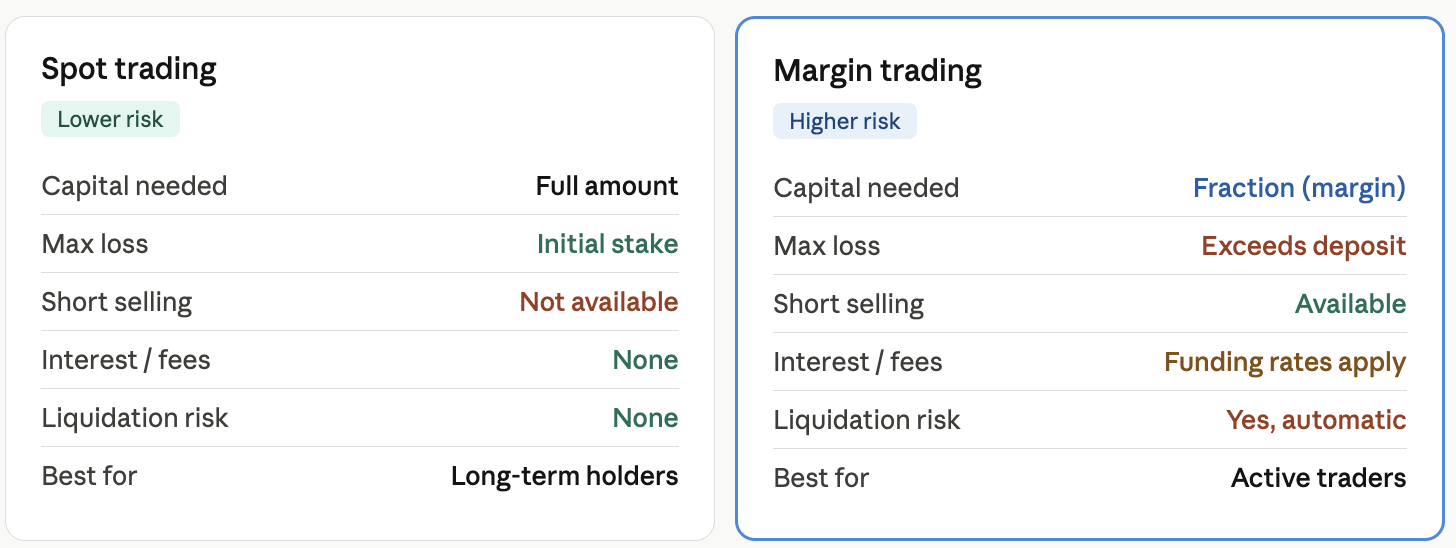
In spot trading, you can only lose the amount you put in. If the price drops by 50%, you lose 50% of the position. Nothing else is at risk. When you trade on margin, you can lose more than your initial deposit, and you still owe the borrowed amount no matter how low the asset falls.
There is a real difference in price. Margin loans have interest, which is often charged as a daily or hourly funding rate in crypto. Buying on margin is mainly used for short-term investments. The longer you keep an investment, the more money you need to make to break even.
Risks of margin trading
The Margin trading risks are not less. Liquidation can happen with little warning in fast-moving markets. The cryptocurrency market is more volatile than stocks because Bitcoin can move 20% or more in a single session. At high leverage, that is more than enough to cause a full wipe. Traders often don't realize how much funding rates and exchange fees lower returns over time. Making decisions based on emotions, like adding margin to a losing position or holding past a stop-loss, usually makes losses happen faster instead of slowing them down.
Margin trading strategies
Traders who have been doing this for a while know how to use margin. Stop-loss orders are not up for discussion. They automatically close a position at a set price, limiting the loss before it reaches liquidation. Setting a stop-loss makes the trader set a maximum acceptable risk before the trade opens, not after emotions have already gotten involved.
Position sizing determines how much capital goes into any single trade. A common "Gold Standard" in risk management is the 1% rule, where a trader never risks more than 1% of their total account value on a single leveraged trade.
If you only use 1% to 2% of your total account value for each trade, a string of losses won't wipe out your account. Traders who are just starting out should always use low leverage, like 2x or 3x. This lets them get used to how margin works without being too close to liquidation, which happens with higher ratios.
Is margin trading suitable for beginners?
Not immediately, and not at high leverage. When the market is under pressure, new traders often don't know how to read it correctly because they don't know how to recognize patterns. Leverage reduces the margin for error on every decision and compresses the time available to make them.
The SEC states plainly that margin accounts "can be very risky and they are not appropriate for everyone." Demo accounts offered by several platforms allow new traders to practice with simulated funds under real market conditions, the appropriate starting point before any real capital is at risk.
Conclusion
Margin trading in crypto is useful because it lets you take short positions, get more exposure, and be more flexible than spot markets. Those benefits come with risks that don't forgive mistakes. It's easy to say what discipline is: define risk before opening a position, set a stop-loss, and size within the account's capacity to absorb loss. But it's very hard to keep up when things get tough. Leverage is a tool, and like any tool, its usefulness depends on the person using it.
 Matvii Diadkov
Disclaimer: All materials on this site are for informational purposes only. None of the material should be interpreted as investment advice. Please note that, despite the nature of much of the material created and hosted on this website, HODL FM operates as a media and informational platform, not a provider of financial advisory services. The opinions of authors and other contributors are their own and should not be taken as financial advice. If you require advice, HODL FM strongly recommends contacting a qualified industry professional.