





Legend, a mobile-first decentralized finance application built to simplify crypto services, will shut down after two years of operation, according to a statement from co-founder and chief executive Jayson Hobby. The company said it failed to reach the scale required to sustain its business despite early traction and investor backing.
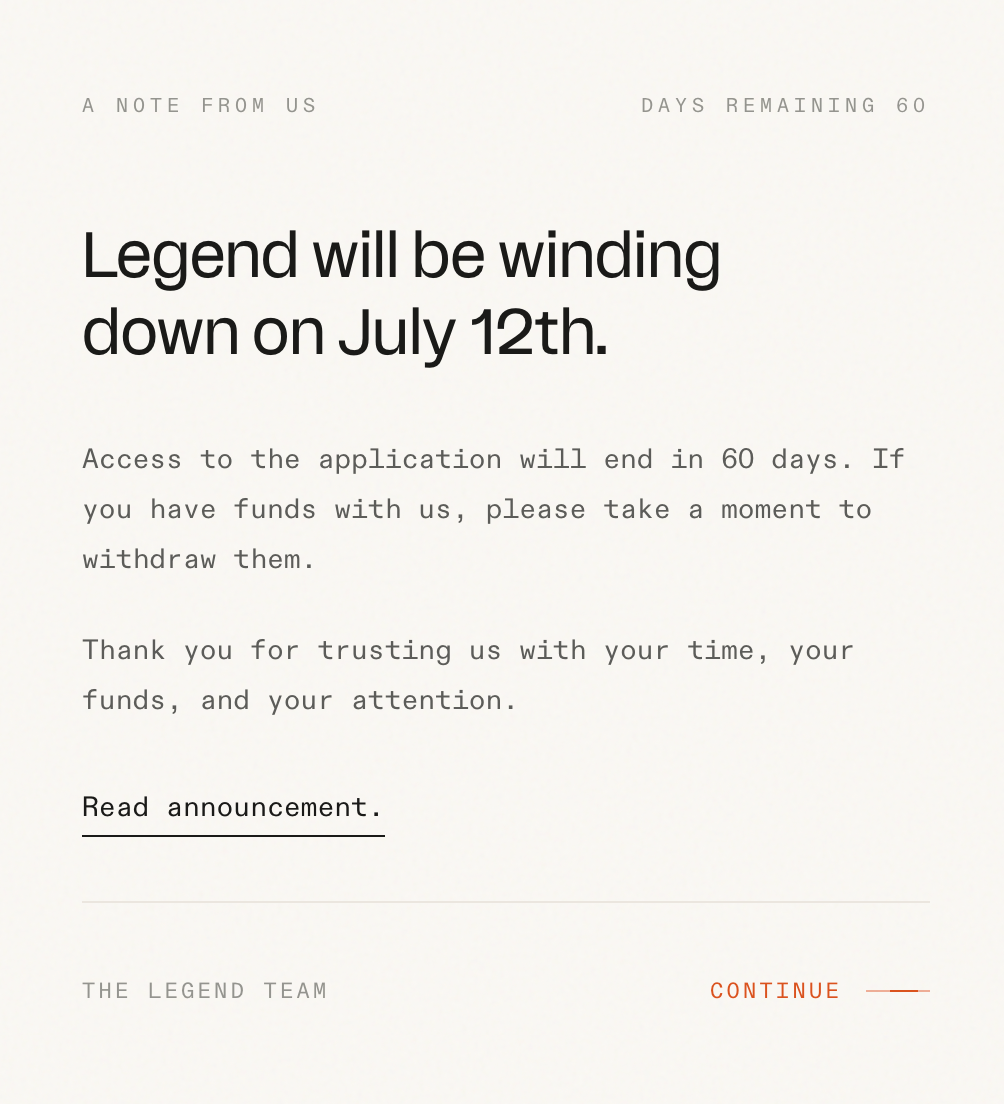
The announcement sets a 60-day timeline for closure. The application will remain active until July 12, after which it will go offline. New user onboarding has already stopped, and the company has asked existing users to withdraw funds before the shutdown date.
Hobby wrote:
"After two years building Legend, we've made the decision to wind down the company."
We’ve made the difficult decision to wind down Legend.
— Legend (@legendapp) May 12, 2026
For users with active balances, we encourage you to remove funds from the app before July 12.
Learn more about the product sunset → https://t.co/wAmnBqtK7x
Product demand did not translate into scale
Legend entered the market with a clear premise. The team aimed to make decentralized finance accessible through a single interface that combined multiple protocols. The app integrated services from platforms such as Aave, Compound, and Uniswap, which allowed users to trade, borrow, swap assets, and earn yield without switching between tools.
The product found users, but the company said adoption did not reach the level required for long-term sustainability. Hobby stated:
"The Legend product found a real audience, but didn't grow to the scale the company needed to be sustainable long-term."
The company raised $15 million in February 2025 with backing from Andreessen Horowitz and Coinbase Ventures. Even with that support, the gap between product usage and business viability remained.
Hard lessons on user priorities
The shutdown points to a broader challenge in decentralized finance. Teams have worked to simplify blockchain interfaces, but user behavior has not always aligned with those efforts.
Hobby addressed this gap directly. He wrote:
"Mainstream users don't care if a product is onchain or not. They want outcomes. Better yield, faster payments, more control over their money."
He added:
"The product that wins isn't the one that explains crypto better, it's the one that hides it completely. The benefits are felt, not explained."
These comments point to a disconnect between product design and user expectations. The company focused on usability, yet users evaluated services based on financial results rather than technical structure.
Shutdown plan and user instructions
Legend has outlined a structured wind-down process. The company said the app will continue to function normally during the transition period, with regular reminders sent to users who still hold funds on the platform.
The timeline includes three stages:
- Immediate announcement and halt to new user onboarding
- Weekly notifications to prompt withdrawals
- Final shutdown on July 12
Hobby confirmed:
"The Legend app will keep running normally for the next 60 days. It will go offline July 12. If you have funds in the product, please move them off platform before the app is shut down."
Documentation related to the closure will remain available for 60 days after the shutdown.
Sector pressure intensifies across DeFi
Legend’s closure follows a series of shutdowns across the decentralized finance sector. Several platforms have struggled with declining activity, security incidents, and shifting user behavior.
Step Finance, a Solana-based aggregator, closed earlier this year after a security breach compromised executive devices and led to losses estimated near $40 million. The company later said its smart contracts were not directly exploited.
Analytics platform Parsec also shut down after five years. Its leadership cited changes in user activity following the collapse of FTX, particularly in lending markets where leverage did not recover to previous levels.
Balancer Labs ended operations after financial strain tied to a $116 million exploit disclosed last year. Other projects, including ZeroLend, have also announced closures after failing to maintain sustainable business models.
These cases show a pattern. User activity has shifted, and revenue models have faced pressure. Temporary spikes in usage tied to specific products or events have not led to consistent growth.
A product vision that fell short of timing
Legend launched with a focus on aggregation. The app aimed to reduce friction by bringing multiple DeFi functions into one place. This approach addressed a known barrier in the sector, where users often rely on several wallets and interfaces.
The company maintained that its product worked as intended. Hobby thanked users who engaged with the platform:
"To everyone who used Legend, who routed a cross-chain swap, earned yield, sent a payment, or just stuck around to see what we'd ship next — thank you."
He added that closing the company was necessary despite the effort invested. "Closing is the right call for our team and our investors."
The shutdown leaves open questions about the next phase of DeFi products. Legend’s experience suggests that usability alone does not secure adoption at scale. Financial outcomes remain the primary driver for users, while infrastructure choices stay in the background.
 Gunel Ismayilova
Disclaimer: All materials on this site are for informational purposes only. None of the material should be interpreted as investment advice. Please note that, despite the nature of much of the material created and hosted on this website, HODL FM operates as a media and informational platform, not a provider of financial advisory services. The opinions of authors and other contributors are their own and should not be taken as financial advice. If you require advice, HODL FM strongly recommends contacting a qualified industry professional.