



Standard Chartered has set a $200 price target for Chainlink's LINK token by the end of 2030, with staged annual targets that would require the token to climb roughly 24 times from where it traded this week.
Geoff Kendrick, the bank's global head of digital assets research, published the forecast in a note titled "Chainlink: Owning the Rails," projecting LINK at $13 by the end of 2026, $41 in 2027, $82 in 2028 and $133 in 2029 before reaching $200.
LINK was priced around $8.31 at the time of the report, up about 0.55% on the day, according to CoinMarketCap data. The bank's Bitcoin and Ethereum targets for the same period stand at $500,000 and $40,000 respectively. On those terms, Standard Chartered's implied return for LINK outpaces both.
The tokenization thesis behind the number
The valuation logic rests on two forecasts. Standard Chartered projects tokenized assets on public blockchains will expand from about $340 billion currently to $4 trillion by the end of 2028. Over a longer horizon, the bank expects assets deployed in DeFi to grow 37 times to reach $2.7 trillion by 2030.
The research note stated that "tokenized assets cannot scale through issuance alone," and identified trusted external data, secure movement between blockchains, privacy tools, and compliance systems as essential for utilization across DeFi and traditional finance workflows. The bank assessed Chainlink as the only platform that covers all of those areas end to end.
Based on those projections, Kendrick estimated that Chainlink's fees could increase about 25 times by 2030, and assumed the token price would track that fee growth. The bank's note also identified Chainlink as responsible for more than 70% of oracle-dependent DeFi value globally and more than 80% of such value on Ethereum. Total value secured exceeded $110 billion at the time of the report. Aave V3 alone accounts for roughly 44% of that figure.
Wall Street on the client list
Kendrick's note named Swift, DTCC, Euroclear, JPMorgan, Mastercard, UBS, Fidelity and S&P Global among institutions that have used Chainlink services. The bank expects customers outside crypto-native markets to represent a larger share of Chainlink's fee base as tokenization projects reach production. Tokenized funds and bonds require recurring access to data such as net asset values and reserve attestations, a demand that crypto-native assets rarely generate.
The institutional argument extends to cross-border payment infrastructure. In June, Chainlink joined Project Pangea alongside FairSquareLab, UniKA and Qivalis to test stablecoin-based foreign exchange settlement between Europe and South Korea. Chainlink said the initiative involves more than 50 banks representing over $10 trillion in assets under management. The project combines ISO 20022 messaging with blockchain settlement infrastructure and existing Swift systems to test payment-versus-payment settlement.
Migrations after the bridge exploit
On interoperability, the note acknowledged that Chainlink still trails LayerZero, but pointed to a shift in activity after a $292 million exploit in April. More than $7 billion in token value has moved from legacy bridge infrastructure to Chainlink's Cross-Chain Interoperability Protocol since that incident. CCIP quarterly volume reached $4.9 billion in the second quarter, up 353% from a year earlier.
Among the protocol shifts was a decision by BitGo on Aug. 4 to select CCIP as the exclusive cross-chain infrastructure for Wrapped Bitcoin. WBTC carried a market capitalization of roughly $7.4 billion at that point. BitGo said it would standardize WBTC deployments around Chainlink's Cross-Chain Token standard and use CCIP as the default interoperability layer for future digital assets it issues. The structure preserves BitGo's control over token contracts and operational settings.
KelpDAO's bridge, which used LayerZero infrastructure, was the one exploited for $292 million. KelpDAO blamed LayerZero for the incident and said it planned to rebuild on Chainlink. LayerZero disputed that characterization.
Total publicly announced moves from LayerZero to Chainlink infrastructure reached approximately $14.6 billion after BitGo's decision, a figure that includes earlier migrations from Mantle, Lombard, Aave and Kraken.
What the report flagged as risks
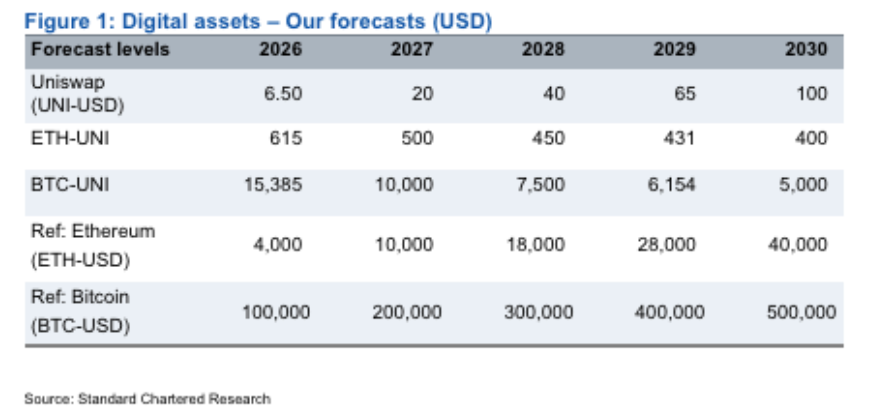
Kendrick built the same 37-fold DeFi growth assumption into previous notes. In June, the bank set a $100 target for Uniswap's UNI and a $3,500 target for Aave's AAVE, followed by a $60 target for Morpho in July. UNI recorded a double-digit gain after Standard Chartered published that coverage. LINK's response to the latest report has been more limited.
The bank identified scenarios that could prevent LINK from reaching its targets. Institutional tokenization could develop more slowly than Standard Chartered projects. Pilot programs with financial institutions may not convert to recurring production workflows. Specialist data providers could take market share from Chainlink, and technical failures could damage confidence in its oracle and cross-chain infrastructure.
In July, Aave expanded CCIP and made it the default cross-chain infrastructure across the Aave App and Stable Vaults. That change extended an existing setup under which CCIP already handled transfers of the GHO stablecoin. GHO was available across eight blockchain networks at that point. United Stables also adopted Chainlink infrastructure the same month, after its U stablecoin surpassed $1 billion in circulating supply and $2.5 billion in daily trading volume. Chainlink Data Feeds and Proof of Reserve went live for U, and the company said it planned to integrate CCIP for future cross-chain transfers.
 Tanya Petrusenko
Disclaimer: All materials on this site are for informational purposes only. None of the material should be interpreted as investment advice. Please note that, despite the nature of much of the material created and hosted on this website, HODL FM operates as a media and informational platform, not a provider of financial advisory services. The opinions of authors and other contributors are their own and should not be taken as financial advice. If you require advice, HODL FM strongly recommends contacting a qualified industry professional.