






For years, the U.S. crypto market ran on guesswork. Exchanges didn't know whether their tokens were securities or commodities. Developers didn't know whether writing smart contracts made them money transmitters. The SEC and CFTC each claimed authority over the same assets, sometimes simultaneously, sometimes in conflict. The result was a regulatory gray zone that cost the industry billions in legal fees and pushed serious projects offshore.
The Digital Asset Market Clarity Act of 2025, widely called the CLARITY Act, is Congress's attempt to end that ambiguity.
What is the CLARITY Act?
The CLARITY Act (H.R. 3633) is proposed federal legislation that seeks to create a comprehensive regulatory framework for digital assets in the United States. The bill, which was introduced in May 2025 by House Financial Services Committee Chairman French Hill and House Agriculture Committee Chairman G.T. Thompson, was passed by the House on July 17, 2025, in a bipartisan vote of 294 to 134.
At its heart, the legislation is about answering a single question that has paralyzed the industry for more than a decade: When is a digital asset a security and when is it a commodity? The answer determines whether the Securities and Exchange Commission (SEC) or the Commodity Futures Trading Commission (CFTC) has jurisdiction and which rules apply.
The bill describes a “digital commodity” as a digital asset whose value is “intrinsically linked” to the use of the blockchain but excludes securities, derivatives, and stablecoins.
Why the CLARITY Act was introduced
For years, the SEC and CFTC have been chasing enforcement actions against crypto businesses without a clear statutory basis. Some answers were provided by court rulings but no coherent system. Token projects couldn’t raise money without risking securities violations. Institutional investors turned their noses up.
The 2022 implosion of FTX made the cost of regulatory ambiguity impossible to ignore. No disclosure obligations were in place at a major crypto exchange that commingled customer funds. The CLARITY Act directly responds to that failure, with provisions requiring exchanges to segregate customer assets and disclose conflicts of interest.
There was also a competitive dimension. Without a domestic framework, crypto businesses incorporated abroad. The European Union moved ahead with MiCA, its own comprehensive crypto rulebook, while American firms operated outside American law.
Key provisions of the CLARITY Act
To better understand the implications of the CLARITY Act, here are its key provisions.
The mature blockchain test
The bill’s main mechanism is a standard for determining when a blockchain is sufficiently decentralized. If a network is found to qualify, its native token moves from SEC to CFTC oversight as a digital commodity. The core principles: no single entity can control more than 20% of the token supply or voting power, the code must be open-source, and for established networks, at least half of all tokens must be held outside the founding team.
SEC jurisdiction
Tokens that are considered investment contracts are still under the SEC’s jurisdiction. Issuers of digital commodities on mature blockchains would have to file an "offering statement.” The bill creates a fundraising exemption for digital commodities on mature blockchains up to $75 million over 12 months.
CFTC jurisdiction
The CFTC would have sole authority over trading in digital commodities, including spot markets. Centralized exchanges, brokers, and dealers would, for the first time, register with the CFTC as digital commodity exchanges (DCEs) and be subject to trade monitoring, recordkeeping, conflict of interest rules, and a prohibition on commingling exchange assets with customer funds.
DeFi and AML
Decentralized finance activities are not required to register, but both agencies retain anti-fraud authority regardless of decentralization. If a developer releases open-source code but does not handle customer funds, then the developer is not a financial intermediary. The Bank Secrecy Act's anti-money laundering requirements would apply to newly registered DCEs, brokers, and dealers.
How the CLARITY Act could reshape the crypto industry
The most immediate effect of the bill for centralized exchanges is a formal registration process with real compliance obligations, which today has no equivalent. For token issuers, the mature blockchain test creates a regulatory pathway that didn't previously exist: projects can start under SEC oversight and eventually shift to CFTC jurisdiction as they decentralize.
For everyday users, the practical effects include clearer disclosure on how customer funds are handled and expanded tax reporting. The bill broadens the IRS definition of "broker," which means more platforms would issue Form 1099-DA to users.
What happens next?
The bill has passed two significant legislative obstacles as of June 2026, but it is not yet a law. The Senate Banking Committee approved it on May 14, 2026 with a bipartisan 15-9 vote. Following this critical approval, the bill was officially reported to the full chamber and placed on the Senate Legislative Calendar under General Orders. This procedural milestone moves H.R. 3633 out of the committee phase and puts it in the official queue for a full Senate floor vote, where 60 votes will be needed to overcome any potential filibuster.
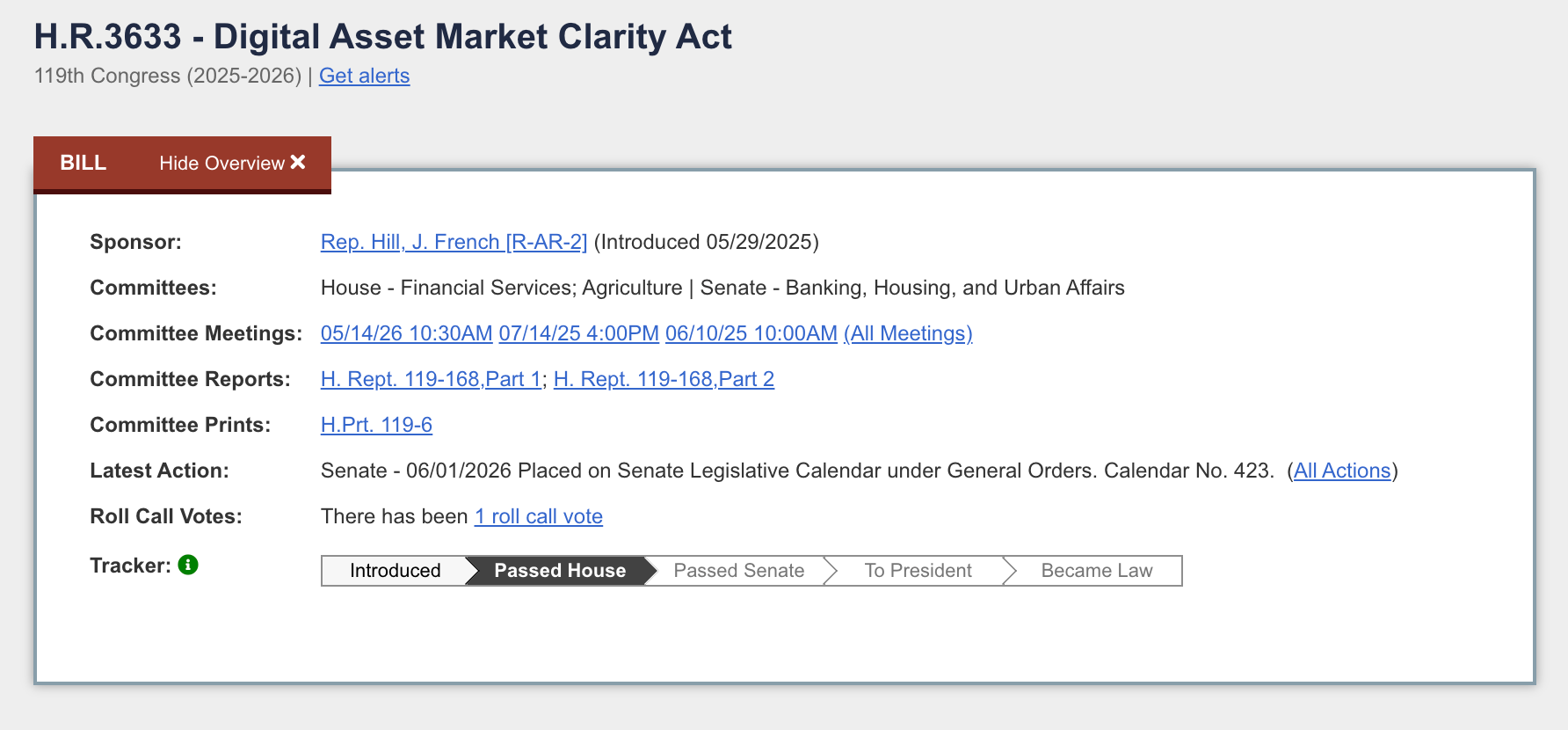
Several disputes could complicate that vote. Senator Angela Alsobrooks voted yes in committee but has conditioned her final support on the addition of ethics provisions. The North American Securities Administrators Association formally opposes the bill, arguing it weakens state-level investor protections. Stablecoin yield rules and DeFi definitions remain unresolved.
Both committees are targeting a July floor vote before the August recess. If that window closes, the bill risks delay past midterm elections and into 2027 or beyond.
Conclusion
The CLARITY Act would replace enforcement-by-guesswork with a written framework. For exchanges, that means a defined regulator to register with. For token issuers, a legal path from launch to decentralization. For users, custody standards and disclosure requirements with real legal backing.
The bill's fate in the Senate will likely determine not just how U.S. crypto is regulated but whether serious development stays onshore at all.
 Anastasiia G
Disclaimer: All materials on this site are for informational purposes only. None of the material should be interpreted as investment advice. Please note that, despite the nature of much of the material created and hosted on this website, HODL FM operates as a media and informational platform, not a provider of financial advisory services. The opinions of authors and other contributors are their own and should not be taken as financial advice. If you require advice, HODL FM strongly recommends contacting a qualified industry professional.