


If you’ve ever bought crypto and left it on an exchange, then you’ve made a security decision, whether you meant to or not. One of the first decisions any crypto holder makes is where to store your assets and who holds the keys.
Choosing the right wallet type for you really comes down to whether you want your private keys on an internet-connected device or something that stays offline. Cost, convenience, and risk all follow from that choice, whether you hold a small amount or a much larger portfolio.
What are crypto wallets?
A crypto wallet does not actually store your coins. Your Bitcoin, Ethereum, and other cryptocurrencies exist on the blockchain, a public digital ledger that records all transactions. A wallet stores the private keys that prove ownership of those assets and allow you to authorize transactions. If the key is lost, nothing can recover access, even though the assets remain visible on the chain.
Each wallet also produces a public address, sort of like a bank account number that you can share with anyone. The private key is more like a PIN, the part that must be kept secret. Hardware and software wallets are non-custodial, meaning only you keep the key.
What are hardware wallets?
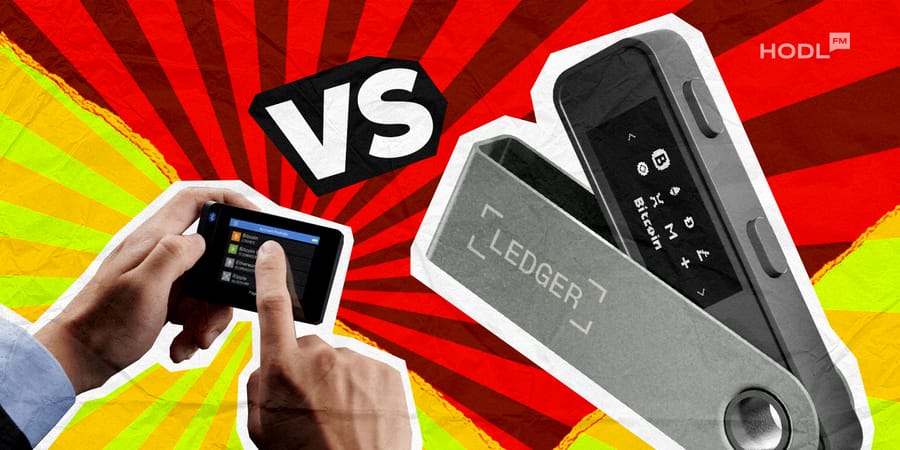
A hardware wallet is a small physical device, often about the size of a USB drive, built to generate and store private keys offline. Popular examples include the Ledger Nano and Ledger Stax lines and Trezor's Safe 5. Newer entrants like Cryptnox pack the same offline storage into an NFC-enabled card instead.
The device signs transactions internally. You plug it in or pair it with your phone, review the transaction on its screen, and approve it there. Only the finished signature leaves the device, never the key itself. This is cold storage, and it closes off remote attacks.
But no device is immune to every threat. Physical theft, a weak PIN, or a device bought from an unofficial reseller remain real risks. Ledger has added recovery options into recent devices, including an optional service that splits a backup key into encrypted fragments held by separate providers and a PIN-protected recovery card that ships with newer touchscreen models.
Hardware wallets suit anyone holding an amount that would genuinely hurt to lose, or crypto meant to sit untouched for years. Prices run roughly $40 to $220 depending on the model.
What are software wallets?
Software wallets are applications that run in your browser, on your phone, or on your desktop. Some of the best known are MetaMask and Trust Wallet, but there are many others, such as Exodus, Electrum, and the Coinbase Wallet app. These are hot wallets. They’re always online, always available.
That convenience is the whole appeal. Setup takes minutes, and you can send, swap, stake, and connect to DeFi apps in a handful of taps, just like a banking app.
The tradeoff is exposure. The same phone running your wallet also runs your email, your browser, and whatever app you downloaded last week. That opens the door to simple attacks: a fake extension, malware that swaps a copied address, or a phishing site that looks almost identical to the real one. None of it has to be especially sophisticated to empty a hot wallet. That’s why software wallets are best for smaller amounts you actually use, not long-term storage.
Hardware vs software wallets
Internet exposure and key storage
Hardware wallets keep private keys on a dedicated offline chip, and the key never touches an online machine, even when preparing a transaction. Software wallets store the keys in an encrypted file on a device that is connected to the internet for most of the day.
Malware risk and awareness
Hardware wallets require transaction confirmation on the screen of the device itself, meaning malware on a connected computer can’t silently authorize anything. Software wallets are more vulnerable to phishing, malicious browser extensions, and clipboard hijacking attacks.
Cost and convenience
Software wallets are free and fast: sending crypto takes seconds. Hardware wallets are about 40 to 220 dollars and add a bit of friction by design, since the physical device has to be on hand to sign anything.
Which one is safer?
Taken purely as devices, hardware wallets are safer. Keeping a key offline removes the most common attack path in crypto. Compromising a hardware wallet generally requires the physical device plus your PIN or written recovery phrase, a much higher bar than a malicious link.
But safety doesn’t end with the device. It’s worth remembering the 2020 Ledger breach, where around a million email addresses and some 270,000 physical addresses were leaked, though private keys were not affected. The fallout included phishing attacks and, in some cases, physical threats to known crypto holders. The key is in a hardware wallet. It can’t protect a home address already exposed in a retailer’s database, and it can’t protect a seed phrase someone reads aloud to a fake support agent.
So hardware wallets are safer against the threats they are built for, as are good habits, buying direct from the manufacturer, never storing a seed phrase digitally, and staying alert to phishing matters regardless of which wallet you choose.
When to use each wallet type
A software wallet makes sense for pocket money, small amounts you are actively spending, swapping, or testing a new protocol with. It is also a suitable option while you are still learning how transactions and fees work.
A hardware wallet earns its cost the moment it stops a single careless click from causing real damage. If losing what’s in a wallet would wreck your month or year, that’s a signal to move it to cold storage.
Many experienced holders treat the situation as both rather than either/or, pairing a hardware wallet for long-term savings with a software wallet for the smaller balance in active use and plugging the hardware device in only when the larger balance needs to move.
Risks and common mistakes
A few mistakes show up again and again:
- Storing a seed phrase digitally, as a screenshot, a cloud note, or a password manager entry. If it exists as a photo or text file, it is one data breach away from being someone else's.
- Buying a hardware device secondhand. A tampered or pre-seeded unit is a known trap, since the seller may already know the recovery phrase.
- Entering a seed phrase into any website, ever. Legitimate wallets ask for it once, during setup or a genuine recovery, never while browsing.
- Relying on SMS-based two-factor authentication instead of an authenticator app, which leaves accounts exposed to SIM-swap attacks.
- Assuming a written seed phrase backup works without testing it, discovering it only once it is too late.
- Skipping firmware and software updates, which patch vulnerabilities attackers actively look for.
None of these mistakes involve breaking cryptography. They are a person, a careless moment, and a mistake. Once crypto is transferred, it can’t be reversed.
Building your wallet strategy
There is no single right answer to hardware versus software, only a right answer for the amount and habits you have. Software wallets give you speed and near-zero cost for the crypto you use day to day. Hardware wallets give you a much higher bar against remote theft for the crypto you intend to leave alone.
Most people who have been in crypto for a while end up using both, sized to match what each one is protecting. Choose the one that matches your current balance first, and add the other one when your holdings grow enough to make it worth it.
 Matvii Diadkov
Disclaimer: All materials on this site are for informational purposes only. None of the material should be interpreted as investment advice. Please note that, despite the nature of much of the material created and hosted on this website, HODL FM operates as a media and informational platform, not a provider of financial advisory services. The opinions of authors and other contributors are their own and should not be taken as financial advice. If you require advice, HODL FM strongly recommends contacting a qualified industry professional.