


Look, the "Ethereum is dead" crowd has been louder than ever this year. And honestly? You can't completely blame them.
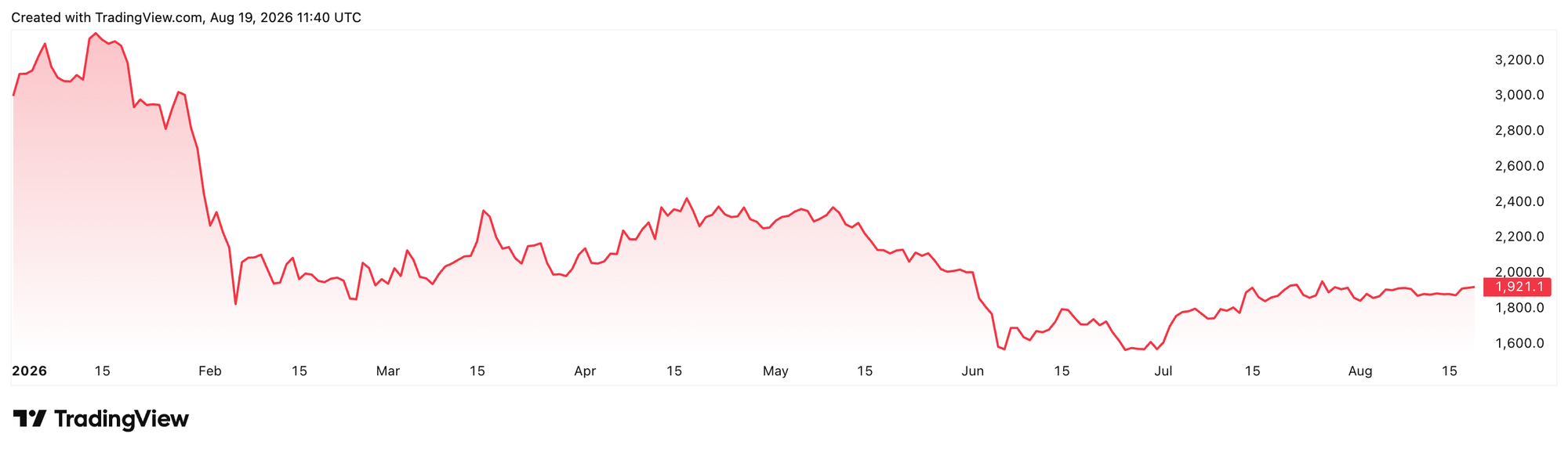
ETH is sitting somewhere it really doesn't want to be. As of Aug. 19, TradingView data puts the price around $1,920, which sounds decent until you remember this thing was nearly touching $4,950 at its peak. That's a brutal gap to stomach, and with a market cap still hanging above $230 billion, according to CoinMarketCap, Ethereum is technically still a giant. Just a giant that's been punched in the face a few times and hasn't quite recovered.
So is it dead? Not really. But is something genuinely broken? That's where it gets interesting.
The price situation is ugly, and there's no sugarcoating it
ETH can't seem to hold $2,000 for any meaningful stretch of time. Every time there's a small recovery, it fades. TradingView's weekly chart recently flagged a death cross, that's when a short-term moving average slips below a long-term one, which sent the usual crowd into a frenzy about further downside. Does a death cross guarantee the price craters? No. But it doesn't exactly inspire confidence either.
What's strange, though, is that institutions haven't bailed. SoSoValue's ETF tracker shows Ethereum spot ETFs swinging back to net positive inflows after a rough patch of outflows. BlackRock's ETHA and Fidelity's FETH are both pulling money in again, which tells you that some of the bigger players still see something worth owning here. That alone makes the "it's over" narrative feel a bit premature.
Here's the awkward part — Ethereum's own success might be its biggest headache right now
This one takes a second to wrap your head around.
Ethereum spent years being criticised for being too slow and too expensive. Gas fees were a nightmare. Regular users couldn't afford to do anything on-chain without paying $50 in transaction costs. So the network doubled down on layer-2 scaling: rollups, optimistic chains, ZK networks, and the whole ecosystem. And it worked. Layer-2s are genuinely fast and cheap now.
But here's the problem nobody really wants to say out loud: all that activity happening on L2s isn't really feeding back into Ethereum's base layer the way it used to.
L2Beat's activity dashboard shows enormous transaction volumes across Ethereum's scaling ecosystem. Looks impressive. The issue is that most of those fees stay on the L2 side. Ethereum applications were pulling in roughly $1.8 billion in fees during Q2, but Ethereum's actual mainnet only captured around $88 million of that. The base layer is essentially a landlord collecting a fraction of the rent while tenants do all the business.
For anyone holding ETH as an investment, that's the question that keeps coming up in every serious discussion right now: if the ecosystem booms but the base layer sees less and less activity, who exactly benefits?
To be fair, Ethereum isn't sitting still
The development side of things is still moving. Vitalik Buterin has been reshaping the long-term roadmap, there's been a lot of talk around what's being called the "Strawmap," which pushes harder on scalability, privacy, quantum resistance, and making rollups more independent and capable. Whether you think that's exciting or just more future promises depends on your patience level at this point.
The broader Ethereum roadmap still prioritises making the protocol more secure and usable. Developers aren't abandoning ship. If anything, the technical activity on the network is arguably more serious and focused than it's been in previous cycles.
The harder sell is connecting all that development work to a reason for ETH's price to actually move upward.
So what's the honest verdict?
Dead? Come on. Ethereum processes billions in value, underpins a sprawling DeFi and NFT ecosystem, and sits beneath dozens of major L2 networks as the settlement layer. You don't throw that away. Institutional money is still flowing in through regulated products. The ecosystem is genuinely busy. The network isn't going anywhere.
But "not dead" and "thriving" are two very different things.
The real conversation in 2026 isn't whether Ethereum survives. It's whether ETH , the actual token, can capture enough value from the massive ecosystem it helped build. Right now, a lot of that value is leaking sideways into L2 tokens, app revenues, and sequencer fees that don't flow back to mainnet holders.
Ethereum built something remarkable. The question it hasn't answered yet is whether it built something that makes owning ETH the obvious choice or just the sentimental one.
That answer, for now, is still being written.
 Roman Zaika
Disclaimer: All materials on this site are for informational purposes only. None of the material should be interpreted as investment advice. Please note that, despite the nature of much of the material created and hosted on this website, HODL FM operates as a media and informational platform, not a provider of financial advisory services. The opinions of authors and other contributors are their own and should not be taken as financial advice. If you require advice, HODL FM strongly recommends contacting a qualified industry professional.