


Ask any Bitcoin holder what HODL means and you will probably get two answers. The first is a joke: "Hold On for Dear Life." The second, the actual one, is far less dramatic. HODL started as a typo. Nothing more, nothing less.
The story behind it, though, is a lot more compelling than the acronym backronym people made up years later.
The night a typo became a movement
In December 2013, a Bitcoin forum user named GameKyuubi posted on Bitcointalk.org while the price was falling hard. He had been drinking, and he meant to write "I AM HOLDING." Instead he typed "I AM HODLING," caught the mistake, and left it in anyway. His post was a raw, half-drunk confession about why he refused to sell even as the market dropped around him. He wrote, "You only sell in a bear market if you are a good day trader or an illusioned noob."
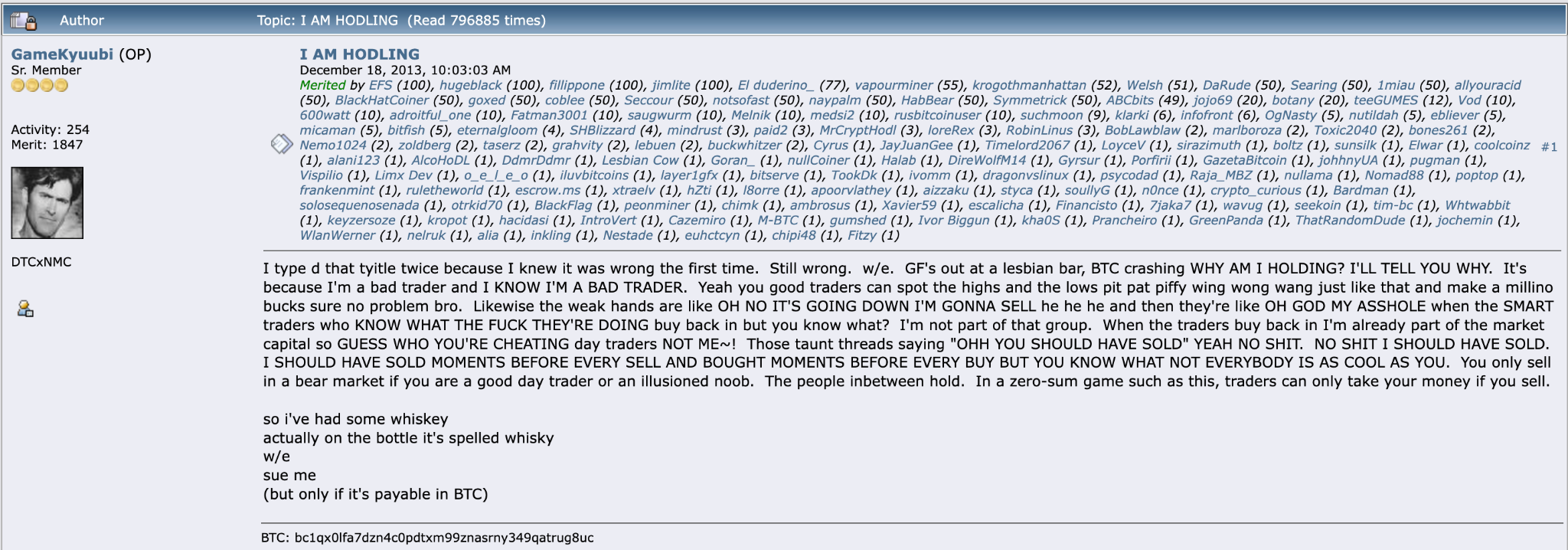
That line stuck. A user named elux replied within minutes with a single word: "HODL!" Others followed. One commenter predicted a meme was coming, and he was right. The original thread eventually collected more than 2,600 replies, and a spelling mistake turned into one of the most recognized words in crypto.
What's easy to miss is that GameKyuubi wasn't posting a strategy, he was posting a confession. He admitted he was bad at trading, that he'd tried to time the market before and lost, and that holding was less a plan than a surrender to his limitations. That honesty is probably why the post survived. Every other piece of trading advice from that era promised an edge. This one admitted there wasn't one, and people related to that more than they related to another chart pattern.
Why HODL is not just buy-and-hold
Traditional investors talk about buy-and-hold as a calm, rational strategy. HODL is more than just a buy-and-hold strategy. It grew out of a specific moment of stress, a trader admitting he was not skilled enough to time the market and choosing to stay in anyway. That emotional honesty is part of why the term resonated. HODLing is not about picking the perfect entry or exit. It is about accepting volatility as the price of participation and refusing to let short-term fear override a long-term position.
HODL and active trading
Put HODL next to active trading, and the contrast gets sharper. A day trader or swing trader is trying to extract profit from volatility itself - buying dips, selling rallies, and sometimes running the same coin through a dozen trades in a week. HODLing does the opposite: it treats volatility as noise to sit through, not signal to act on. The two aren't really competing for the same job. Active trading is a bet on being right about timing. HODLing is a bet on being right about the asset over a long enough window that timing stops mattering as much.
That's also where HODL differs from its closest cousin, dollar-cost averaging. DCA is a buying discipline, putting in a fixed amount on a fixed schedule regardless of price, which smooths out the entry point over time. HODL is a holding discipline - it says nothing about how you got your coins, only that once you have them, you don't sell into fear. A lot of long-term investors actually run both at once: DCA in, then HODL once it's in the wallet. Staking is a different approach, since it involves putting already-held coins to work for yield rather than deciding whether to sell them, though plenty of stakers describe what they're doing as "HODLing with a paycheck."
Bitcoin's case for staying put
The scarcity argument sits underneath most HODL thinking. Bitcoin has a hard cap of 21 million coins, and its halvings cut new supply roughly every four years. According to The Block, the fourth halving occurred on April 20, 2024, at block height 840,000, cutting the block subsidy from 6.25 BTC to 3.125 BTC. That fixed issuance schedule is part of the argument that bitcoin can behave differently from currencies whose supply expands through policy decisions.
Adoption numbers back up the long-term thesis too. As of February 13, 2026, U.S. spot bitcoin ETPs held 1,268,383 BTC, or about 6.04% of bitcoin's maximum supply, according to Bitbo data cited by VanEck . Treasury trackers separately report close to 3.8 million BTC held across public companies, private entities, and sovereign holders. None of that guarantees future gains, but it shows why long-term holders feel like they are part of something bigger than a single trade.
Living through the crashes
HODLing sounds simple until the chart turns red. VanEck's own numbers make that clear: bitcoin traded around $68,747 on February 13, 2026, roughly 45% below its October 2025 peak near $125,173. A one-year return figure from that same window shows a loss of 28.66%, even while the three-year, five-year, seven-year, and ten-year returns remain sharply positive.
The pattern is not new. Bitcoin hit nearly $20,000 in the 2017 run, then fell more than 80% during the 2018 crypto winter. It reached an all-time high near $69,000 in November 2021, then went through a steep downturn the following year. In mid-2026, on-chain data indicated that the market was in a late-stage bear phase with early signs of accumulation, according to a market cycle analysis published by YieldFund in July 2026. Bitcoin had recovered from a June low around $60,000 after a 20.5% drop, and spot ETFs recorded seven straight days of net inflows near $1 billion a day. None of this erases the pain of the drawdown. It just shows that every HODL era eventually faces one.
What's psychologically strange about HODLing is that doing nothing is often harder than doing something. Watching a portfolio drop 40% while your brain is screaming at you to act, and choosing to simply not look at the app for a week, takes a specific kind of discomfort tolerance that has nothing to do with market knowledge. Behavioral finance calls this loss aversion, the pain of a loss hits roughly twice as hard as the pleasure of an equivalent gain, which is exactly why panic-selling near the bottom is such a common pattern. HODLing works when it works, mostly because it removes the option to act on that impulse in the moment.
Diamond hands and the language that followed
HODL did not stay alone for long. "Diamond hands" arrived from stock options trading in the late 2010s and found a permanent home in crypto through communities like WallStreetBets. The phrase describes someone who holds through volatility and often buys more during a dip, treating the drop as a discount rather than a warning sign. That is a subtle but real difference from classic HODLing, which is mostly about staying put rather than actively adding to a position during a crash. Its opposite, "paper hands," describes traders who sell fast when fear spreads, and the diamond hands crowd tends to view that group as the liquidity that lets stronger holders buy in cheap.
Does the strategy work for every coin?
This is where HODL culture gets more careful. The approach has a real track record with bitcoin and ethereum, both of which have recovered from brutal drawdowns and gone on to set new highs. Smaller altcoins do not carry the same liquidity or institutional backing, and holding through a crash does not guarantee a recovery. The Terra LUNA collapse in 2022 is the clearest warning here. Investors who tried to buy the dip watched the token fall from roughly $80 to essentially nothing within days. HODL works as a philosophy when it is paired with a realistic read on the asset itself, not blind loyalty to any token that carries the label.
Institutions, retail traders, and forum communities all lean on the same word but use it slightly differently. A fund allocating a small bitcoin position inside a 60/40 portfolio is HODLing for diversification. A forum poster refusing to sell during a crash is HODLing out of conviction or stubbornness, depending on how the story ends. A staker locking coins into a protocol for yield is HODLing with a side income. And a trading desk that keeps a small "core" position untouched while actively trading around it is, in effect, running HODL and active trading side by side rather than picking one or the other. Either way, the term that started as a drunk typo on a crashing Tuesday in 2013 is still doing a lot of work in crypto conversations more than a decade later.
 Gunel Ismayilova
Disclaimer: All materials on this site are for informational purposes only. None of the material should be interpreted as investment advice. Please note that, despite the nature of much of the material created and hosted on this website, HODL FM operates as a media and informational platform, not a provider of financial advisory services. The opinions of authors and other contributors are their own and should not be taken as financial advice. If you require advice, HODL FM strongly recommends contacting a qualified industry professional.