


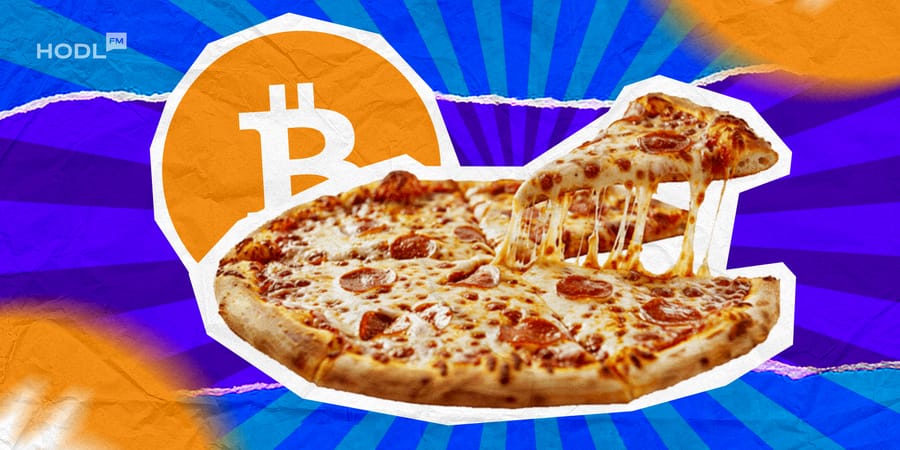



Bitcoin Pizza Day returned on May 22, marking 16 years since a Florida programmer completed the first known real-world transaction using Bitcoin by spending 10,000 BTC on two pizzas. The moment, once a casual forum experiment, has evolved into one of the most widely recognized milestones in cryptocurrency history.
The transaction took place on May 22, 2010, when early Bitcoin adopter Laszlo Hanyecz exchanged 10,000 bitcoins for two pizzas from Papa John’s. At the time, the value of the coins was approximately $41. The trade set an early reference point for Bitcoin’s price and demonstrated that the digital asset could function as a medium of exchange outside online communities.
Today, those 10,000 bitcoins are worth more than 770 million dollars, according to the HodlFM crypto calculator.

The first real Bitcoin purchase and its market impact
The pizza purchase remains the first documented case of Bitcoin being used to buy a physical good. Before that moment, Bitcoin largely existed within technical forums and early adopter circles where value was theoretical and peer-to-peer transfers carried no established price reference.
The transaction provided a measurable exchange rate between Bitcoin and a real-world product. That reference point helped establish early confidence that the asset could move beyond experimentation into commerce.
At the time of the trade, Bitcoin had no clear market valuation. The idea of spending 10,000 BTC on food reflected the uncertainty of the early ecosystem, where participants tested whether the system could support practical use cases.
🍕 16 years ago, someone paid 10,000 $BTC for two pizzas.
— HodlFM (@Hodl_fm) May 19, 2026
At the time, it was just dinner. Today, that same Bitcoin is worth over $767M.
The most expensive pizza order in history and one of Bitcoin’s first real-world payments.
Happy Bitcoin Pizza Day! pic.twitter.com/fOpLO5Fh0m
Laszlo Hanyecz and the early experimentation phase
Laszlo Hanyecz, a Florida-based developer, played a central role in the early adoption phase of Bitcoin. His decision to offer 10,000 BTC for two pizzas originated on the BitcoinTalk forum, where users discussed potential applications for the technology.
A user known as “jercos” accepted the offer, ordered the pizzas, and completed the transaction. The exchange became the first recorded instance of Bitcoin leaving the digital environment and entering physical commerce.

At the time, Bitcoin carried minimal monetary recognition. Hanyecz later explained that the coins had no practical value in his view, which shaped his willingness to use them for something tangible.
From $41 pizza to multimillion-dollar benchmark
The financial contrast between 2010 and today defines the cultural significance of Bitcoin Pizza Day. The same 10,000 BTC that purchased two pizzas for roughly $41 would now represent a value measured in hundreds of millions of dollars based on recent market prices.
Bitcoin’s price trajectory has moved through multiple cycles of expansion and correction since that first transaction. As adoption increased, the asset transitioned from a niche digital experiment into a globally traded financial instrument with institutional participation and large-scale liquidity.
The pizza trade is often used as a symbolic benchmark to illustrate Bitcoin’s long-term volatility and growth. It also reflects how early adoption periods often involve uncertainty that later becomes historical reference points.
How Bitcoin Pizza Day became a global tradition
Every year on May 22, the cryptocurrency community marks Bitcoin Pizza Day as a symbolic reminder of Bitcoin’s origin in real-world use. The date now functions as a cultural checkpoint for the industry rather than a technical milestone.
Community events, online discussions, and marketing campaigns often center on the story of the pizza purchase. Exchanges, developers, and crypto users reference the trade to highlight how far the ecosystem has developed since 2010.
The tradition also reinforces a broader narrative within the crypto industry: early experimentation often carries disproportionate long-term outcomes when viewed through historical price changes.
Early uncertainty and the lack of valuation frameworks
In 2010, Bitcoin lacked pricing infrastructure, exchange platforms, and institutional recognition. The ecosystem operated primarily through peer-to-peer communication, where valuation depended on informal agreement rather than market data.
The pizza transaction occurred in this environment of uncertainty. Participants did not have historical price charts, trading volume data, or liquidity benchmarks. Decisions reflected experimentation rather than investment strategy.
That early stage of development shaped how Bitcoin would later be interpreted. The pizza trade became a reference point for discussions about opportunity cost, long-term holding, and market unpredictability.
Bitcoin’s evolution
Since that first purchase, Bitcoin has moved through phases of adoption that include retail trading growth, exchange development, and institutional entry. Daily transaction volumes have expanded significantly, and global ownership has reached widespread levels across multiple markets.
The asset now operates within structured financial systems that include exchanges, custody solutions, and regulated investment products in several jurisdictions.
Despite that evolution, the Bitcoin Pizza Day story remains central to its identity. It represents the moment when digital value first intersected with physical goods in a verifiable way on a public blockchain.
A lasting reference point in financial history
Sixteen years later, the pizza transaction continues to function as a cultural and financial reference point. It highlights how early digital assets can shift from experimental tools to global markets over time.
The story of Laszlo Hanyecz and his 10,000 BTC purchase remains unchanged in detail, but its interpretation has evolved. What began as a simple exchange for food now serves as one of the clearest illustrations of Bitcoin’s long-term transformation.
 Tanya Petrusenko
Disclaimer: All materials on this site are for informational purposes only. None of the material should be interpreted as investment advice. Please note that, despite the nature of much of the material created and hosted on this website, HODL FM operates as a media and informational platform, not a provider of financial advisory services. The opinions of authors and other contributors are their own and should not be taken as financial advice. If you require advice, HODL FM strongly recommends contacting a qualified industry professional.