





This week’s crypto news covers the EBA’s proposed MiCA rules for crypto lending, Trump’s latest Strategy stock purchase, BlackRock’s view on AI-driven crypto demand, and the Fed’s proposed stablecoin capital and redemption requirements.
Top gainers and losers of the week
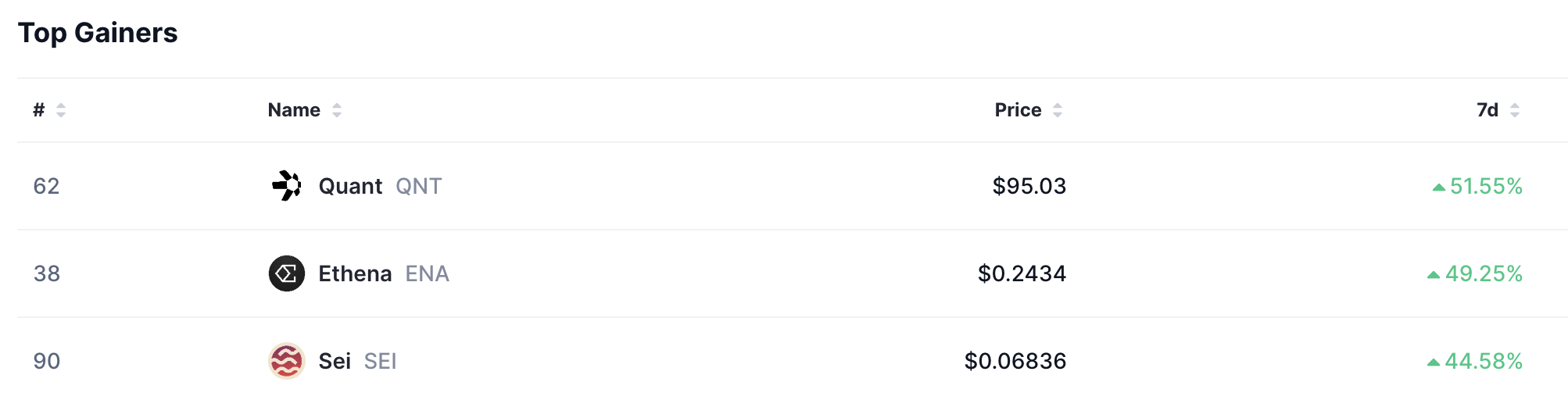
- Quant (QNT) – spearheaded the week's market rally, surging 51.55% over the last seven days to hit $95.03;
- Ethena (ENA) – continued its strong performance, climbing 49.25% throughout the week to settle at $0.2434;
- Sei (SEI) – built up impressive buying momentum, advancing 44.58% across the seven-day period to reach $0.06836.

- Pons (PONS) – pulled back following its previous explosive rally, losing 9.92% over the week to drop to $0.6397;
- MemeCore (M) – experienced moderate selling pressure, sliding 7.03% to close at $1.20;
- Aster (ASTER) – edged slightly lower across the seven-day stretch, dipping 1.92% to finish trading at $0.7353.
EBA wants crypto lending regulated under MiCA rules
The European Banking Authority called for crypto lending to be brought under MiCA's regulatory framework, in a response to the European Commission's targeted consultation on potential changes to the rules.
The EBA said crypto borrowing and lending should be regulated, including cases where crypto asset service providers facilitate access to DeFi lending protocols. It recommended the Commission conduct a cost-benefit analysis of adding intermediated crypto lending to MiCA's regulated services list, which could bring new compliance requirements and oversight activity.
Proposed measures include suitability tests for users, leverage limits, and additional disclosure requirements. The EBA also raised restricting access to lending involving asset-referenced or e-money tokens that require MiCA authorization, and introducing a certification regime for DeFi lending protocols.
The regulator pointed to prior research showing crypto borrowing and lending activity across at least 16 EU member states, and said easier access to DeFi through crypto firms and AI tools is increasingly blurring the line between centralized and decentralized finance. The recommendations form part of the EBA's broader input into the Commission's MiCA review, which also covers stablecoin rules, asset classification, and reporting requirements.
Trump discloses $100K Strategy stock purchase in July
President Trump disclosed purchasing $50,001 to $100,000 worth of Strategy shares on July 27, according to a US Office of Government Ethics filing released Tuesday, following a smaller $1,001 to $15,000 purchase three days earlier.
The July 27 buy matched Trump's largest previously disclosed Strategy purchase, a $50,001 to $100,000 transaction on February 12, according to BitcoinTreasuries.NET. Strategy remains the world's largest publicly traded corporate Bitcoin holder with 846,000 BTC. The filing does not show total shares held, since transactions are reported in value ranges rather than running balances.
Trump's filing also disclosed a Coinbase stock purchase and sales of Bitcoin miners MARA Holdings and CleanSpark in July, though the Strategy buy was the largest crypto-linked transaction identified. It represented a small share of broader portfolio activity that month, which included $5 million to $25 million sales each of Microsoft and Amazon stock. The White House told CNBC that Trump's portfolio is independently managed by third-party institutions without his input.
Strategy shares have rallied nearly 30% over the past five trading days and about 37% over the past month. The disclosure lands as Trump's administration pushes crypto-friendly policy through the SEC and CFTC after the CLARITY Act failed to advance in the Senate on September 15.
BlackRock says AI adoption will drive crypto demand
BlackRock's latest research paper, "The Machine-Native Economy," argues that broad AI adoption represents an underappreciated source of demand for digital assets, positioning stablecoins and blockchain infrastructure as machine-native payment rails for the AI era.
"Together, these developments position AI as a structural catalyst for digital asset adoption and digital assets as a potential facilitator of the AI economy," wrote authors Will Su, Robert Mitchnick, Jay Jacobs, and William Helm.
The paper argues agentic AI's need for automated, high-frequency, sub-cent transactions favors stablecoins and native cryptoassets over existing payment rails, which face merchant fee and settlement constraints.
"Several types of digital assets may support agentic commerce, but stablecoins are likely to lead transactional use," the authors wrote.
The paper also identifies compute, the processing power behind AI training and inference, as an emerging tokenizable asset class, where claims on capacity could be traded, pledged as collateral, or purchased automatically by AI agents.
The thesis echoes arguments from Coinbase CEO Brian Armstrong, who said in July that "AI being a megatrend takes nothing away from crypto... it makes crypto more important." Coinbase's x402 protocol, Tempo's Machine Payments Protocol, and Circle's agent wallet tools already support this kind of AI-driven payment activity.
Fed proposes capital rules for stablecoin issuers
The Federal Reserve proposed capital, redemption, and disclosure requirements for stablecoin issuers under its supervision on Thursday, moving to implement the GENIUS Act ahead of its January 18, 2027 effective date.
Under the proposal, issuers would face an operational-risk capital charge of 2% on the first $20 billion in stablecoins outstanding, 1.5% on the next $30 billion, and 1% on amounts above $50 billion, alongside additional capital requirements tied to credit and operational risk. Issuers would generally need to process redemptions within two business days, and if reserves fall below the required one-to-one backing, must notify the Fed and either restore reserves or liquidate and redeem outstanding tokens.
Monthly reports on outstanding stablecoins and reserve composition would require examination by a registered accounting firm and certification from the issuer's CEO and CFO. A separate proposal would create an application process for Fed-supervised banks seeking to issue payment stablecoins through subsidiaries.
Fed Governor Michael Barr supported the proposal but said more work remains. "Stablecoins will only be stable if they can be reliably and promptly redeemed at par in a range of conditions," Barr said, calling for universal redemption rights and raising concerns about a threshold limiting Fed enforcement to only "significant or systemic" anti-money laundering deficiencies. The proposals are open for public comment for 60 days.
 Roman Zaika
Disclaimer: All materials on this site are for informational purposes only. None of the material should be interpreted as investment advice. Please note that, despite the nature of much of the material created and hosted on this website, HODL FM operates as a media and informational platform, not a provider of financial advisory services. The opinions of authors and other contributors are their own and should not be taken as financial advice. If you require advice, HODL FM strongly recommends contacting a qualified industry professional.