


This week brought major developments across crypto regulation, tokenization, blockchain infrastructure, and security. The CFTC expanded relief for crypto wallet software, WisdomTree partnered with MoonPay on tokenized funds, Chainalysis reported a rise in blockchain-based malware activity, and Circle launched its Arc mainnet with major financial institutions among its validators.
Top gainers and losers of the week
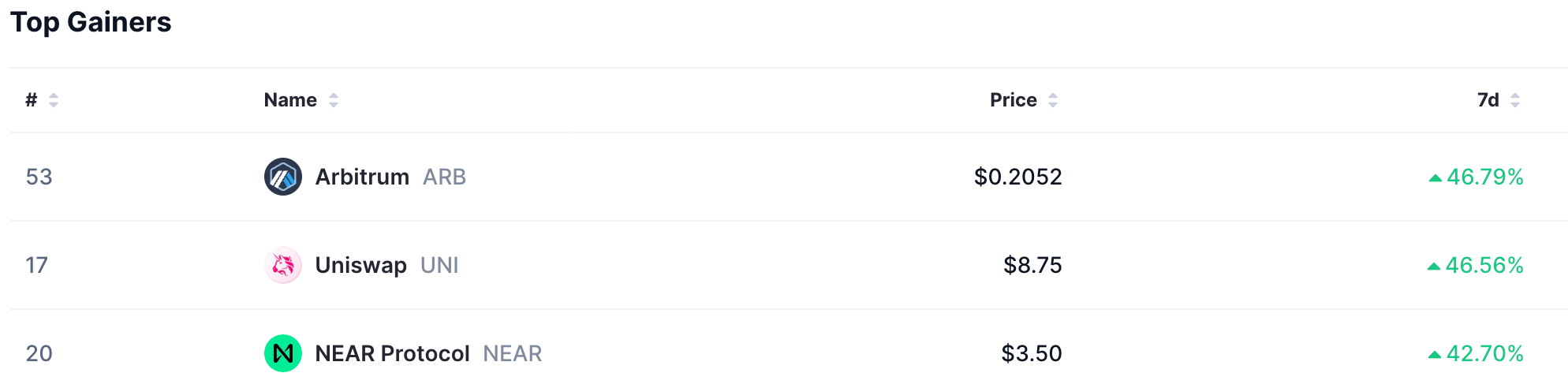
- Arbitrum (ARB) – surged sharply over the last seven days, climbing 46.79% to reach a price of $0.2052;
- Uniswap (UNI) – sustained a strong rally, rising 46.56% throughout the week to settle at $8.75;
- NEAR Protocol (NEAR) – picked up significant buying interest, advancing 42.70% across the seven-day period to hit $3.50.
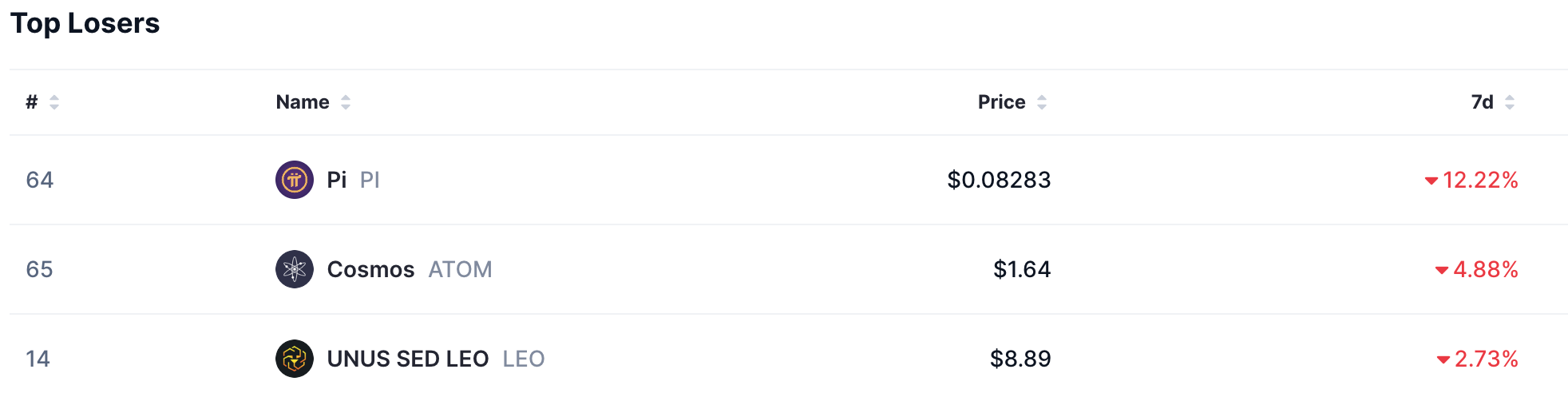
- Pi (PI) – took a downturn over the week, sliding 12.22% to drop to $0.08283;
- Cosmos (ATOM) – experienced mild downward pressure, dipping 4.88% to close at $1.64;
- UNUS SED LEO (LEO) – edged lower across the seven-day stretch, falling 2.73% to finish trading at $8.89.
CFTC expands no-action relief for crypto wallet software
The CFTC issued a no-action position on September 17 extending relief to providers of passive software that connect users to regulated derivatives firms. The Market Participants Division said it will not recommend enforcement against qualifying providers for failing to register as introducing brokers, provided they meet conditions limiting their role in transactions.
The position broadens a similar letter issued to Phantom Technologies in March covering its self-custodial crypto wallet software. That earlier relief let Phantom provide and market software connecting users to registered futures brokers and exchanges without registering as an introducing broker itself. Thursday's action makes that same relief broadly available to qualifying providers rather than limited to a single company.
To qualify, providers must restrict their role, including limits on exercising discretion over users' orders. Phantom and the Hyperliquid Policy Center had pushed in July for exactly this kind of broader protection, asking the CFTC to shield non-custodial wallet providers from introducing broker requirements.
The move came two days after the CLARITY Act failed to advance in the Senate. CFTC Chair Michael Selig said on X that "the CFTC is locked in and ready to ship its rules for the new frontier of finance," signaling the agency intends to act under existing authority regardless of the bill's stalled status.
WisdomTree and MoonPay team up on tokenized fund access
WisdomTree and MoonPay announced a strategic collaboration on September 17 to expand US investor access to WTGXX, WisdomTree's tokenized money market mutual fund, while enabling MoonPay to use the fund as part of its stablecoin reserve management.
The partnership gives WisdomTree an access point into MoonPay's network of more than 35 million accounts and 1,700 partners, extending distribution beyond its own broker-dealer, WisdomTree Securities.
"Stablecoins are reshaping how people and businesses both hold and move value, and working with MoonPay as an access point can give eligible U.S. investors another path to deploy their assets into WTGXX," said Jonathan Steinberg, WisdomTree's Founder and CEO.
Caroline D. Pham, CEO of MoonPay Institutional, framed the deal within a broader shift toward tokenized financial infrastructure.
"This year, we have seen rapid adoption of blockchain infrastructure and tokenization of financial assets to expand investor access," Pham said.
The companies described the agreement as a foundation for broader collaboration on additional tokenized fund opportunities, including in global markets. WisdomTree currently manages approximately $176.7 billion in assets globally, inclusive of Ceres Partners' farmland platform.
State hackers hide malware on blockchains, Chainalysis finds
State-linked hackers accounted for roughly two-thirds of new activity each quarter as attackers increasingly stored malware instructions on public blockchains, according to a Chainalysis report. The number of times threat actors used this technique, known as a blockchain dead drop, rose 420% over the past 12 months.
Chainalysis connected previously unattributed activity across Tron, Aptos, and BNB Smart Chain to UNC5342, a North Korea-linked group tracked by Google Threat Intelligence. Encoded pointers in Tron and Aptos transactions directed infected devices to a BSC transaction containing encrypted server addresses used for remote access and data theft.
Separately, Chainalysis identified suspected Iran-linked actors writing command-and-control routing data onto the Bitcoin blockchain, using small payments sent to a well-known address with historical ties to Satoshi Nakamoto as a permanent public checkpoint for infected devices to retrieve updated instructions.
The technique increases malware campaign durability since blockchain data remains accessible even after domains or servers are taken down. Chainalysis also recorded a 440% increase in malicious blockchain writes since July 2025, coinciding with the emergence of high-capacity open-source Chinese AI models capable of producing malicious code with limited safeguards, though the firm said it found only a "clear point-in-time association" rather than definitive proof of AI's role.
Circle launches Arc mainnet with major bank validators
Circle launched the Arc mainnet on September 16, a layer-1 blockchain built around USDC as native gas and positioned as infrastructure for stablecoin payments, tokenized markets, and agentic economic activity.
Arc offers EVM compatibility, deterministic sub-second settlement finality, and interoperability with more than 20 blockchains through Circle's CCTP and Gateway. CEO Jeremy Allaire called it "the single most significant launch in Circle's history since USDC itself."
The network supports more than 20 fiat stablecoins, including USDC, EURC, JPYC, and TRYB, alongside tokenized assets like BlackRock's BUIDL and Circle's USYC available natively at launch. Circle's founding validator cohort includes BlackRock, DTCC, Mastercard, Visa, ICE, and Standard Chartered, marking institutions that will help operate the network rather than simply connect to it.
The launch follows Arc's October 2025 public testnet debut, which drew more than 100 participating companies. Circle also completed the genesis mint of 10 billion ARC tokens this week, making it the first publicly traded company to mint a network token for a new layer-1 blockchain, though the company said the mint does not commit it to a public token launch. Arc plans to explore a transition from Proof of Authority to Proof of Stake in 2027.
 Roman Zaika
Disclaimer: All materials on this site are for informational purposes only. None of the material should be interpreted as investment advice. Please note that, despite the nature of much of the material created and hosted on this website, HODL FM operates as a media and informational platform, not a provider of financial advisory services. The opinions of authors and other contributors are their own and should not be taken as financial advice. If you require advice, HODL FM strongly recommends contacting a qualified industry professional.