


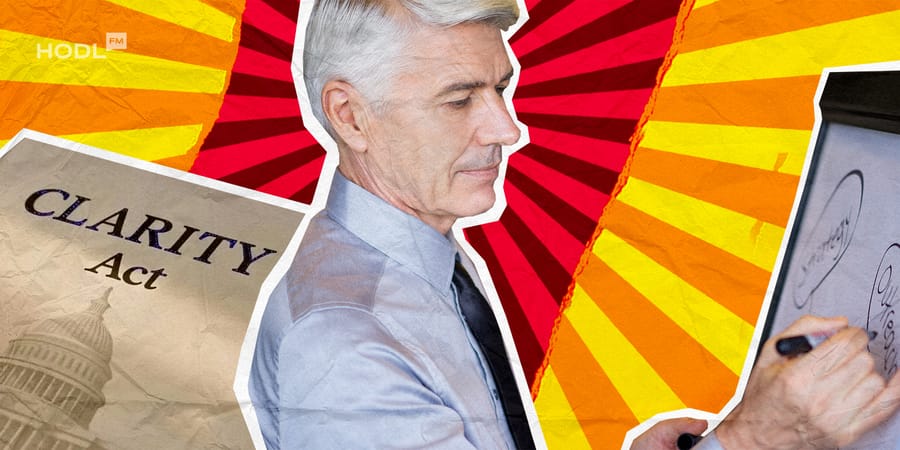



The Senate failed to advance the Digital Asset Market Clarity Act on Tuesday, falling short of the 60 votes needed for cloture after Democratic opposition centered on President Trump's personal crypto wealth. Sens. Kirsten Gillibrand, Catherine Cortez Masto, Angela Alsobrooks, Cory Booker, and Mark Warner, all seen as potential swing votes, ultimately voted against the bill.
Warner explained his vote directly.
"We got close to resolving some of the toughest outstanding issues around law enforcement and national security, but ultimately, the failure to address this fundamental conflict of interest made it impossible for me to support moving forward," he said. "That is why I voted no today."
Senator Cynthia Lummis, the bill's lead architect, had called the moment "now or never" ahead of the vote. Afterward, she placed the blame squarely on Democrats.
"This afternoon, Senate Democrats proved they were never truly serious about protecting consumers and preserving American leadership," Lummis wrote on X. "For over a year, they presented demands and the second we met them, they made new demands and moved the goal posts."
Where the ethics language actually broke down
The core disagreement centered on how the bill treated Trump's crypto holdings, which have grown to hundreds of millions of dollars tied to World Liberty Financial and the TRUMP memecoin. Republicans, led by Lummis, released text giving state attorneys general limited authority to sue crypto exchanges and the Justice Department over ethics violations, requiring officials to divest "significant financial interest" or place holdings in a blind trust.
Democrats rejected that framework as unenforceable, since the Justice Department itself would decide whether to pursue an enforcement action against the president. On Monday night, Senate Democrats countered with a proposal to broaden ethics restrictions specifically to cover Trump's crypto wealth, including his children's holdings, and to require officials with very large crypto company interests to sell those stakes entirely rather than placing them in a blind trust, according to Politico. Lummis rejected that counteroffer.
The blind trust mechanism at the center of the dispute has a documented history of failing to prevent conflicts in practice. A blind trust is meant to remove a public official's knowledge of and control over specific holdings, managed by an independent trustee. But crypto assets complicate that structure in ways traditional blind trusts were not designed for. Unlike stocks or bonds, cryptocurrency holdings can be tracked in real time on public blockchains, and a sitting president's public statements or policy actions affecting a specific token could still be interpreted as market-moving even absent direct trading control. Government ethics scholars have noted that blind trusts work best for liquid, fungible assets managed through conventional custodians, a description that fits traditional securities more cleanly than volatile, publicly traceable crypto holdings tied to specific ventures the president's family controls.
What happens to the bill from here
With the cloture vote failed, the path forward is unclear. The Senate is heading into recess ahead of November midterm elections, and even if a future procedural vote succeeded, the House would still need to act, a step that could not happen until after the elections since House leadership canceled its final two weeks of September session.
Ripple CEO Brad Garlinghouse said the loss extended beyond any single company's interests.
"This one stings," Garlinghouse wrote. "This was an opportunity bigger than Ripple or one company - we did this for the industry, for consumers and to cement the US's position as the crypto capital of the world." He added that "a post mortem needs to be done on why this failed," attributing the outcome to Democrats elevating politics over policy, while noting Ripple's business "has never been stronger" regardless of the vote's outcome.
Regulators move forward without the legislative backing
SEC Chair Paul Atkins had urged lawmakers to advance the bill just a day before the vote, but signaled his agency would proceed regardless.
"With or without that legislation, this Administration will deliver for American investors and technological innovators," Atkins said at a Solana Policy Institute event. "Promises were made, and they will be kept."
Coinbase CEO Brian Armstrong took a similar position after the vote failed.
"The SEC and CFTC have the tools they need to create clear rules under existing authority, and I expect will begin working on this in earnest," Armstrong wrote. "So clarity is coming to crypto regardless." He noted that GENIUS, the stablecoin law signed in 2025, remains in force independent of the Clarity Act's fate, and acknowledged that "there were some concessions we made on CLARITY that were tough to swallow, so perhaps it's for the best."
Without comprehensive legislation, the SEC and CFTC are left filling gaps through individual rulemaking rather than a unified statutory framework. The SEC's Regulation Crypto Assets proposal, which addresses exemptions for certain token offerings, and ongoing CFTC work under Chair Michael Selig represent the regulatory path Armstrong and Atkins both referenced. That approach carries an inherent limitation compared to legislation: agency rules can be reversed by a future administration or struck down through litigation in ways that a statute passed by Congress cannot, which is precisely why industry groups like Ripple and Coinbase had pushed so heavily for the Clarity Act specifically, rather than relying on rulemaking alone.
Senator Tim Scott framed the vote as a Republican success undercut by Democratic obstruction.
"Today, nearly all Senate Republicans voted to advance the Clarity Act, but the motion fell short because of Senate Democrats," Scott said. "We moved the ball forward, and now it's time for the SEC and CFTC to set clear rules of the road for digital assets until Congress legislates."
 Gunel Ismayilova
Disclaimer: All materials on this site are for informational purposes only. None of the material should be interpreted as investment advice. Please note that, despite the nature of much of the material created and hosted on this website, HODL FM operates as a media and informational platform, not a provider of financial advisory services. The opinions of authors and other contributors are their own and should not be taken as financial advice. If you require advice, HODL FM strongly recommends contacting a qualified industry professional.