






Crypto markets closed the week with mixed performance, as select altcoins posted strong gains while others saw double-digit losses amid shifting sentiment.
Major industry developments shaped the narrative: the ongoing FTX aftermath continued with a proposed settlement involving Fenwick & West, Coinbase’s CEO outlined key infrastructure upgrades needed for mainstream crypto adoption, and Trump Media’s large Bitcoin transfer to Crypto.com wallets drew attention to corporate treasury activity. On the tech side, Perplexity AI released its open-source “Bumblebee” tool, highlighting growing focus on software supply-chain security across the ecosystem.
Top gainers and losers of the week
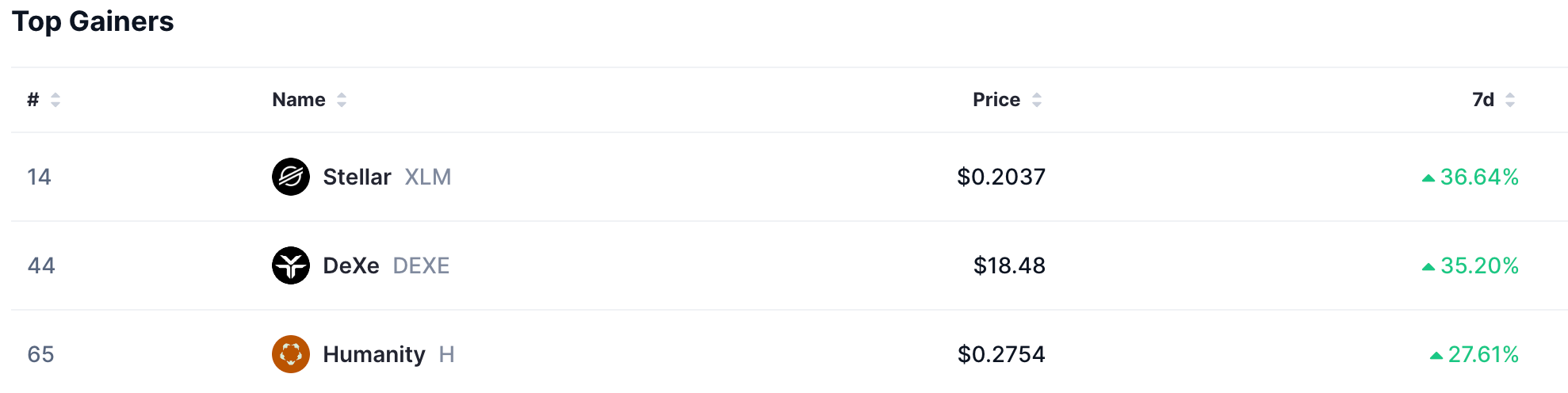
- Stellar (XLM) - soared by 36.64% to $0.2037 this week;
- DeXe (DEXE) - surged 35.20% during that time to reach a price of $18.48;
- Humanity (H) - The price went up 27.61% to $0.2754.
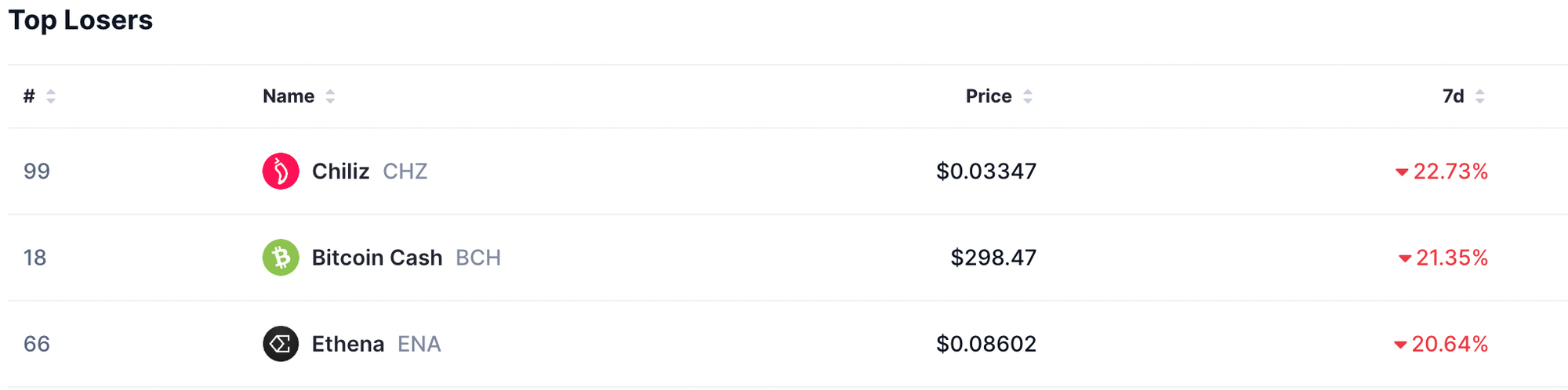
- Chilliiz (CHZ) - end week price of $0.03347, down this week by 22.73%.
- Bitcoin Cash (BCH) - lost 21.35% to end the week at a price of $298.47.
- Ethena (ENA) - ended the week down 20.64%, at $0.08602;
Fenwick agrees to proposed settlement in FTX lawsuit, court approval pending
Silicon Valley law firm Fenwick & West has agreed to a proposed settlement in a lawsuit filed by former users of collapsed crypto exchange FTX, according to court filings linked to the case. The agreement remains subject to approval by a U.S. judge and does not take effect at this stage.
Former customers accused the law firm of helping design legal and corporate structures that supported FTX and its affiliated trading firm Alameda Research. The complaint claims these structures allowed customer funds to move and mix without proper safeguards.
Court filings also state that Fenwick advised FTX on legal strategies intended to avoid money transmitter licensing requirements in some jurisdictions. These allegations form part of the broader civil case that followed the exchange’s collapse.
In August 2025, plaintiffs expanded their complaint using evidence from the criminal trial of Sam Bankman-Fried and the FTX bankruptcy process. They argued that testimony and findings showed Fenwick became “deeply intertwined” with the exchange’s operations.
The filing referenced former executives Nishad Singh, Gary Wang, and Caroline Ellison. It claims Singh said Fenwick knew about certain internal practices involving customer funds and legal structures connected to them.
Additional allegations include assistance in forming entities tied to Alameda Research and North Dimension, used to route customer deposits. Plaintiffs also pointed to encrypted communication practices among FTX executives.
The case remains ongoing while FTX-related recoveries continue. The FTX Recovery Trust distributed $2.2 billion in March, with another payout scheduled for May 29.
Coinbase CEO outlines eight upgrades needed for crypto-based finance expansion
Brian Armstrong said the global financial system still requires eight major upgrades before crypto-based finance reaches full mainstream use. His remarks focused on structural changes across tokenization, payments, artificial intelligence, and regulation.
Armstrong said the financial system must move toward a model that operates more globally and more on-chain. He wrote,
“Jobs not done until we get these working for all.”
Major areas where the financial system still needs an update:
— Brian Armstrong (@brian_armstrong) May 24, 2026
1. Tokenization of real-world assets - Real estate, stocks, bonds, funds, etc. onchain for instant settlement, fractional ownership & massive distribution.
2. 24/7 Global trading - Pooled global liquidity, every…
His list included real-world asset (RWA) tokenization, 24/7 global trading, stablecoin-based payments, AI-driven financial tools, self-custody wallets, easier capital formation, sound money systems, and improved regulatory frameworks.
The top priority in his view remains asset tokenization. Armstrong said traditional instruments such as real estate, stocks, bonds, and funds could move onto blockchain rails to enable faster settlement and broader access. This view aligns with wider industry attention on tokenization, which has expanded rapidly in recent years.
Stablecoins also featured prominently in his framework. He highlighted near-instant global payments using digital currencies and described a future where AI agents can initiate transactions without human input. Coinbase has already tested related systems through AI payment infrastructure and on-chain settlement tools.
Regulation formed another key pillar. Armstrong called for risk-based rules rather than uniform restrictions, a position that mirrors ongoing policy debates in the United States around digital asset legislation.
Coinbase continues to expand in these areas through stablecoin services, tokenization tools, and AI-enabled payment systems. The company links these developments to a broader shift toward automated and programmable finance.
Trump Media moves $204 million in Bitcoin to Crypto.com wallets
Bitcoin wallets attributed to Trump Media & Technology Group transferred more than 2,650 BTC, valued at roughly $204 million, to addresses linked with Crypto.com late Thursday, according to blockchain analytics firm Arkham.
Blockchain data suggests the assets originated from wallets associated with Trump Media, which has previously accumulated large Bitcoin holdings as part of its broader digital asset strategy. Transfers from private wallets to centralized exchanges are often associated with liquidity management or potential asset sales, although no confirmation has been provided in this case.
Arkham data shows the company still holds approximately $504 million in Bitcoin following the latest transfer. Earlier this year, smaller transactions from related wallets also moved funds to Crypto.com addresses, including a transfer worth about $245,000 in BTC.
The latest transfer comes as Trump Media reported financial pressure in recent earnings disclosures. The company recorded a net loss of approximately $406 million in Q1 2026, driven largely by non-cash losses tied to digital assets and equity holdings.
The company, which also operates the Truth Social platform, continues to hold significant digital asset exposure alongside its media operations. Shares of Trump Media have shown volatility this year, trading far below previous highs as investors weigh performance and asset risk.
Earlier developments also show a shifting strategy. The company recently dropped plans for Bitcoin and combined Bitcoin-Ethereum exchange-traded funds, signaling adjustments to its broader crypto ambitions.
Perplexity open-sources Bumblebee tool to detect supply-chain threats
Perplexity AI has released a new open-source security tool called Bumblebee, designed to detect malicious software packages and compromised developer environments without executing any code.
The company describes the system as a read-only scanner that inspects metadata instead of running programs. Unlike traditional security tools that install or execute software to test for threats, Bumblebee analyzes package descriptions, configuration files, browser extensions, and AI tool settings without triggering embedded scripts.
Today we're open-sourcing Bumblebee, a read-only scanner for macOS and Linux.
— Perplexity (@perplexity_ai) May 22, 2026
It checks developer machines for risky packages, extensions, and AI tool configs.
Connected to Computer, it can trigger deeper scans whenever a new supply-chain risk emerges.https://t.co/FOaWnF1yQy pic.twitter.com/wXauD4wDOT
Perplexity compares the approach to reading an ingredient label rather than consuming the product itself. The design aims to reduce risk during supply-chain attacks, where malicious code activates immediately upon installation.
The tool gained relevance after a May 11 incident in which a hacker group known as TeamPCP inserted malicious code into more than 160 software packages used by millions of developers. The compromised packages included tools linked to Mistral AI, UiPath, and a widely used React library with over 12 million weekly downloads.
Bumblebee also scans MCP configuration files, which define how AI assistants connect to external systems such as email services, databases, and calendars. These files can create security risks if modified, as they may allow unauthorized data access or command execution through connected AI tools.
The scanner extends coverage to browser extensions across major platforms, including Chrome, Edge, Brave, Arc, and Firefox, as well as development plugins used in code editors like VS Code.
Perplexity said it uses Bumblebee internally to protect systems supporting its search platform, browser, and AI agents. The company runs automated checks across developer machines when new threats are identified, followed by human review before deployment.
 Abimbola Adu
Disclaimer: All materials on this site are for informational purposes only. None of the material should be interpreted as investment advice. Please note that, despite the nature of much of the material created and hosted on this website, HODL FM operates as a media and informational platform, not a provider of financial advisory services. The opinions of authors and other contributors are their own and should not be taken as financial advice. If you require advice, HODL FM strongly recommends contacting a qualified industry professional.