






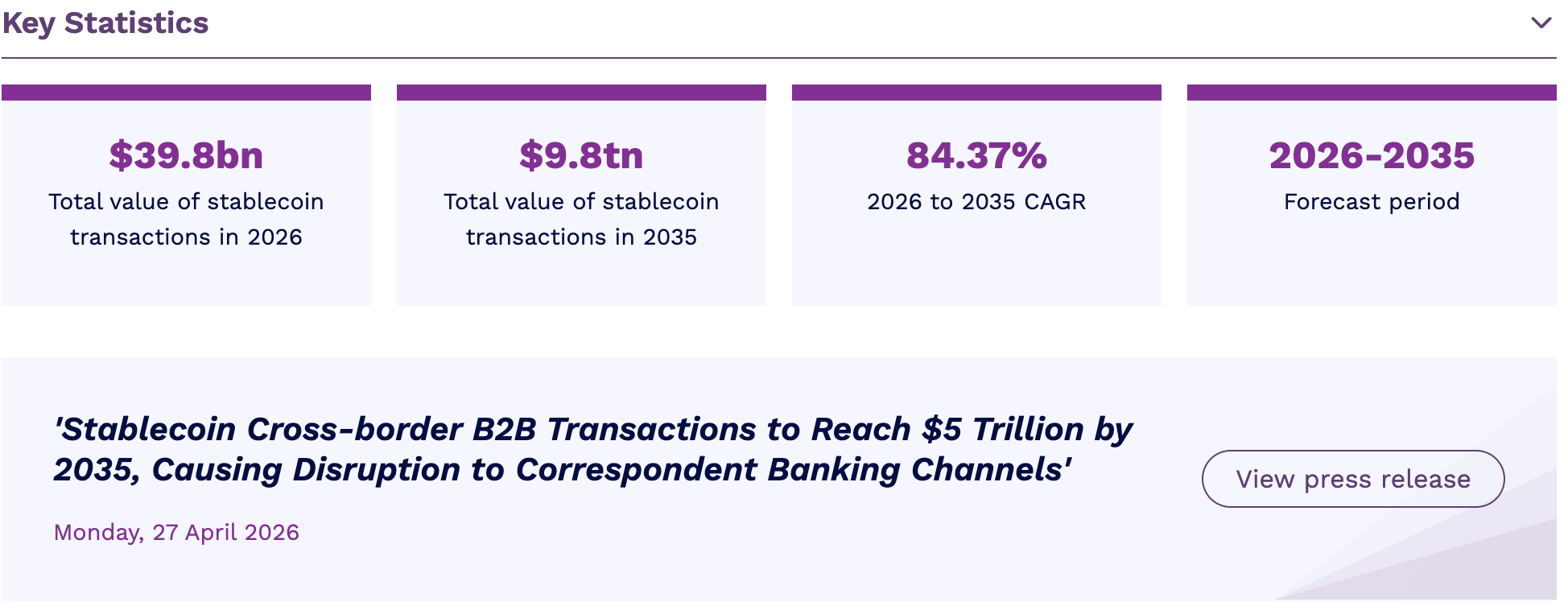
A new report from Juniper Research projects a sharp transformation in how stablecoins function within the global financial system. According to findings released on April 27, cross-border business-to-business (B2B) stablecoin transactions will rise from $13.4 billion in 2026 to $5 trillion by 2035, as corporate use cases begin to dominate activity.
The report shows that 85% of total stablecoin transaction value will come from B2B flows by 2035. This marks a clear shift away from retail trading and speculative use toward enterprise adoption. Companies already integrate stablecoins into treasury management, supplier payments, and cross-border settlements where timing and cost efficiency remain critical.
Juniper attributes this growth to structural inefficiencies in traditional correspondent banking. Existing systems depend on multiple intermediaries, which introduce settlement delays, foreign exchange spreads, and messaging fees. Stablecoins operate on blockchain networks that enable near-instant settlement and continuous availability, which reduces both processing time and transaction costs.
“Stablecoins are not replacing payments infrastructure; they are being adopted where the advantages are most pronounced,” said Research Analyst Jawad Jahan. “Cross-border B2B is where those advantages are greatest, and where we expect the most sustained volume growth over the forecast period.”
Cross-border payments drive adoption
The report identifies cross-border B2B payments as the main driver behind projected growth. Businesses that move large sums across jurisdictions face friction in legacy systems, especially when transactions involve multiple currencies or banking partners.
Stablecoins offer an alternative by acting as a neutral settlement layer, particularly in corridors where dollar-denominated tokens dominate. These assets allow firms to bypass correspondent banking chains and execute transfers with fewer intermediaries.
Juniper notes that stablecoin usage spans multiple segments, including person-to-person transfers, consumer payments, and card-linked activity. Despite this diversity, enterprise flows show the strongest long-term growth potential.
The firm also highlights the importance of enterprise integrations. Payment providers and issuers that align with treasury platforms and corporate finance systems will likely capture the largest share of this emerging market.
Growth meets regulatory scrutiny
The expansion of stablecoins has drawn increasing attention from policymakers. At a seminar in Tokyo, Pablo Hernández de Cos warned that U.S. dollar-backed stablecoins could carry “material consequences” for global economic policy.
He pointed to structural concerns around how major tokens such as USDt and USDC manage reserves and redemption processes. Unlike traditional money, these assets may impose conditions or fees on redemptions, which can affect liquidity under stress.
De Cos said a sudden increase in redemptions could force issuers to liquidate reserve assets such as government bonds or bank deposits. This scenario could transmit pressure into broader financial markets.
In Europe, regulators have moved to tighten oversight under frameworks such as MiCA. Officials have warned that gaps in regulation could allow issuers to shift operations across jurisdictions during periods of stress.
Banks have also started to test alternatives. Swiss institutions, including UBS, have launched pilot projects for franc-denominated stablecoins that aim to combine blockchain efficiency with existing regulatory safeguards.
Previous projections point to larger shift
Earlier reports covered by HodlFM News suggest that the scale of stablecoin adoption could extend far beyond current forecasts. Research from Chainalysis estimates that adjusted stablecoin transaction volumes reached $28 trillion in 2025 after a 133% compound annual growth rate between 2023 and 2025.
The firm projects that annual volumes could climb to $719 trillion through organic growth alone by 2035, with an upper estimate of $1.5 quadrillion when broader adoption factors are included. These projections rely on two key trends: generational wealth transfer and increasing use of stablecoins at the point of sale.
Chainalysis notes that younger generations show higher adoption rates for crypto-based financial tools. As wealth shifts toward these groups over the next two decades, stablecoins may become a default mechanism for payments and value transfer.
Institutional activity also supports this trajectory. Payment firms and financial companies continue to invest in infrastructure that supports stablecoin integration, which signals long-term strategic positioning rather than short-term experimentation.
Market momentum continues to build
Separate findings from the U.S. Treasury’s advisory committee indicate that the stablecoin market could reach a $2 trillion market capitalization by 2028. Growth drivers include institutional demand, merchant adoption, and the emergence of yield-bearing stablecoin products.
At present, dollar-pegged stablecoins dominate the sector, with USDt and USDC accounting for the majority of supply.
The convergence of enterprise adoption, regulatory developments, and institutional investment suggests a shift in how stablecoins function within global finance. Juniper’s forecast places B2B payments at the center of this transition, where efficiency gains and cost reductions offer immediate advantages for businesses operating across borders.
 Gunel Ismayilova
Disclaimer: All materials on this site are for informational purposes only. None of the material should be interpreted as investment advice. Please note that, despite the nature of much of the material created and hosted on this website, HODL FM operates as a media and informational platform, not a provider of financial advisory services. The opinions of authors and other contributors are their own and should not be taken as financial advice. If you require advice, HODL FM strongly recommends contacting a qualified industry professional.