




Crypto this week was a mix of explosive meme coin rallies, steady declines among major tokens, and headlines that highlighted both the opportunities and risks of the market. Here’s a quick look at the biggest movers and the key stories shaping the space.
Top gainers and losers of the week
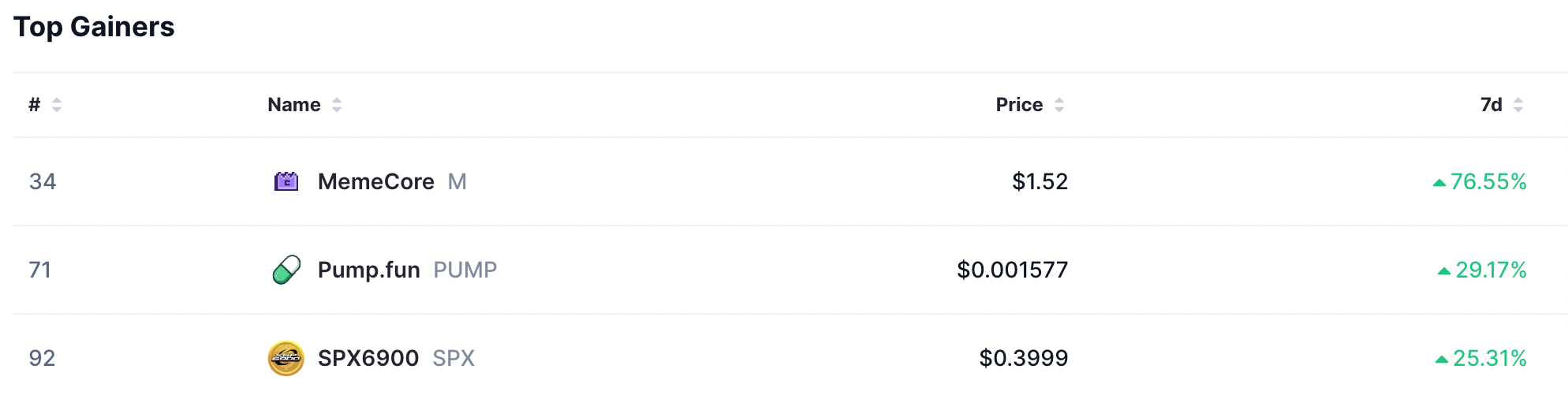
- MemeCore (M) – staged an impressive rally, skyrocketing by 76.55% over the course of the week to trade at $1.52;
- Pump.fun (PUMP) – gained substantial traction during this period, advancing 29.17% to reach a price of $0.001577;
- SPX6900 (SPX) – booked notable upward momentum, climbing 25.31% over the last seven days to push its value to $0.3399.
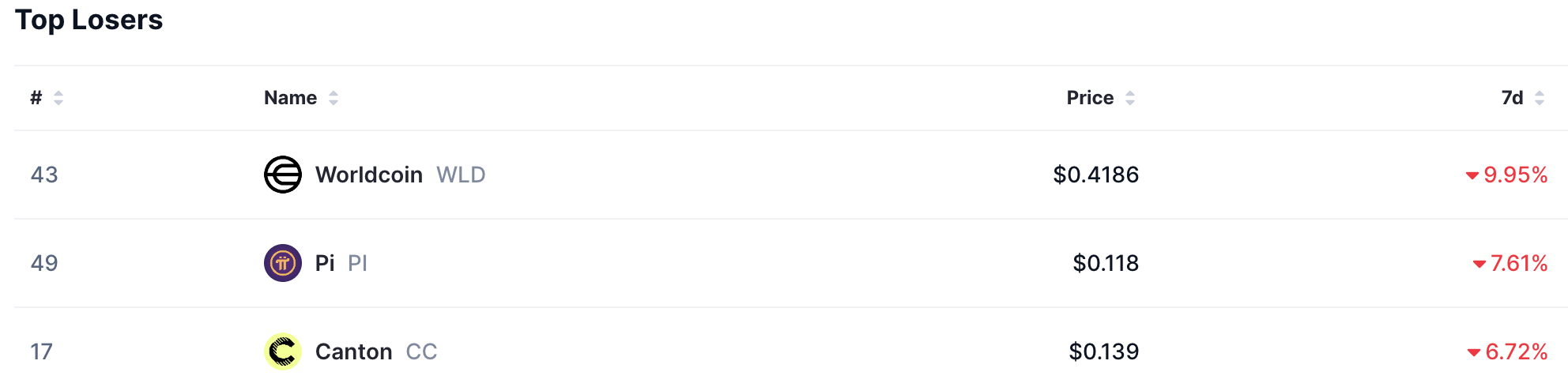
- Worldcoin (WLD) – experienced a steady pullback, dipping 9.95% throughout the week to end at a price of $0.4186;
- Pi (PI) – encountered downward pressure over the seven-day stretch, losing 7.61% of its value to close at $0.118;
- Canton (CC) – slid backward to round out the period, posting a 6.72% decline and settling at $0.139.
Hollywood director jailed for gambling Netflix funds on Dogecoin
Carl Erik Rinsch, the director of the 2013 Keanu Reeves film "47 Ronin," was sentenced Monday to 30 months in federal prison for defrauding Netflix out of $11 million, money he lost on speculative options trades before turning a Dogecoin bet into a $27 million windfall he spent on Rolls-Royces and luxury goods.
Director sentenced for production fraud: “Carl Erik Rinsch promised to make a television show,” said U.S. Attorney Jay Clayton. “Instead, he used $11 million meant for production as his personal casino and luxury fund.”https://t.co/5XHj1gWFyi
— US Attorney SDNY (@SDNYnews) June 29, 2026
US District Judge Jed Rakoff also imposed three years of supervised release and ordered $11 million in restitution. Netflix had paid Rinsch's production company more than $44 million to produce a sci-fi series called "White Horse," later retitled "Conquest." In 2020, he requested an additional $11 million to complete the project. Prosecutors said he moved most of that money into a personal brokerage account and never delivered the show.
Rinsch lost $5.9 million within weeks on speculative options, including pandemic-era bets on a COVID drugmaker and a market crash. He then transferred more than $4 million to crypto exchange Kraken and purchased Dogecoin. As the meme coin surged in 2021, he cashed out nearly $27 million. "Thank you and god bless crypto," he wrote to a Kraken representative at the time, per a 2023 New York Times report.
The windfall funded a spending spree that included five Rolls-Royces, a Ferrari, a $388,000 Vacheron Constantin watch, and roughly $8.7 million in furniture, antiques, and designer clothing, according to a forensic accountant hired by his ex-wife. Rather than return the money, Rinsch sued Netflix for more than $14 million he claimed he was owed. An arbitrator ruled against him.
A Manhattan jury convicted Rinsch in December on wire fraud, money laundering, and five counts of transacting with illicitly obtained property. He faced up to 90 years. Prosecutors sought five. Rakoff imposed a lighter term after the defense presented evidence of an untreated mental health condition, with family members, friends, and former colleagues describing a marked change in behavior starting around 2019. Reeves, who also produced the series, sent a letter to the court urging leniency.
Rakoff was unmoved on the underlying conduct. US Attorney Jay Clayton, the former SEC chair, said Rinsch "made risky bets on highly speculative stock options and cryptocurrency," and that the sentence "sends a deterrent message."
Ukraine puts seized $8.3M in USDT under state control
Ukraine transferred more than $8.3 million in seized Tether to a government-controlled wallet, marking the first time the country has moved confiscated digital assets into active state management.
The National Agency for Finding, Tracing, and Management of Assets, known as ARMA, received the funds from wallets tied to an alleged member of an international hacking group. The holding, valued at over 372 million Ukrainian hryvnias at the time of transfer, came from a case involving a network that prosecutors say attacked individuals and companies across Europe and the United States.
Investigators said the group stole confidential data, demanded ransoms, and laundered proceeds in Ukraine through real estate and vehicles. Authorities estimate the network caused more than $100 million in total damage. Four suspects, including the alleged organizer, remain in custody. Total seizures in the case exceeded $11.1 million, covering homes, apartments, vehicles, and cash.
Until now, crypto seized in Ukrainian cases sat frozen with no agency actively holding or moving the funds. The transfer gives ARMA direct control of the wallet. A 2025 reform law overhauled how ARMA manages seized property, adding independent audits and tighter oversight as a condition of hundreds of millions of euros in European Union support.
The step stops short of confiscation, which requires a court conviction. Ukraine has not said whether it will sell the USDT or hold it.
Yield-bearing stablecoin supply falls $3.5B in Q2 2026
Yield-bearing stablecoin supply fell by more than $3.5 billion in the second quarter of 2026, reversing nearly three years of consecutive quarterly growth, according to a Thursday report from crypto exchange CEX.IO.
The category declined by 15% during Q2. Ethena's sUSDe lost 52% of its supply, shedding nearly $2 billion, while Sky's sUSDS fell by 16%. Treasury-backed products moved in the opposite direction. Ondo Finance's USDY rose by over 66%, Circle's USYC increased by nearly 16%, and BlackRock's BUIDL grew by 2%, widening the gap between crypto-native yield assets and products backed by traditional finance instruments.
The broader stablecoin market recorded its first quarterly contraction since Q3 2023. Total supply fell to $312 billion in Q2, while adjusted transaction volume declined by 5.5%. Total stablecoin transaction counts fell by 530 million to 4.48 billion, which CEX.IO described as the largest quarterly decline on record. Transfers below $250 increased by 5% to $19.39 billion, suggesting smaller peer-to-peer payments held up better than larger automated flows.
The Q2 drop reverses a strong start to 2026. In Q1, stablecoin supply grew by approximately $8 billion to a record $315 billion. Early warning signs had already appeared: retail-sized transfers fell by 16% in Q1 and automated activity accounted for roughly 76% of transaction volume.
Tanay Ved, senior research associate at institutional data provider Talos, told Cointelegraph that a recovery in stablecoin supply would signal "fresh capital coming back into the ecosystem more broadly" and help support onchain liquidity. Ved said spot ETF flows remain the most important demand channel to watch because they tend to reflect more durable shifts in institutional appetite.
Kalshi and Polymarket hit $44.8B in June volume
Kalshi and Polymarket recorded $44.8 billion in combined monthly trading volume in June, a 75% jump from May's $25.66 billion, according to The Block's data, as the FIFA World Cup drove a wave of new bets across both platforms.
Kalshi saw the largest month-over-month gain, with volume rising 87.4% to $31.5 billion from $16.81 billion. Polymarket's main non-US platform drew $10.26 billion, up 45% from $7.08 billion in May. Polymarket US, the regulated domestic platform, reported $3.04 billion, up from $1.77 billion the prior month.
The World Cup, which kicked off on June 11, was the primary catalyst. Kalshi's FIFA World Cup Winner market has drawn more than $832 million in bets, with approximately 35% of volume backing France. Individual game contracts on Polymarket attracted between $500,000 and $2 million per match. The tournament is scheduled to conclude on July 19.
The volume surge arrives alongside active legal pressure on both platforms. More than a dozen state authorities have taken action against Kalshi and Polymarket, accusing them of operating unlicensed sports betting. Both platforms, alongside the Commodity Futures Trading Commission, argue federal regulation governs their sports-related markets and overrides state jurisdiction.
 Kristian Koch
Disclaimer: All materials on this site are for informational purposes only. None of the material should be interpreted as investment advice. Please note that, despite the nature of much of the material created and hosted on this website, HODL FM operates as a media and informational platform, not a provider of financial advisory services. The opinions of authors and other contributors are their own and should not be taken as financial advice. If you require advice, HODL FM strongly recommends contacting a qualified industry professional.