



Robinhood reported first-quarter 2026 results with revenue growth and rising user activity, yet a sharp decline in its crypto business weighed on overall performance and investor sentiment.
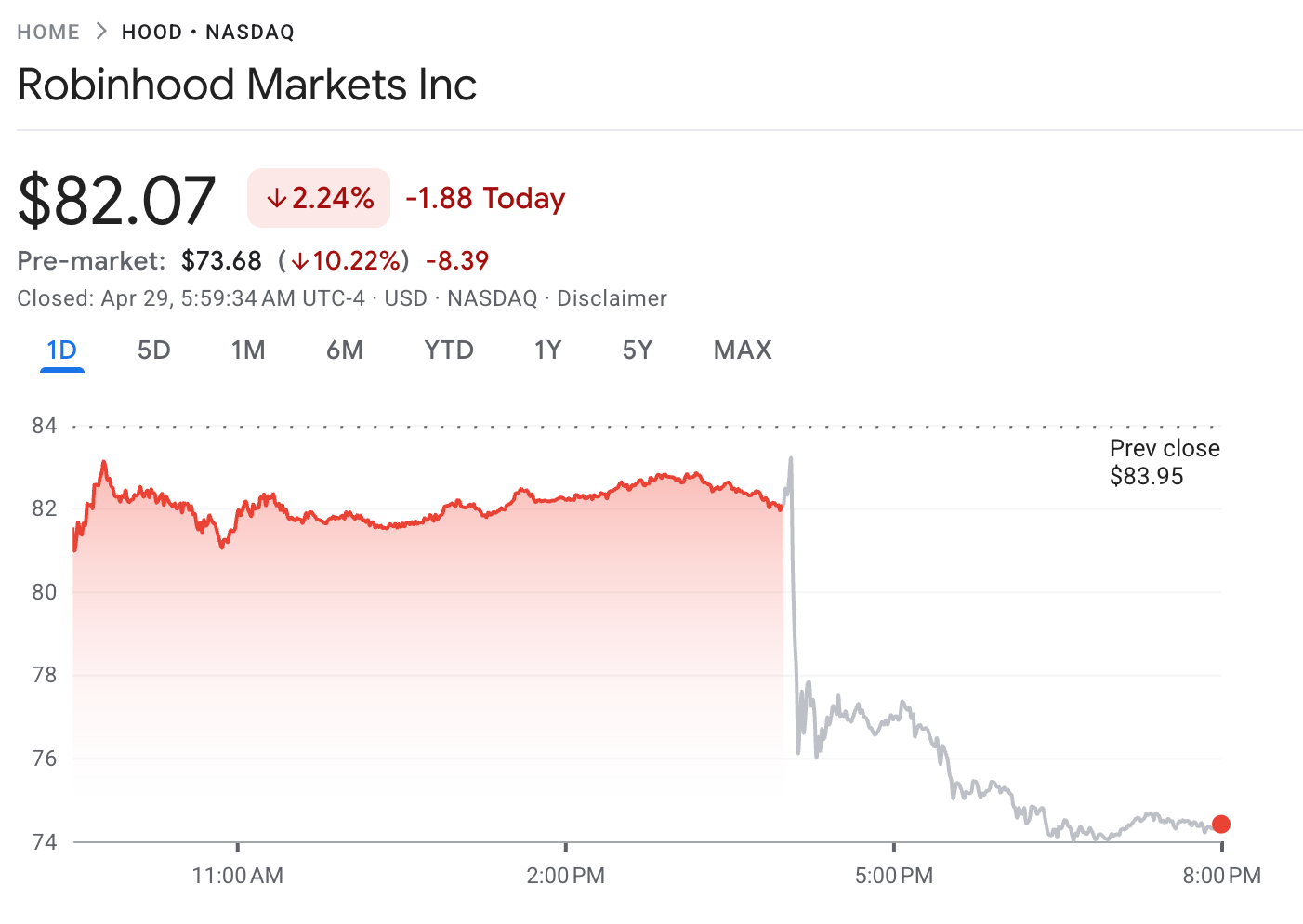
The company recorded $1.07 billion in total net revenue, a 15% increase year over year. Net income reached $346 million, while diluted earnings per share stood at $0.38, up 3% compared with the same period last year. Despite these gains, the results fell short of expectations, which contributed to a drop in Robinhood shares in after-hours trading, according to Google Finance data.
Transaction-based revenue rose 7% to $623 million. Growth came from equities and options trading, along with a surge in event contract activity. Revenue from event contracts reached $147 million, a 320% increase, which indicates strong adoption of prediction markets. Equities revenue rose 46% to $82 million, while options revenue increased 8% to $260 million.
Crypto revenue moved in the opposite direction. The company reported $134 million in crypto transaction revenue, a 47% decline from the previous year. Trading volume in crypto also dropped, with Robinhood App volumes falling 48% to $24 billion.
Robinhood Markets has just released financial results for the first quarter of 2026.
— Robinhood (@RobinhoodApp) April 28, 2026
Check out the highlights from @vladtenev below, and catch our earnings call live at: https://t.co/OchQ0srrMI pic.twitter.com/Ncvq4S8h9c
Leadership points to long-term crypto strategy
Robinhood CEO Vladimir Tenev addressed the decline in digital asset activity and linked it to broader market conditions.
“Price moves up and down, but what I can tell you is crypto as technology infrastructure is going to be big, and we’re investing,” he said. He added: “We’re at the very beginning of what’s going to be a tokenization supercycle.”
The company has shifted attention toward infrastructure and product development rather than short-term trading gains. This approach includes expanding blockchain-based services and integrating assets tied to real-world applications.
Crypto weakness has now extended across multiple quarters. Transaction-based crypto revenue has declined for three consecutive periods, according to company disclosures.
Prediction markets and new products drive engagement
While crypto activity slowed, other parts of the platform showed strong engagement. Robinhood Predictions, a platform powered through its partnership with Kalshi, recorded its strongest quarter to date.
Users traded 8.8 billion event contracts during the quarter. This marked a 780% increase compared with the platform’s early phase in 2025. The company expects about $3 billion in trading volume for April, which would rank among its highest monthly figures.
The surge in prediction markets contributed to the growth of the “other” revenue category. That segment offset part of the decline in crypto income and highlighted a shift in user behavior toward alternative trading products.
Robinhood also expanded its ecosystem with new features. The company rolled out Cortex Assistant, an AI-powered tool designed to deliver real-time insights. It also launched a social trading beta for a limited group of users, which introduces verified trades and community interaction within the app.
Deposits and subscriptions reach new highs
Customer growth and deposits continued to rise. Funded customers reached 27.4 million, an increase of 1.7 million year over year. Total platform assets climbed 39% to $307 billion.
Net deposits totaled $17.7 billion during the quarter, representing a 22% annualized growth rate. Over the past 12 months, net deposits reached $67.8 billion.
Subscription growth also stood out. Robinhood Gold subscribers increased 36% to 4.3 million, generating $50 million in revenue. Average revenue per user rose 8% to $157.
The company reported $5 billion in cash and cash equivalents at the end of the quarter. It also repurchased $250 million worth of shares, part of a broader $1.5 billion buyback program authorized earlier this year.
Expansion plans increase cost outlook
Robinhood raised its expense outlook for 2026. The company now expects adjusted operating expenses and share-based compensation to range between $2.7 billion and $2.825 billion.
The increase includes an additional $100 million investment tied to the development of Trump Accounts. These accounts, structured as child-focused investment vehicles, will include a government contribution and allow annual deposits from families.
Robinhood will serve as broker and initial trustee for these accounts, working with BNY to manage custody and infrastructure.
Broader strategy targets global expansion
The company continues to position itself as a global financial platform. It secured in-principle approval from the Monetary Authority of Singapore to expand brokerage services in the region.
Robinhood has also launched a public testnet for its Ethereum Layer 2 network, designed to support tokenized real-world assets. The system has processed more than 100 million transactions to date.
Meanwhile, its banking and advisory products continue to grow. Robinhood Banking surpassed $2 billion in deposits, while its managed investment service reached $1.6 billion in assets under management.
Market reaction shows a mixed outlook
Robinhood shares declined after the earnings release, due to concerns over slowing growth in key segments. The company has delivered strong stock performance over the past year, but volatility has increased in recent months.
Crypto remains a significant variable. Trading activity has fallen alongside broader market declines, with digital asset prices below previous highs. Robinhood’s strategy now leans on diversification across products such as options, prediction markets, and AI-driven tools.
The quarter highlights a transition phase. Core metrics such as deposits, subscriptions, and platform assets continue to grow. At the same time, crypto revenue has lost momentum, which has reshaped the company’s near-term outlook.
 Gunel Ismayilova
Disclaimer: All materials on this site are for informational purposes only. None of the material should be interpreted as investment advice. Please note that, despite the nature of much of the material created and hosted on this website, HODL FM operates as a media and informational platform, not a provider of financial advisory services. The opinions of authors and other contributors are their own and should not be taken as financial advice. If you require advice, HODL FM strongly recommends contacting a qualified industry professional.