






Bitcoin flows into Binance have stayed elevated for nearly 10 consecutive days, a pattern that has drawn attention across the market during a period of weak price momentum and cautious sentiment. Data shared by CryptoQuant analyst Darkfost shows a sharp rise in exchange inflows, alongside broader signals that point to reduced demand from key channels.
Darkfost reported that the weekly average of Bitcoin inflows to Binance rose from 378 BTC on May 16 to 1,190 BTC within less than 10 days. The shift marks a more than threefold increase in a short window. On May 18, the exchange recorded a single-day inflow above 3,600 BTC, one of the largest daily spikes in recent weeks.
Inflows have remained consistently higher than outflows since mid-May. The trend has pushed Binance’s Bitcoin reserves higher. Holdings on the exchange climbed from 616,000 BTC on April 24 to around 632,000 BTC, an increase of 16,000 BTC over one month.
🔴 Bitcoin inflows on Binance haven't stopped in 10 Days
— Darkfost (@Darkfost_Coc) May 25, 2026
The market remains in a correction driven by tense geopolitical conditions affecting economies worldwide, making it particularly difficult for risk assets to navigate in this environment.
💥 In this context, for nearly 10… pic.twitter.com/VztQF96fMQ
Exchange flows point to potential sell pressure
Sustained inflows to centralized exchanges often attract attention because they can indicate intent to sell. Traders typically move assets to exchanges when they plan to take profit, reduce exposure, or shift into a more defensive position.
Darkfost connected the current inflow streak to a broader market correction tied to geopolitical tension and reduced appetite for risk assets. Bitcoin recorded a drop of as much as 6.2% during the same period, which aligns with the rise in exchange balances.
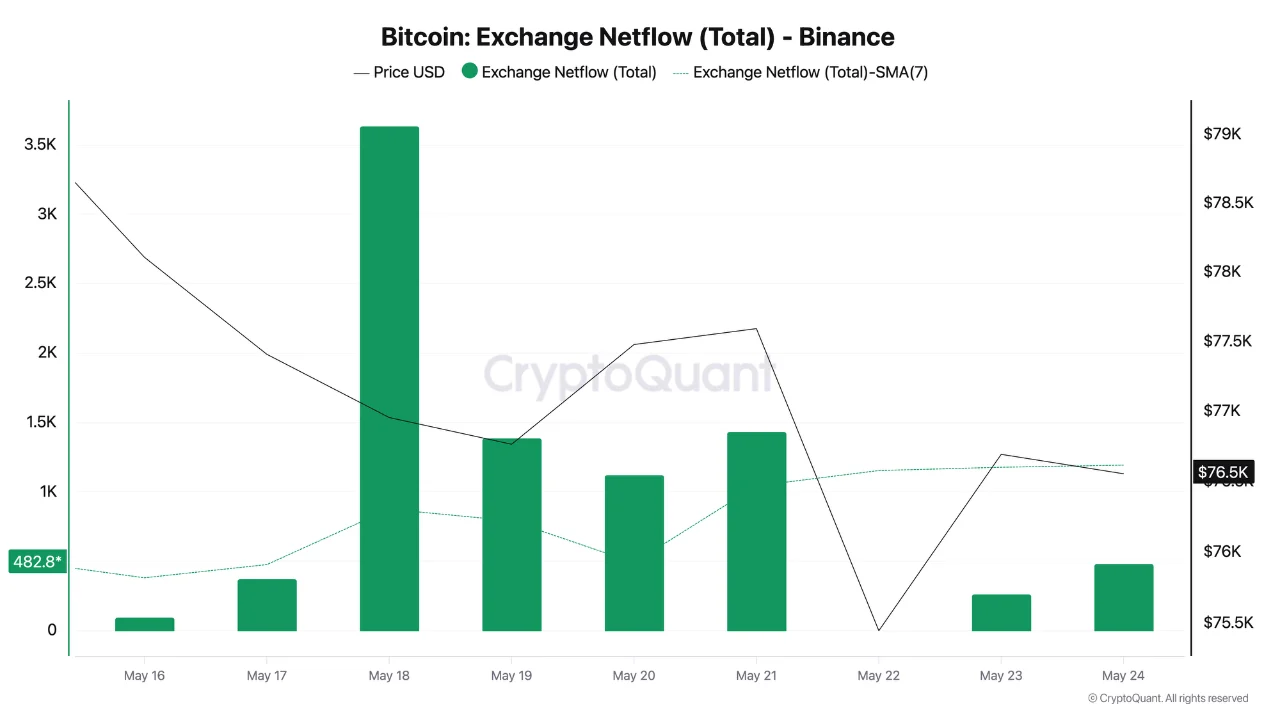
The data does not confirm that all incoming Bitcoin will enter the market as sell orders. It does show that a larger share of supply now sits on a major trading venue during a fragile phase for price action. This shift matters because liquidity conditions can change quickly when coins move from cold storage or long-term holdings to exchanges.
CryptoQuant analyst CryptoOnchain reported that Binance netflows surged by 425% in the same period. The update also noted that older coins returned to exchanges, a pattern that can reflect repositioning among longer-term holders.
ETF outflows add to pressure on demand
At the same time, spot Bitcoin exchange-traded funds in the United States recorded consistent outflows. According to SoSoValue data, 11 U.S.-listed spots Bitcoin ETFs saw net redemptions for six straight sessions from May 15 through May 22. Total outflows reached $1.26 billion across those sessions.
This trend removes a visible source of spot demand at a time when exchange inflows increase. The combination creates a mixed but cautious market structure. Coins move toward exchanges while institutional demand through ETFs weakens.
ETF outflows do not always signal deeper market stress. Past episodes have coincided with periods when long-term buyers returned to accumulate. The current streak still reduces immediate buying pressure in the spot market.
Price holds range while momentum stays neutral
Bitcoin traded near $77,537 at the time of reporting, with a daily gain of 0.54%, according to HODLFM data. The asset stayed within a 24-hour range between $76,053 and $77,407. Market capitalization stood near $1.55 trillion, with daily trading volume around $22 billion, according to CoinMarketCap data.
Technical indicators reflect a neutral stance with a slight bearish tilt. The price remains below the 20-day Bollinger Band midline near $78,877. This level acts as short-term resistance. The lower band near $75K marks a key support zone, while the upper band near $82,751 defines the next resistance area if momentum improves.
The relative strength index sits near 52. This reading places momentum in neutral territory, with pressure leaning slightly to the downside. Volume remains limited, which suggests that recent price moves lack strong participation.
A move above $78,800 would strengthen the short-term structure. A break below $75,000 would expose the market to renewed downside pressure.
Conflicting signals keep outlook uncertain
Other market indicators present a mixed picture. Data referenced by CryptoQuant shows that funding rates have returned to positive levels. This suggests that retail traders maintain long exposure. Elevated leverage without strong spot demand can increase risk if prices move lower.
XWIN Japan reported that the Coinbase Premium has turned deeply negative, a metric often used to track U.S. institutional demand. A negative reading can indicate weaker buying interest from that segment.
At the same time, Titan of Crypto pointed to a longer-term technical signal. He said Bitcoin’s monthly logarithmic MACD histogram remains a key indicator. He added that the signal remains unconfirmed until the monthly candle closes.
#Bitcoin Pattern worth watching 👀
— Titan of Crypto (@Washigorira) May 24, 2026
Historically, #BTC’s bottom formed after 2 consecutive lighter red bars on the monthly logarithmic MACD histogram.
May hasn’t closed yet.
If history rhymes, the worst of the downside may already be behind us. pic.twitter.com/iHaTn6VRQa
Macro events shape short-term direction
Macro conditions continue to influence sentiment across crypto markets. Crypto.news reported that traders are watching developments tied to a potential U.S.-Iran agreement, along with upcoming U.S. economic data. April PCE inflation figures, first-quarter GDP, and consumer confidence readings remain in focus.
These factors contribute to a cautious environment where both risk appetite and liquidity remain uncertain. Exchange inflows and ETF outflows highlight pressure points in the current structure, while technical signals leave room for either continuation or reversal.
For now, Bitcoin sits between competing forces. Rising supply on exchanges suggests possible selling activity, while longer-term indicators keep the possibility of stabilization in view.
 Gunel Ismayilova
Disclaimer: All materials on this site are for informational purposes only. None of the material should be interpreted as investment advice. Please note that, despite the nature of much of the material created and hosted on this website, HODL FM operates as a media and informational platform, not a provider of financial advisory services. The opinions of authors and other contributors are their own and should not be taken as financial advice. If you require advice, HODL FM strongly recommends contacting a qualified industry professional.