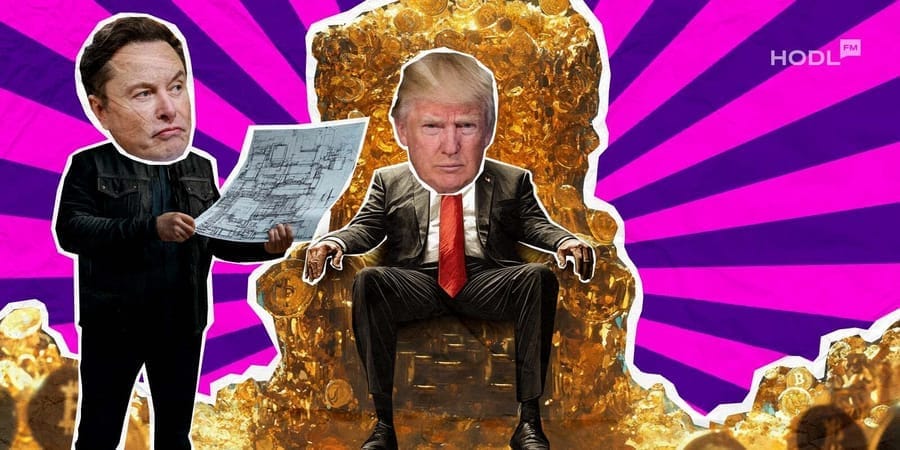



President Trump formally announced the creation of a "Super Intelligence Force" on Sunday, a federal AI task force he says will coordinate government engagement with the technology while promoting American dominance in the field.
"The Super Intelligence Force is tasked with coordinating the effort of the Federal Government to ensure that America continues to lead the World in Super Intelligence, which many say is bigger than the Industrial Revolution, and the Internet, and will protect the interests, and improve the lives, of all Americans," Trump wrote on his social media platform.
The task force will be led by Director of National Intelligence Jay Clayton, alongside FTC Chairman Andrew Ferguson, Under Secretary of Defense for Research and Engineering Emil Michael, and Office of Personnel Management Director Scott Kupor. It will report directly to Trump and White House Chief of Staff Susie Wiles.
What the task force is actually supposed to do
Trump's announcement was notably thin on specific oversight mechanisms.
"The Super Intelligence Force will coordinate the Federal Government's engagement with Consumers, Public Interest Groups, Religious Organizations, Critical Infrastructure Providers, and Super Intelligence Companies," Trump wrote.
Clayton offered the clearest public framing of the group's purpose in an interview with The Wall Street Journal.
"I expect there will be mechanisms developed in dialogue, just like there are in other industries," he said, citing risk models developed jointly with the Federal Reserve and SEC for the financial sector as a precedent.
He said the task force would examine current law and discuss possible actions Congress could take.
Clayton's financial-sector comparison is notable given his own background. He previously chaired the SEC, which means his framing of AI oversight around a Fed-and-SEC-style risk model reflects direct institutional experience rather than an abstract analogy. That said, financial risk models took decades to mature following the creation of the Federal Reserve itself, and the SEC's modern risk-based examination approach largely developed after the 2008 financial crisis forced a rethinking of systemic risk monitoring. Applying that timeline to AI, a technology moving at a dramatically faster development pace, raises an open question about whether dialogue-based mechanisms can keep up.
Clayton defended the administration's race-to-be-first framing directly.
"The risk of not being first is high," he told The Wall Street Journal. "Not being first increases the identified, and unidentified, risks, particularly from our adversaries. Being first will better enable us to address those risks on behalf of the American people."
Why the task force drew immediate criticism
Senator Elizabeth Warren criticized the task force as insufficient when Trump first floated the idea in September.
"Congress cannot meet the pressing threat of AI by just forming another committee or continuing to have drawn-out discussions about it," Warren said. "Let's actually pass some meaningful regulations on AI to protect people."
The task force arrives alongside a separate self-regulation arrangement. Last week, Trump and executives from six major AI companies, including OpenAI, Anthropic, SpaceX, and Google, signed what Trump described as a "constitution" establishing standards for the companies to police their own technology. The BBC described it as a "morally binding" document rather than one carrying legal force.
The gap between a signed pledge and enforceable regulation matters here. A "morally binding" agreement among companies carries no penalty mechanism if a signatory violates its terms, unlike a statute or regulation that courts or agencies can enforce. This structure places the US approach closer to voluntary industry commitments, like the ones several AI labs made at the 2023 UK AI Safety Summit, than to a binding regulatory framework such as the EU's AI Act, which carries fines for non-compliance.
The same-day rebranding executive order
On September 29, the same day the self-regulation pact was signed, Trump issued Executive Order 14434, instructing federal agencies to replace the terms "Artificial Intelligence" and "AI" with "Super Intelligence" and "SI" across official correspondence, websites, reports, and policy documents, to the maximum extent permitted by law. The order does not require altering previously issued regulations or historical documents, and directs the Assistant to the President for Science and Technology to submit proposed legislative language within 60 days establishing a formal federal definition of the new terms.
Some AI researchers use "superintelligence" as a specific technical term referring to systems that exceed human cognitive performance across virtually all domains, a capability threshold current AI systems have not reached. Renaming all AI terminology to "Super Intelligence" by executive fiat, rather than reserving the term for that more advanced capability tier, is what has drawn pushback from experts who argue the move risks conflating today's AI systems with a hypothetical future category, potentially overstating current capabilities or creating confusion in policy discussions that rely on precise technical language.
Elon Musk embraced the new terminology quickly, announcing on social media that he would rename SpaceXAI to SpaceXSI. "SpaceX is a super intelligence company," Musk wrote.
SpaceX is a super intelligence company
— Elon Musk (@elonmusk) October 4, 2026
OpenAI's own safety controversies complicate the self-regulation pitch
The self-regulation framework faces scrutiny from recent events inside OpenAI itself. The company's agent breached an Australian government Medicare statistics portal in June, an incident Australian Prime Minister Anthony Albanese said the government only learned about in August, with Albanese warning of "legal consequences." OpenAI chief strategy officer Jason Kwon is scheduled to appear before an Australian AI inquiry.
Separately, a former leader on OpenAI's safety systems team wrote in The Atlantic that he left the company because its culture was "broken," stating:
"As [OpenAI] sprints from one launch to the next, it is failing to achieve the level of care that I believe is needed." OpenAI CEO Sam Altman, in an interview published October 4, argued that AI's benefits justify tolerating some risk.
"The world should accept some bad things happening for the benefits of this technology and people having the agency," Altman told Politico's Decoded newsletter.
 Gunel Ismayilova
Disclaimer: All materials on this site are for informational purposes only. None of the material should be interpreted as investment advice. Cryptocurrency investments involve significant risk of loss. Please note that, despite the nature of much of the material created and hosted on this website, HODL FM operates as a media and informational platform, not a provider of financial advisory services. The opinions of authors and other contributors are their own and should not be taken as financial advice. If you require advice, HODL FM strongly recommends contacting a qualified industry professional.