


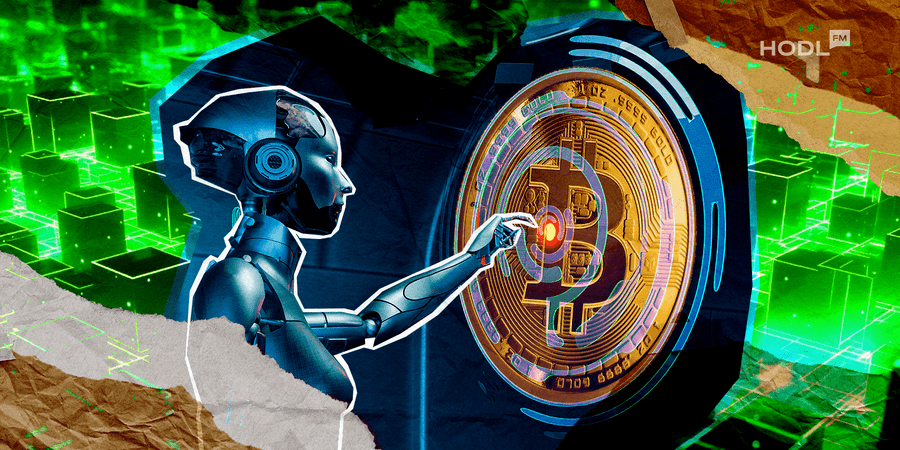



BlackRock published a research paper titled "The Machine-Native Economy" the week of September 22, arguing that AI represents machine-native intelligence while digital assets represent machine-native money, a pairing the firm says will drive increasing convergence as autonomous AI agents take on more real-world economic activity.
"AI is machine-native intelligence and crypto is machine-native money. Both AI and digital assets translate real-world inputs into formats machines can use," BlackRock wrote on X.
Fundstrat's Tom Lee responded to the framing directly, reversing the usual emphasis on autonomy.
"Crypto is central to keeping humans in the loop on AI," Lee wrote.
Crypto is central to keeping humans in the loop on AI https://t.co/kMmisTASIZ
— Thomas (Tom) Lee (not drummer) FundstratDirect.com (@fundstrat) September 29, 2026
What the tokenization comparison actually claims
The paper's central argument rests on a structural parallel: large language models divide text into tokens and encode them numerically for processing, while blockchains represent economic value and ownership as digital tokens designed for machine-verifiable transfer. Authors Will Su, Robert Mitchnick, Jay Jacobs, and William Helm wrote that "AI and digital asset tokenization convert real-world inputs into machine-native representations," positioning both systems as solving a similar translation problem for different domains.
BlackRock cited Bitcoin Policy Institute research testing what payment preferences AI models express in simulated scenarios, finding that model outputs generally favored stablecoins for everyday payments and bitcoin for long-term value storage. The paper was careful to frame this as "simulated model responses rather than observed agent behavior," a distinction that separates theoretical model preference from confirmed transaction patterns in production systems.
Why existing payment rails fall short for agents
The paper lists specific structural limits in ACH and card networks: account setup and credentialing often require human involvement, merchant fees make very low-value transactions uneconomic, and settlement times vary, with ACH volume typically settling within one business day while card dispute finality can extend further. Against those constraints, the authors wrote that "several types of digital assets may support agentic commerce, but stablecoins are likely to lead transactional use."
Stablecoins carried more than $300 billion in circulating market capitalization as of September 2026, with adjusted transaction volume exceeding $11 trillion in 2025, a figure BlackRock places in the same broad range as Visa and Mastercard's annual payment volumes. That volume grew at an 80% compound annual rate from 2020 to 2025, compared to roughly 8.5% for ACH over the same period.
Compute as a new asset class agents can trade
The paper's second major thesis treats computing capacity itself as an emerging investable resource. Combined revenue estimates for AWS, Microsoft's Intelligent Cloud, and Google Cloud imply approximately $1.1 trillion by 2030, a 29% compound annual growth rate from 2025 levels, according to Bloomberg-compiled analyst estimates cited in the report.
Ecosystem projects have already begun building toward this thesis directly. vAPI Network, among others building compute marketplace infrastructure, aligns with the paper's vision of agents that discover, provision, and pay for compute through programmable rails like x402, querying real-time marketplace APIs to compare capacity by price, performance, and location before provisioning resources autonomously.
BlackRock pointed to Stripe's August 2026 agreement to acquire OpenRouter, a platform distributing AI workloads across more than 400 models from over 80 providers, as an early signal that compute-usage optimization is becoming embedded financial infrastructure rather than a separate technical layer. Given Stripe's existing footprint across payments and stablecoins, the authors wrote this "points to a potential convergence between compute procurement, usage-based billing, and programmable settlement."
Where blockchain settlement fits into the compute thesis
The paper described agentic payment protocols building on MCP, introduced by Anthropic in 2024, and A2A, launched by Google in 2025, as the coordination layer that connects agents to tools and to each other. On top of those, Coinbase's x402 protocol handles machine-initiated payment settlement using the HTTP 402 status code, described in the paper as blockchain-agnostic with stablecoins as an early primary use case.
BlackRock's illustrative diagrams show agents settling compute payments through protocols like x402 across supported networks including Solana, alongside Ethereum-based settlement, pointing to the paper's broader point that stablecoin issuance and settlement now spans multiple blockchain architectures rather than concentrating on a single chain.
McKinsey data cited in the paper projects AI inference will become the largest AI workload by 2030, driven by an enterprise and consumer user base the authors describe as considerably larger and more fragmented than the concentrated set of AI training market participants. That inference demand, the paper argues, is what will eventually require the elastic, just-in-time compute access that tokenized capacity claims are designed to support.
BlackRock characterized the overall ecosystem as still nascent, with agentic payment activity and compute-market liquidity both limited today, while positioning digital assets as increasingly integral infrastructure as AI adoption broadens.
 Tanya Petrusenko
Disclaimer: All materials on this site are for informational purposes only. None of the material should be interpreted as investment advice. Please note that, despite the nature of much of the material created and hosted on this website, HODL FM operates as a media and informational platform, not a provider of financial advisory services. The opinions of authors and other contributors are their own and should not be taken as financial advice. If you require advice, HODL FM strongly recommends contacting a qualified industry professional.