



Meta introduced Muse Wonder and Muse Wonder Full on Monday, calling them its most capable models to date for personal and professional agent work. Mark Zuckerberg announced the release on X, writing that the models mark "a much larger and more advanced class of models that brings us to the frontier" compared to Muse Spark, the company's first model family under Meta Superintelligence Labs. "It's been just over a year since we started Meta Superintelligence Labs," he wrote, and added that both Muse Wonder and Muse Wonder Full are available now, with Muse Wonder reaching users through the Meta Model API and Muse Code, and Muse Wonder Full reserved for Muse Code subscribers.
It's been just over a year since we started Meta Superintelligence Labs. Muse Spark was our first family of models, and now Muse Wonder is a much larger and more advanced class of models that brings us to the frontier.
— Mark Zuckerberg (@finkd) October 12, 2026
We're releasing two models today. Muse Wonder for fast… pic.twitter.com/FyJJmXJzET
According to Meta's blog post, the models were trained at the company's "gigawatt-scale Prometheus data center" and build on the scaling approach Meta first laid out with Muse Spark, spanning both pretraining and reinforcement learning. Meta describes the release as "another step toward bringing personal superintelligence to the billions of people who use our products."
Memory and focus built into the model
Meta built two capabilities into Muse Wonder that it says set this family apart from earlier releases. The first, Active Memory, carries context about a user across conversations and retrieves relevant details when needed. The second, Active Focus, describes how the model works through a difficult task over time, tries different approaches when it hits a wall, adapts as new information comes in, and asks for clarification or confirmation before taking consequential actions.
Meta tested these abilities against benchmarks it built specifically for this purpose, including MemoryBench for long-term contextual memory, FocusBench for sustained task focus, and SWE-Marathon for long-running software engineering work. The company also measured domain-specific performance using external tools, including Harvey's Legal Agent Benchmark, which requires a model to work from source documents and follow detailed instructions to produce legal work product, and Vals Finance Agent V2 for financial reasoning tasks.
Meta Superintelligence Labs was formed in mid-2025 after Zuckerberg restructured the company's AI research units and brought in Scale AI founder Alexandr Wang to help lead the effort, following a period where Meta's Llama models had fallen behind rivals including OpenAI and Google on several public benchmarks. The Muse Wonder release is the clearest signal yet that the restructuring produced a model Meta considers competitive at the frontier, rather than a defensive catch-up release.
A focus on generalization, not just benchmark scores
Meta spent part of its announcement addressing a criticism that has followed large language model releases industry-wide, sometimes called "benchmaxxing," where a model scores well on public benchmarks without a matching gain in real-world versatility. To counter that, Meta compared Muse Wonder Full against Muse Spark 1.3 on tasks the models were not specifically trained for, plotting performance as reasoning effort scales up. Meta reported that Muse Wonder Full performs better on unfamiliar tasks than its in-distribution score would predict, which it attributes to building on a larger base model before post-training.
This kind of out-of-distribution testing has become more common since 2024, after several model providers faced public accusations of training on or near benchmark test sets, including disputes involving Chinese model makers and, separately, criticism aimed at some OpenAI release claims. Meta's decision to publish this comparison directly suggests the company anticipated similar scrutiny for Muse Wonder.
Safety claims center on private data and misuse
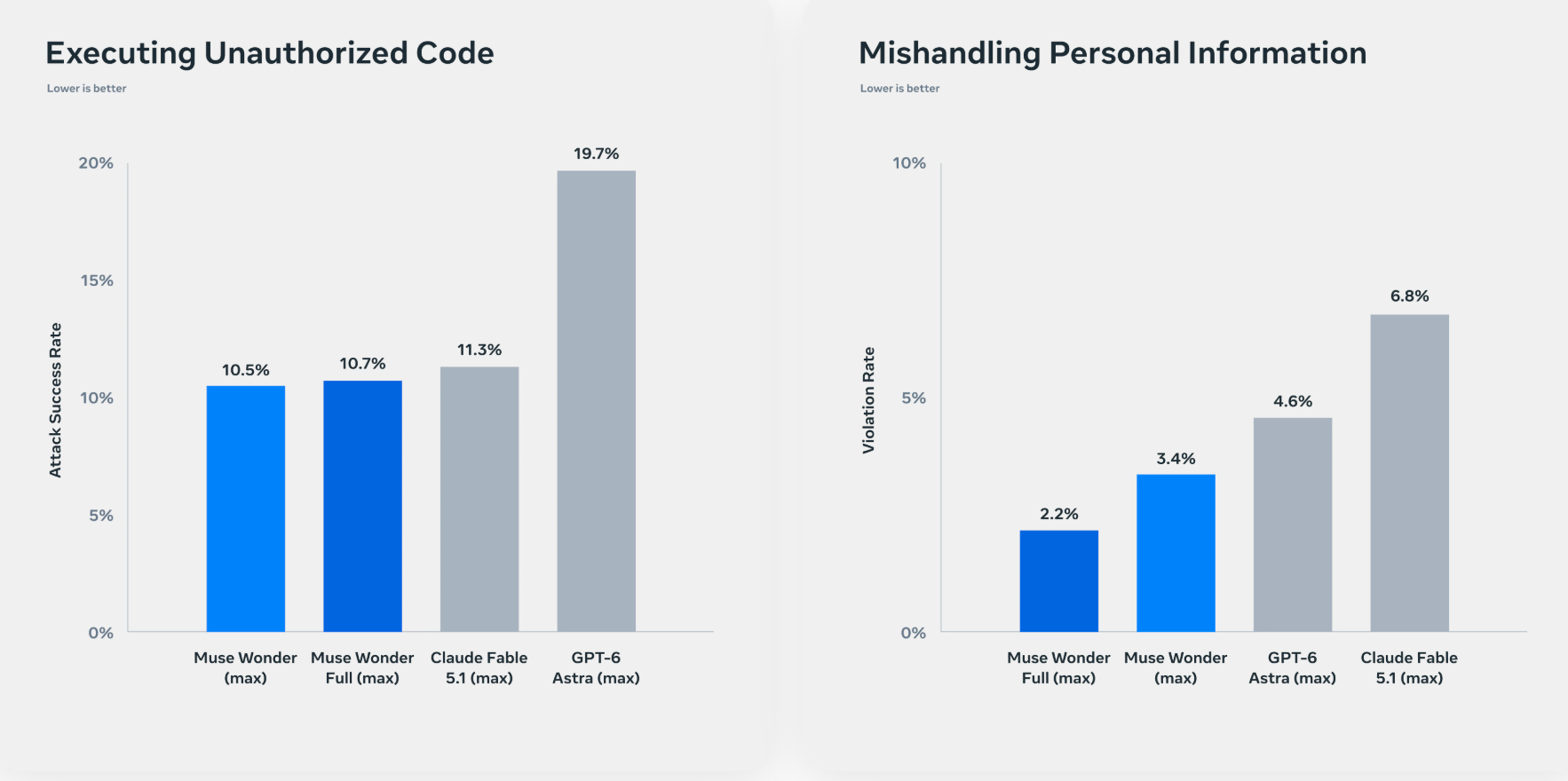
Because a personal agent may handle messages, calendars, and private documents, Meta said it trained Muse Wonder specifically to resist adversarial instructions and handle private information carefully. The company published benchmark results on unauthorized code execution attempts and personal-information handling violations, alongside refusal rates tied to biological risk and cyber misuse scenarios. Meta said the model offers "our strongest safeguards to date against CBRN (chemical, biological, radiological, and nuclear) and cyber misuse, while preserving access to frontier cyber capabilities for defensive use, per our Meta Superintelligence Scaling Framework."
Muse Wonder will roll out to Muse subscribers first before reaching wider users, and Meta said it plans to use the model to build specialized, lighter versions it can eventually bring to everyone on the platform. A fuller safety report is expected soon, according to the company's blog post.
 Matvii Diadkov
Disclaimer: All materials on this site are for informational purposes only. None of the material should be interpreted as investment advice. Cryptocurrency investments involve significant risk of loss. Please note that, despite the nature of much of the material created and hosted on this website, HODL FM operates as a media and informational platform, not a provider of financial advisory services. The opinions of authors and other contributors are their own and should not be taken as financial advice. If you require advice, HODL FM strongly recommends contacting a qualified industry professional.