


Some crypto exchanges come and go. Bitfinex has been around since 2012 and is still here. That longevity matters when choosing an exchange. This Bitfinex review covers how the platform works, what it costs, what the security situation actually looks like today, and whether it makes sense for your trading needs.
What is Bitfinex?
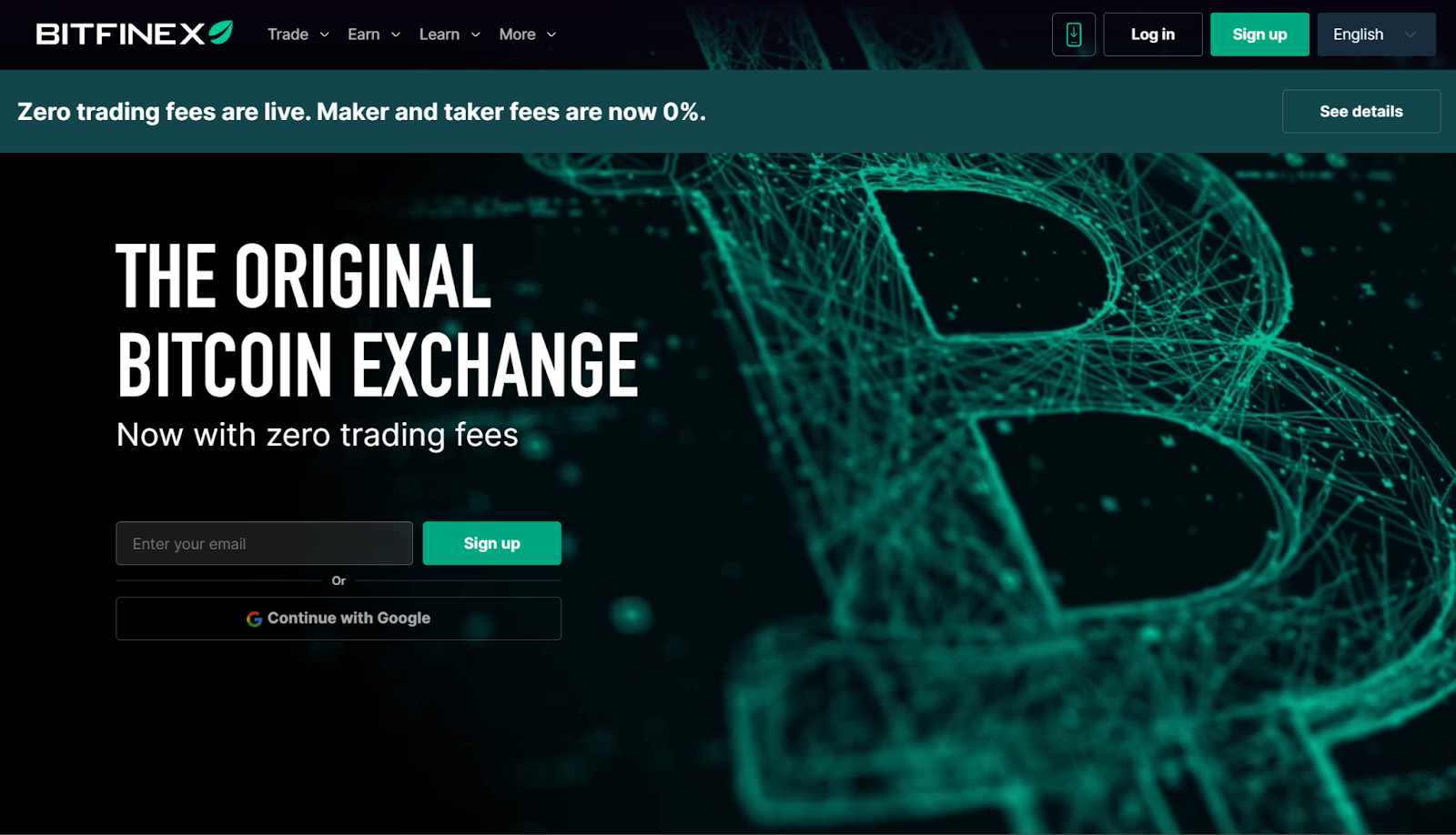
The Bitfinex exchange started in December 2012 as a peer-to-peer Bitcoin marketplace. Over time, it grew into a full trading platform with margin funding, derivatives, tokenized securities, and staking. It is owned and operated by iFinex Inc., the same company behind Tether (USDT).
It's not built for casual users. The interface is dense, the features are layered, and the whole platform assumes you already know what you're doing. The platform has around 1.6 million users and is available in over 180 countries. However, traders based in the US, UK, and Canada are blocked, based on Bitfinex’s securities terms of service
To open an account, you create a profile, verify your email, and activate two-factor authentication. For fiat deposits or withdrawals, identity verification is required, including a government-issued ID, proof of address, and a selfie.
Features of Bitfinex
Bitfinex offers a wider range of tools than most exchanges. The platform includes leveraged trading, derivatives, tokenized securities, and staking, all built around giving experienced traders full control. Here is what the platform actually includes.
Margin trading
Bitfinex uses a peer-to-peer model for margin funding. Users who want to lend their funds offer them to other traders who borrow to open leveraged positions. Borrowers can access up to 10x leverage through this system. Lenders set their own rates and earn interest on what they deploy.
Order types
For traders who think carefully about execution, Bitfinex offers a wide set of advanced order types that most retail platforms don't have. Fill or Kill, One-Cancels-the-Other, and Iceberg orders are all available.
Wallet structure
Bitfinex separates funds across five different wallet types: the Exchange Wallet for spot trading, the Funding Wallet for P2P lending, the Margin Wallet for leveraged positions, the Derivatives Wallet, and the Capital Raise Wallet used within Bitfinex Securities.
Staking
Bitfinex offers soft staking on a selection of supported tokens. Rewards are paid out weekly, and there is no lock-in period, meaning you can withdraw or trade your tokens at any time. That is meaningfully different from staking programs on other platforms that lock your funds for weeks at a time.
Paper trading
The paper trading feature lets you test strategies using real market data without putting actual money at risk. It mirrors the live order book and leverage levels. You can run multiple paper accounts at the same time. For anyone who wants to stress-test a strategy before going live, this is a genuinely useful tool.
Bitfinex securities
Bitfinex Securities is a regulated entity of the exchange that provides its users with the ability to purchase tokenized real-world assets. By the end of 2025, assets on the platform reached $250 million and included instruments such as US Treasury bills, Bitcoin mining hash power, and microfinance bonds. Bitfinex Securities is licensed and operates in El Salvador and Kazakhstan, becoming one of the rare crypto exchanges where there is a regulatory framework for tokenized assets trading.
Supported cryptocurrencies and markets
Bitfinex presently trades more than 250 different cryptocurrencies as well as more than 400 trading pairs. Some of these cryptocurrencies include Bitcoin, Ethereum, XRP, Solana, Litecoin, and Chainlink, while others include stablecoins such as USDT and USDC.
Bitcoin makes up about 50% of all volume traded on the platform. There is decent liquidity in major trading pairs, but the order book may lack liquidity when it comes to altcoins.
Bitfinex trading fees explained
And that is the crucial update to be noted here. Bitfinex made all its trades free of trading fees on December 17, 2025. This means both takers and makers can trade without paying any fee for their trades.
It is a global move by the company, not just a promotional offer. The official zero-fee FAQ section on the website clearly states that there is no volume limit set for it and no LEO holding required.
Before the change, standard fees were 0.1% for makers and 0.2% for takers. For active traders executing large volumes, the savings are significant.
Other fees that still apply:
- Crypto withdrawals: network fees apply depending on the blockchain used. The full schedule is on the fees page
- Fiat withdrawals: standard wire transfers cost 0.1% with a 5 to 10 business day processing time. Express wire transfers cost 1% and settle within 24 hours
- Margin funding: the platform takes a 15% cut of interest earned by lenders
On the LEO token: with trading fees now at zero, the LEO trading discount no longer applies. LEO holders still get reductions on margin funding fees and a limited number of fee-free fiat withdrawals each month. Full details are in the LEO benefits page.
Security and platform reputation
Bitfinex has a complicated security history. In 2015, around 1,500 BTC were taken from a hot wallet. The 2016 breach was far more serious, with approximately 120,000 BTC stolen. In response, Bitfinex reduced every user's balance by 36% to cover the loss and issued BFX tokens as compensation. All BFX holders were fully repaid by April 2017, within eight months of the hack.
On the legal side, January 2025 brought a notable development: a US federal court ruled that 94,643 BTC recovered from the 2016 hack must be returned to Bitfinex, confirming the exchange as the victim of the crime.
The regulatory picture is still thin. Bitfinex holds formal licenses only in El Salvador and Kazakhstan. It has paid $60 million in regulatory fines to the New York Attorney General and the CFTC. The long-running connection to Tether and the unresolved questions around that relationship continue to be a background concern for some traders.
Pros and cons of Bitfinex
No exchange is perfect, and Bitfinex is no exception. Here is a straightforward breakdown of where it stands.
Bitfinex alternatives
Bitfinex is not the right fit for everyone. If you are blocked by geography, prefer a simpler interface, or need stronger regulatory protection, there are solid options worth considering.
Binance vs Bitfinex: Binance has a larger asset selection and a more accessible interface for new traders. It still charges trading fees, though, which Bitfinex no longer does. A current fee comparison shows how wide that gap has become since December 2025. For anyone wanting more altcoin options or simpler onboarding, Binance is the stronger choice.
Coinbase vs. Bitfinex: Coinbase is completely licensed in America and has been designed for simplicity. You would find this exchange ideal if you’re an American citizen or need a platform that provides great customer protection. Bitfinex cannot be accessed by Americans, no matter what angle you take.
Kraken vs. Bitfinex: Unlike Coinbase, Kraken operates in both the American and British markets, holds a regulatory license in various regions, and even comes with some advanced features that Coinbase doesn’t provide.
Who should use Bitfinex?
Bitfinex suits traders who are already comfortable with how exchanges work and want access to serious execution tools. If you are running leveraged strategies, using the P2P lending market, or looking to access tokenized real-world assets, the platform has the depth to support that.
The paper trading feature ensures that those learning how to use complicated trading strategies can access the platform easily, but the platform itself isn’t focused on the beginner trader.
If you are based outside the US, UK, and Canada and want a professional-grade exchange that no longer charges trading fees, Bitfinex is a platform worth evaluating.
Final thoughts
Bitfinex has been through a lot. Two hacks, heavy regulatory fines, and years of controversy tied to Tether. What it has also done is recover, rebuild its security infrastructure, and in late 2025, permanently eliminate trading fees across every product on the platform.
It is currently the second-largest exchange by Bitcoin holdings, with around 403,000 BTC in custody. The toolset is professional-grade, and the platform has been operational for over a decade.
For traders in eligible countries who want deep liquidity and zero fee drag on their positions, Bitfinex remains one of the more capable options available in 2026. Go in knowing the history and the limitations, and it holds up well.
 Kataryna Dyl
Disclaimer: All materials on this site are for informational purposes only. None of the material should be interpreted as investment advice. Please note that, despite the nature of much of the material created and hosted on this website, HODL FM operates as a media and informational platform, not a provider of financial advisory services. The opinions of authors and other contributors are their own and should not be taken as financial advice. If you require advice, HODL FM strongly recommends contacting a qualified industry professional.