




Camelot is a decentralized cryptocurrency exchange built on the Arbitrum blockchain. It provides access to trading over 50 cryptocurrencies using a decentralized web platform for the entire ecosystem. With a minimum deposit of $1 and dynamic trading fees that remain competitive, Camelot is designed for users seeking income in the Arbitrum environment.
What is Camelot Exchange?
Launched in 2022, the platform focuses on providing liquidity for a wide range of crypto assets. Its primary trading instruments are cryptocurrency pairs supported by the V3 liquidity system, enabling users to efficiently manage capital and earn income by providing liquidity, farming, and staking using native tokens.
The central features of the Camelot ecosystem are two utility tokens: GRAIL and xGRAIL. The public token sale took place on November 29, 2022. Camelot GRAIL functions for trading and passive income. xGRAIL is a wrapped version that unlocks advanced features such as increased farming yields and early access to launch opportunities.
In addition to the DEX, Camelot also includes Launchpad, which helps projects in the Arbitrum ecosystem conduct public token sales and raise funds.
Tokens and tokenomics: GRAIL and xGRAIL
GRAIL serves as the primary token for trading and passive income. Meanwhile, Camelot xGRAIL is a wrapped version that unlocks advanced features, including increased yields from farming and early access to launch opportunities.
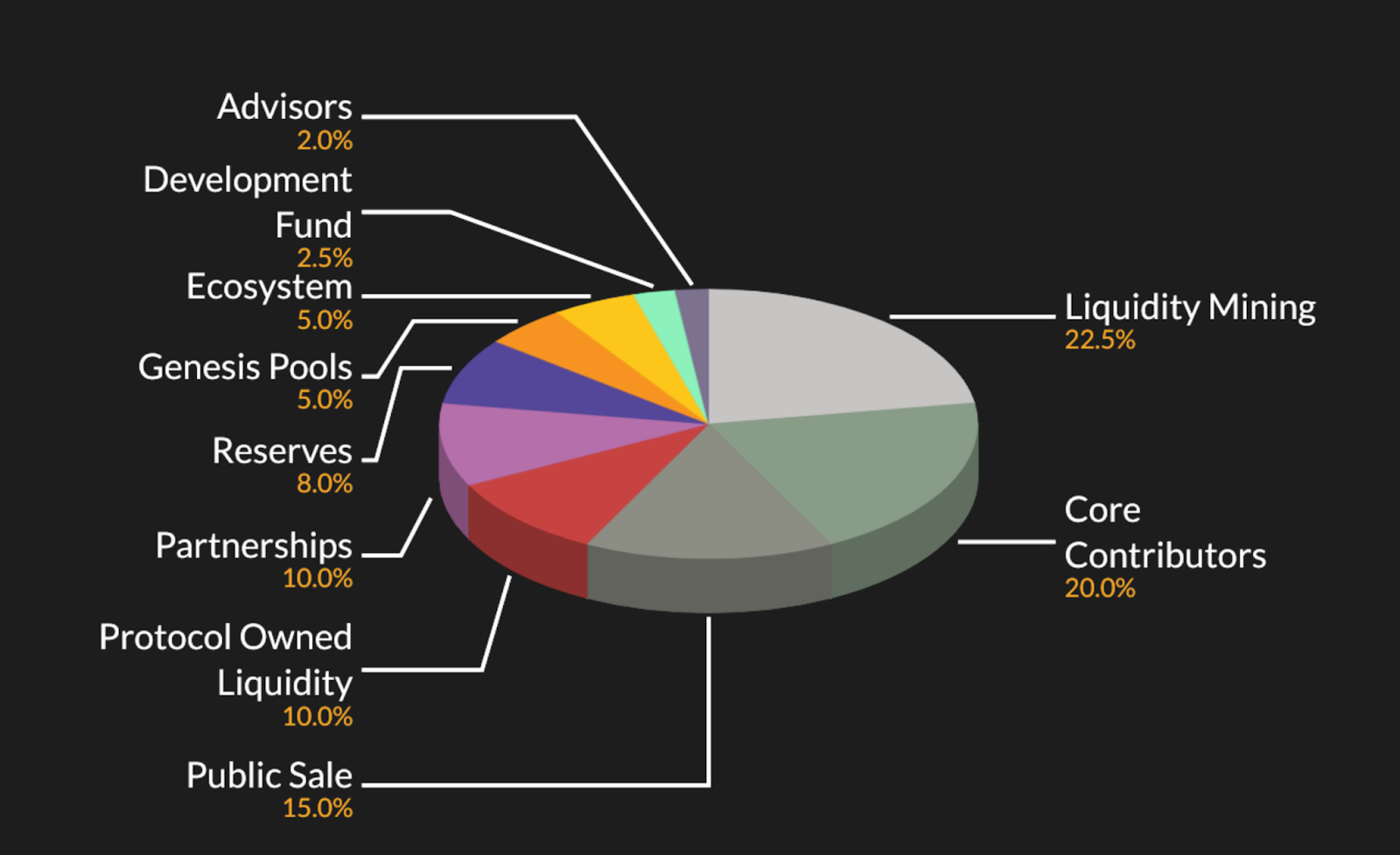
- 22.5% to Liquidity Mining over the next 3 years
- 20% to the Core Contributors vested linearly over 3 years
- 10% to Partnerships (6-months cliff and 2 years vesting)
- 8% to Reserves (pre-minted in a multisig)
- 5% to Ecosystem
- 2.5% to the Development Fund vested linearly over 3 years
- 2% to Advisors vested linearly over 3 years
All emissions are made with a combination of GRAIL and xGRAIL, except reserves and the development fund.
This dual-token system allows Camelot to limit pressure from users selling tokens after farming on the platform, allowing the protocol to actively maintain supply and demand balance and ecosystem stability. For those who agree to switch to xGRAIL will receive additional bonuses and interest.
Major differences between GRAIL and xGRAIL:
By participating in xGRAIL, Camelot incentivizes users to hold $GRAIL long-term and has created a number of token deflation mechanisms to stimulate long-term growth in the value of $GRAIL.
Features of Camelot DEX
Automated Market Maker
Camelot’s core product is a highly customized AMM designed to handle different market conditions more efficiently than standard constant-product exchanges. The protocol uses a dual-liquidity model, applying different pricing curves depending on asset volatility. AMMs enable automated and permissionless trading of digital assets through liquidity pools, replacing traditional buyer-seller markets.
The AMM also introduces dynamic directional fees where transaction costs are not fixed. Fees can vary by trading pair and may differ depending on whether the trade is a buy or a sell.
Staked positions
Instead of issuing standard fungible LP tokens, Camelot represents liquidity as staked positions wrapped into NFTs, known as spNFTs. Each spNFT corresponds to a unique liquidity position and permanently stores all relevant parameters, including deposited amounts, lock duration, and reward multipliers.
spNFTs allow users to actively manage liquidity by adding or removing capital, extending lock periods to increase rewards, or restructuring exposure through position merging and splitting. When positions are combined, the longest lock duration is preserved.
Yield farming
Liquidity providers on Camelot earn rewards through dual liquidity: LP pair and incentive programs. Incentive programs are distributed in GRAIL and xGRAIL in an 80/20 split.
Nitro Pools
Nitro Pools are specialized liquidity pools built using locked LP positions or spNFTs with a predefined unlock schedule. Users can deposit, withdraw, and harvest rewards even while the pool remains locked. Pools can be configured with conditions such as minimum position size, mandatory lock durations, or wallet-based eligibility requirements.
Participants are additionally subjected to the following factors:
- Provide the minimum quantity of spNFT.
- Set a minimum lock time or a set unlock date.
- Specify the wallets that are eligible to participate in the pool’s spNFT stake.
Genesis Pools
Genesis Pools are liquidity mining pools designed specifically for Camelot partner projects. Their primary goal is to deepen liquidity while aligning incentives with the project being supported. Rewards are primarily distributed in the partner’s native token, with GRAIL and xGRAIL incentives.
Launchpad
Camelot Arbitrum Launchpad allows projects to launch their tokens and distribute supply to the community while leveraging Camelot’s liquidity infrastructure. According to CoinGecko data, the Camelot Launchpad market cap currently costs $13.3M, with seven launchpad projects having used the protocol, including its GRAIL token.
xGRAIL Plugins
Plugins are modular smart contracts connected to the xGRAIL token. Core plugins developed by the Camelot team include revenue-sharing through the Dividends plugin and yield amplification through the Yield Booster plugin, which allows xGRAIL to increase rewards on specific spNFT positions.
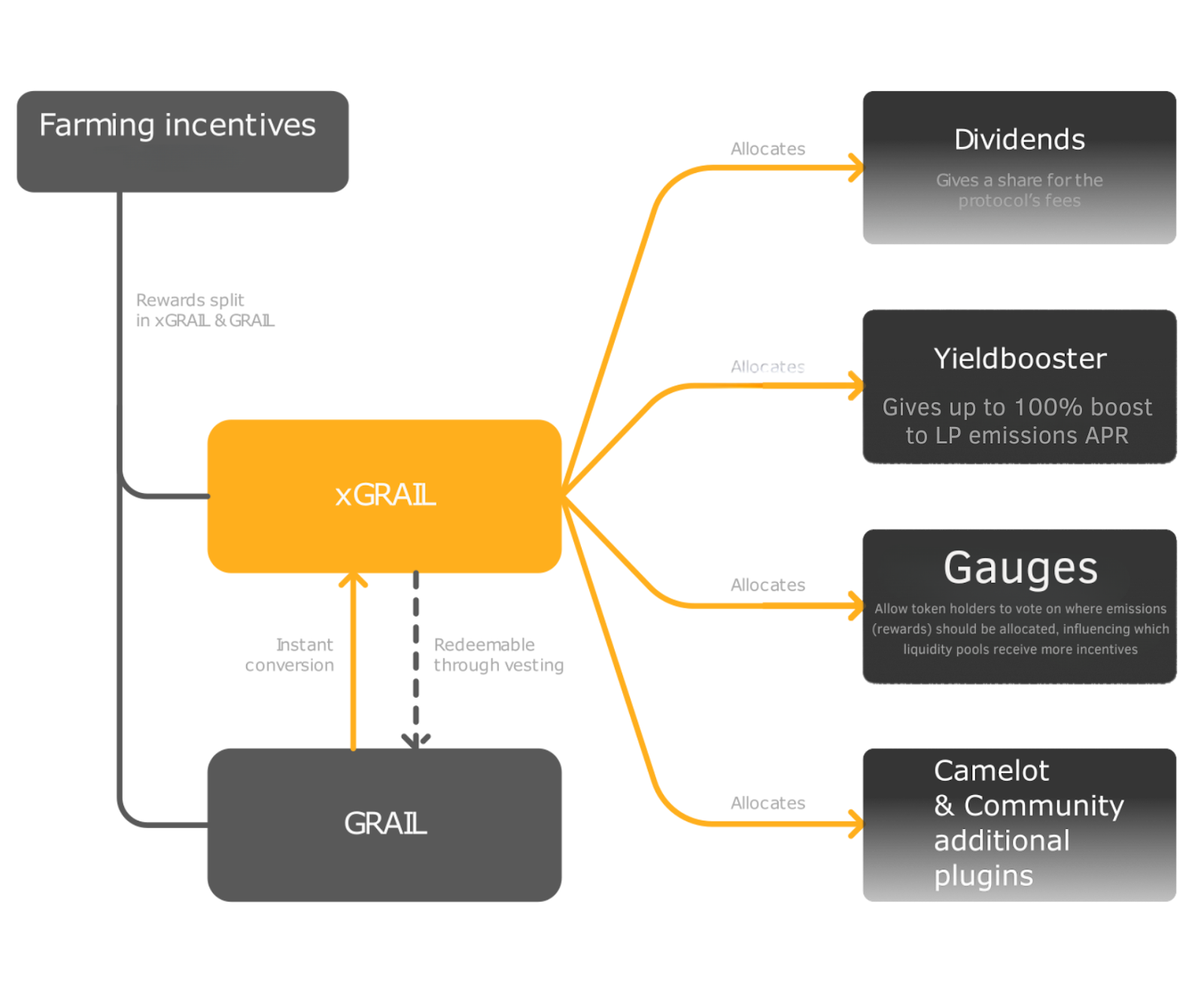
External developers and protocols can also build their own plugins as long as they follow Camelot’s technical constraints.
Camelot’s role in the Arbitrum ecosystem
On February 17, 2023, Nitro Cartel launched the public sale of its $TROVE governance token on Camelot Launchpad. Nitro Cartel is an index protocol; its first index, ALP, represents select blue-chip tokens such as $GMX, $MAGIC, and $GRAIL.
Factor DAO launched the public sale of its native $FCTR token on Camelot Launchpad on February 20, 2023. $FCTR holders can earn $veFCTR by staking $FCTR and receive 50% of the platform's revenue.
PerpyFinance launched the public sale of its native $PRY token on Camelot Launchpad on March 16, 2023.
The Round Table (a reference to the Knights of the Round Table in King Arthur's palace, Camelot) brings together over 20 key Arbitrum developers, with the exchange's function extending beyond simply providing Camelot DeFi products. Launchpad Camelot can help incubate various new projects within the Arbitrum ecosystem and provide them with liquidity through its internal infrastructure.
Therefore, the overall development of the Arbitrum ecosystem is closely linked to Camelot. The liquidity generated by these new projects' tokens will be pooled to increase Camelot's overall liquidity and accelerate the growth of its TVL and trading volume, thereby ensuring the overall growth of the Arbitrum network.
Fees and trading costs
Camelot provides partner protocols with the ability to directly control swap fees for their own pairs based on market conditions and protocol specifics. It is built on the second version of Algebra, a protocol that allows projects to implement concentrated liquidity technology.
As part of its customizable AMM, Camelot has launched:
- Directional & dynamic volatility fees
- Limit orders
- Rebasing tokens support
- Custom tick spacing
Therefore, Camelot trading fees can vary depending on factors such as underlying volatility, buy and sell direction, market conditions, and more. Consequently, fees for each pool will be highly market-dependent.
During periods of low volume, fees will decrease accordingly, and conversely, during periods of significant market volatility, fees will increase to reflect this. Each project launching on Camelot's AMM can set up custom swap rates for its LP pairs, tailored to its own strategy.
Risks and limitations
- An absence of regulatory oversight or licensing by any government authority.
- Limited to the Arbitrum and Orbit chains ecosystem.
- No fiat support.
- Limited funding options that do not include bank cards or P2P transfers.
- No NFT support (only leverages NFT technology for its liquidity infrastructure - spNFTs).
Camelot vs. other decentralized exchanges
For a fair comparison, we do not include multi-chain exchanges such as Uniswap or Sushiswap. The following comparison table includes Arbitrum-only DEXes.
Is Camelot Exchange worth using in 2026?
Despite the exchange not being licensed by any government authority, MixBytes' Algebra Finance Core Security Audit Report identified one high-severity, four medium-severity, and nine low-severity violations. After addressing the identified violations, the exchange acknowledged their existence or corrected them. No other issues that could impact protocol functionality were identified. The overall code quality is very high.
The platform may not be suitable for traders who require access to multiple blockchains, robust regulatory protection, or traditional payment methods. It's best suited for DeFi-focused users already transacting on Arbitrum DEXes, who prioritize income generation over comprehensive regulatory options.
 Maryna Hornieieva
Disclaimer: All materials on this site are for informational purposes only. None of the material should be interpreted as investment advice. Please note that despite the nature of much of the material created and hosted on this website, HODL FM is not a financial reference resource, and the opinions of authors and other contributors are their own and should not be taken as financial advice. If you require advice. HODL FM strongly recommends contacting a qualified industry professional.