




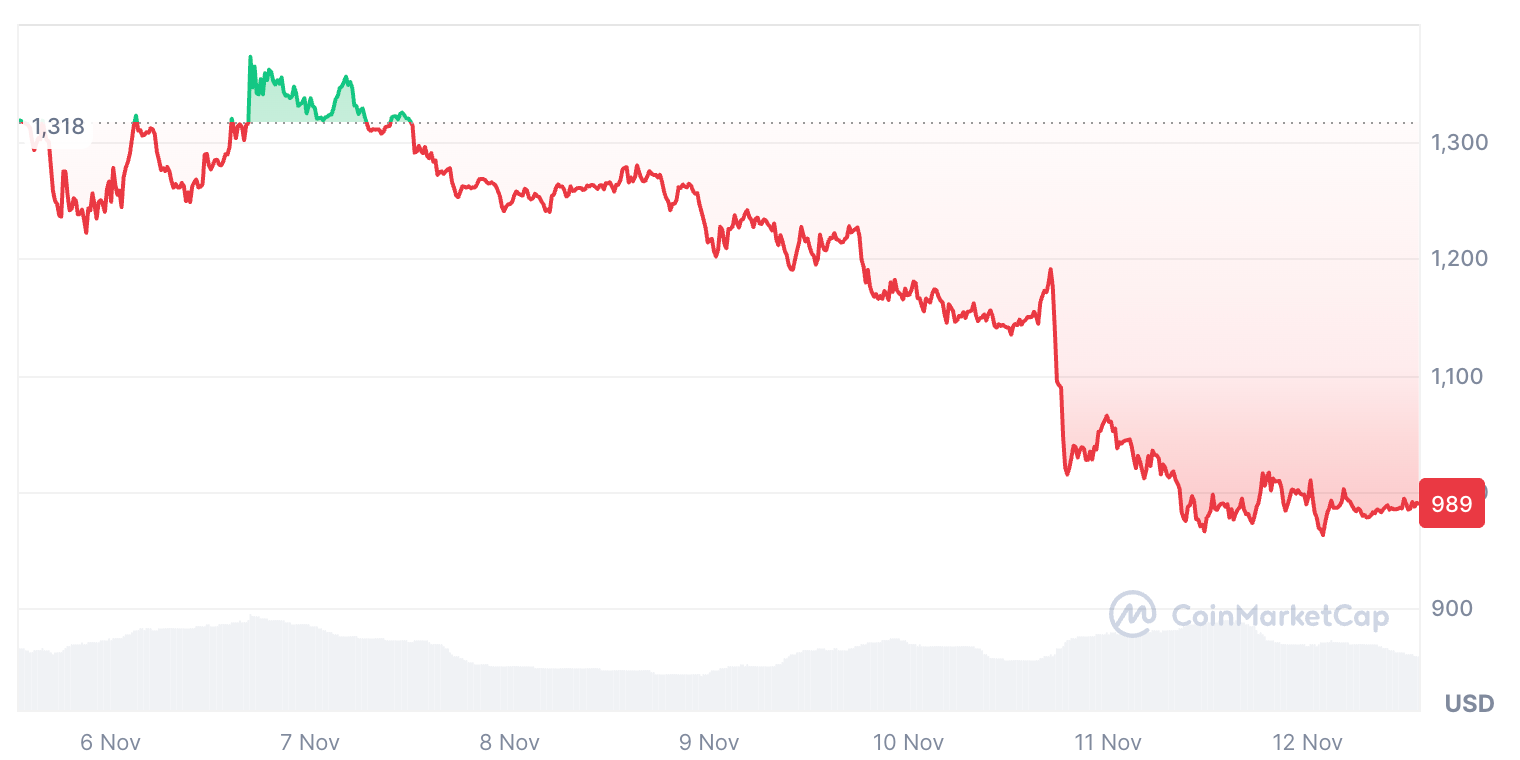
Zcash (ZEC) fell to a two-month low of $962.85 on Wednesday, a day after Grayscale pledged $1 million to nonprofits and projects supporting the Zcash network. It was the first time Zcash traded below $1,000 since September. Its 13.5% drop led 24-hour losses among the 100 largest cryptocurrencies, and it was down 24.5% over seven days. ZEC traded near $989 on Nov. 12, according to CoinMarketCap data.
A sharp reversal after the NU7 upgrade
The slide undid a recent run. Zcash was still above $1,370 as recently as Nov. 7. The NU7 network upgrade cut the target block time to 25 seconds from 75 seconds. It also made about 12,224 ZEC in the initial privacy pool unusable. The upgrade went live on Nov. 6 and did not hold the price.
The pullback looks like profit-taking after a big rally. Zcash rose 102% over the past 90 days, against a 47% rise for Monero, so far more Zcash holders have profits to take. Monero slipped 10.41% over seven days, which points to pressure concentrated on Zcash itself. ZEC was down 25.22% over seven days.
Hot inflation data hit a weak market
The broader market gave sellers more room. Crypto prices fell further Tuesday after US consumer prices rose 0.4% in October from the previous month, above the 0.3% economists forecast. Stronger-than-expected inflation fed concerns about tighter monetary policy. Bitcoin was down 5.8% and Ether down 11.6% over the same period, according to CoinGecko.
Higher inflation can push central banks to keep rates elevated or raise them, which tends to hurt speculative assets. Smaller tokens that rallied hard, as Zcash did, often fall faster than Bitcoin when that happens.
ETF outflows and forced selling
Money is also leaving Zcash's US fund. Grayscale converted its Zcash Trust into a US spot exchange-traded fund that began trading on NYSE Arca on Aug. 25. The funds shed $14.61 million in a day, the most since Oct. 15. November net outflows stand at $29.78 million, and net assets have fallen to $562.16 million, the lowest since Sept. 4. October outflows totaled about $46 million.
The Grayscale pledge did not offset that. The firm committed $1 million to nonprofits and initiatives, including $400,000 already given in equal $100,000 shares to the Zcash Foundation, Pretty Good Policy for Zcash, Shielded Labs and Project Tachyon. The funding is not a direct purchase of ZEC.
Derivatives amplified the drop. About $18 million in ZEC liquidations hit traders, mostly longs. Open interest fell nearly 28% from its recent peak, which signals deleveraging across ZEC derivatives.
A liquidation happens when an exchange closes a leveraged position that no longer has enough collateral. The forced sales add to selling pressure, and that can trigger the next round.
A treasury vote and the levels traders watch
One more factor sits in the background. A draft Zcash Improvement Proposal by Sean Bowe, Zooko Wilcox and Jason McGee was merged into Zcash's specifications on Nov. 11. It would remove 50,000 ZEC from Zcash Community Grants and end its 8% share of new block rewards. The authors point to ZEC's price rise as the reason to shrink the treasury while keeping the grants program running. The amount is about 53.4% of the grants treasury's ZEC. Holders are set to vote on it. Nothing in the filings ties the proposal directly to the sell-off.
A ZIP is Zcash's formal way to propose changes to the protocol and its funding rules. Proposals move through drafting and community review before activation.
Chart levels now matter more than news. ZEC trades below its 20-day moving average of $1,206.82 and its lower Bollinger Band at $1,005.11. Its 14-day RSI sits near 34, close to the oversold line of 30. The 200-day average sits at $782. Trader Daan Crypto Trades said:
"There is a big liquidation cluster on Hyperliquid in the $800-$900 area."
His target for a bounce is modest, toward $950 to $1,000. A daily close above $1,000 would put ZEC back over the lost level, and the next resistance sits near $1,100.
Not every signal is negative. Grayscale data shows about 70% of Zcash's active developers have over a year of crypto experience, against 58% industry-wide. That has not translated into price support so far.
 Anastasiia G
Disclaimer: All materials on this site are for informational purposes only. None of the material should be interpreted as investment advice. Cryptocurrency investments involve significant risk of loss. Please note that, despite the nature of much of the material created and hosted on this website, HODL FM operates as a media and informational platform, not a provider of financial advisory services. The opinions of authors and other contributors are their own and should not be taken as financial advice. If you require advice, HODL FM strongly recommends contacting a qualified industry professional.