



Bitwise Chief Investment Officer Matt Hougan published an investor memo on August 4 arguing that the crypto industry will continue to grow even if the Clarity Act fails to clear the Senate before the August recess, while also urging Congress to pass the bill.
The window Hougan identified as decisive was Wednesday, August 5. Under Senate Rule XXII, cloture must be filed at least two days before a vote can occur. With the Senate scheduled to depart after August 7 and enter a state work period from August 10 through September 11, a cloture filing on August 5 represented the last procedural route to a pre-recess vote. No cloture motion for the Clarity Act had been announced by the end of Tuesday's session. The Senate's August 4 floor schedule did not include H.R. 3633, and the chamber's list of pending cloture motions named two unrelated matters.
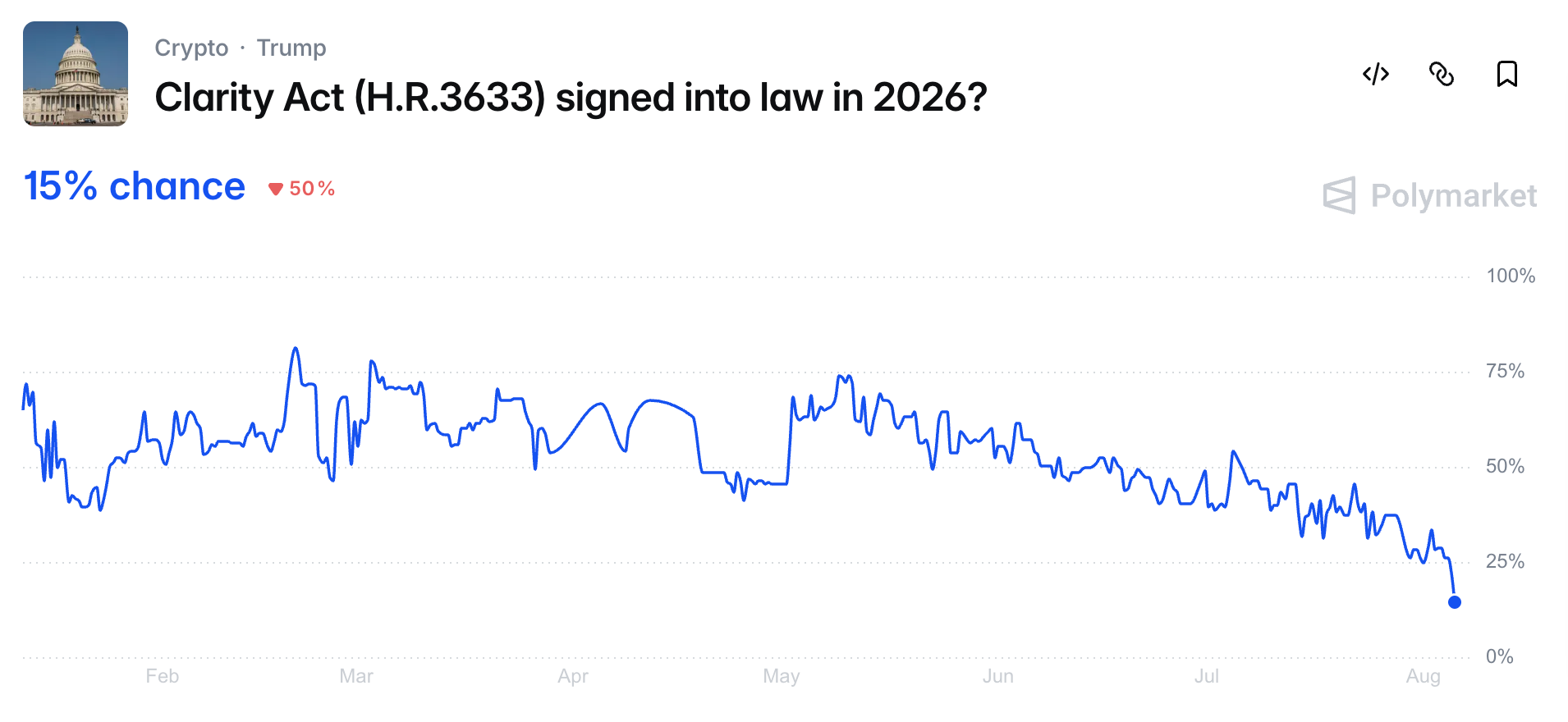
Polymarket placed the probability of the Clarity Act becoming law by December 31 at 15%.
Why Hougan believes the bill will not truly die even if it misses the deadline
Hougan did not argue that the deadline was irrelevant. He described it as a meaningful inflection point and said a failed vote would leave the bill in what he called a "walking dead" state.
"Nothing can actually kill it, but it will lurch along," he wrote. His expectation is that after the August deadline passes, there will be sustained discussion about attaching the legislation to a year-end omnibus package or reviving it in September. Neither path has been announced by Senate leadership.
He identified that prolonged uncertainty as bad news for one specific reason.
"Uncertainty around Clarity is keeping some professional investors on the sidelines of crypto markets," Hougan wrote. "They don't want to allocate capital to crypto only to see the Clarity Act fail and send the market lower."
His preferred outcome if the bill does not pass this week is for Polymarket odds to fall decisively into the teens, which he said would at least remove the uncertainty overhang and set up a fall rally.
The Clarity Act grew out of FIT21, which the House of Representatives passed in May 2024. The newer proposal began moving through Congress in May 2025. The Senate Banking Committee approved it 15 to 9 on May 14, 2026. Senator Cynthia Lummis subsequently released a merged 616-page proposal combining work by the Banking and Agriculture committees. That version sits on the Senate legislative calendar without a scheduled floor vote.
What SEC rules can and cannot replace
Hougan's fallback scenario centers on SEC Chair Paul Atkins. He cited Atkins' statement that the commission is "ready, willing, and able to come out with rules that address the same issues as Clarity." Hougan called SEC rules a potentially faster and more crypto-friendly alternative in the short term.
"In the short term, rules from Atkins' SEC are likely to be more crypto- and innovation-friendly than those that would emerge from a bipartisan bill in Congress; they may even be an accelerant," he wrote. "The risk is that a future administration appoints a less friendly SEC chair who reverses them."
That durability gap is the structural limit of the SEC path. The Clarity Act would divide digital asset jurisdiction between the SEC and the Commodity Futures Trading Commission. The SEC can change rules governing securities and token offerings within its existing authority, but it cannot independently grant the CFTC nationwide authority over digital commodity spot markets. Agency rules also remain subject to reversal through a subsequent regulatory process, while federal legislation can only be changed by new congressional action.
Atkins has himself acknowledged this distinction. In an official speech, he said statutory language provides the strongest protection against future regulators reversing the current approach.
Where the political disputes actually stand
Seven Democratic senators said on July 22 that the updated Republican bill text "falls short.", according to Politico. Catherine Cortez Masto, Angela Alsobrooks, Cory Booker, Ruben Gallego, John Hickenlooper, Mark Warner, and Raphael Warnock requested stronger consumer protection, stricter rules on elected officials' conflicts of interest, and tighter market integrity provisions. They said negotiations would continue, but they did not signal support.
The merged bill contains an ethics division that restricts covered officials and their spouses from issuing or sponsoring digital assets for compensation while in office. Democrats have not accepted those provisions as sufficient, particularly in light of financial disclosures showing President Trump earned more than $1 billion from crypto-related ventures last year, as HodlFM reported previosly.
Banks are separately seeking tighter restrictions on stablecoin rewards. The current proposal prohibits interest paid solely for holding stablecoins but allows certain activity and loyalty rewards. Banking groups argue that some exceptions could resemble deposit interest and pull funds away from community lending.
Twelve senators also requested that CFTC-registered prediction market platforms be barred from listing contracts resembling sports wagers, with protections for state authority and tribal gaming compacts. Those disputes require statutory authority that SEC rules cannot resolve on their own.
Hougan's broader argument that crypto does not need the bill to move forward
Hougan used a historical parallel to anchor his argument. In 1994, the House passed sweeping telecom reform by 423 votes to 4, and the effort died in the Senate without a floor vote.
"But the internet didn't wait around," he wrote. "Over the next two years, Netscape launched and went public, Amazon and eBay opened for business, and the number of websites grew exponentially."
Congress eventually passed the Telecommunications Act of 1996, which he described as crucial to decades of subsequent growth. He argued the two-year delay did not slow anything in retrospect.
His case for crypto's independent momentum rested on institutional developments already in motion. BlackRock's most profitable ETF is a Bitcoin ETF. Nasdaq and JPMorgan are moving to tokenize assets. Visa, Mastercard, and Stripe are building a stablecoin platform with Coinbase. Robinhood launched its own blockchain with DeFi integrations. The OCC has granted trust charters to Circle, Ripple, and Paxos.
"In a world where Clarity fails and the SEC lays out rules instead, crypto will have at least two and a half years until a new administration could potentially install a new SEC chair to make continued progress," Hougan wrote. "At that point, no SEC chair will be able to put the genie back in the bottle."
He closed by restating the case for the bill itself.
"To be clear: Congress should pass the bill, and crypto will be better off if it does. The Clarity Act is not a perfect bill, but it is a good one. It would boost the U.S. economy, protect investors, improve ethics protections, and help us compete in the era of onchain finance."
 Kristian Koch
Disclaimer: All materials on this site are for informational purposes only. None of the material should be interpreted as investment advice. Please note that, despite the nature of much of the material created and hosted on this website, HODL FM operates as a media and informational platform, not a provider of financial advisory services. The opinions of authors and other contributors are their own and should not be taken as financial advice. If you require advice, HODL FM strongly recommends contacting a qualified industry professional.