






Cloudflare announced Cloudflare Wallets and cloudflare.pay on Tuesday, giving AI agents a stable identity and the ability to spend stablecoins on APIs, content, and digital services within limits their human operators set in advance.
The launch fills the buy side of a market Cloudflare started building in July. Its Monetization Gateway, announced on July 1, lets websites and API providers charge agents per request in stablecoins through the x402 protocol, which repurposes the HTTP 402 status code to attach payment to an HTTP request. Wallets gives those agents a funded account to pay from. Without both sides, neither works at scale.
Matthew Prince, Cloudflare's co-founder and CEO, framed the problem the product addresses.
"The Internet is shifting from human-driven browsing to agent-driven commerce, and the infrastructure needs to keep up," he said. "When an agent shows up at your door, you need to know who sent it. Cloudflare can give agents a face, a link to the human or organization that owns them, so that trust, accountability, and real commerce can follow. It's the identity and payment infrastructure the agentic web needs to function."
Why AI agents currently struggle to pay for anything
The practical friction is more specific than it sounds. When an AI agent tries to access a new API, it typically has to navigate a login page built for humans, wait for a person to add a payment method, generate an API key manually, and then work out how to call the service. Agents lack a stable identifier to sign up with and have no native way to pay. The result, as Cloudflare's announcement described it, is that agents often abandon registration, payment, and API key steps entirely and push them back to humans.
Will Papper, who works on agent payments at Cloudflare and co-founded onchain developer platform Syndicate, made the case for small budgets as an unlock.
"If an agent is responsible for $10, you can worry less about its spending than if it is responsible for $1,000," he wrote.
At x402 price points, where individual API calls run a few cents, $10 gives an agent enough budget to try and compare many services before a human needs to review anything.
x402 has settled 160.6 million transactions worth $41.2 million across seven chains and 18 tracked facilitators, according to Agent Economy, which monitors transfers from known facilitator addresses on EVM chains and Solana. That averages roughly 26 cents per transaction. Agent Economy cautions that its totals include tests, infrastructure traffic, and repeated service calls.
How Account Wallets and Virtual Wallets are structured
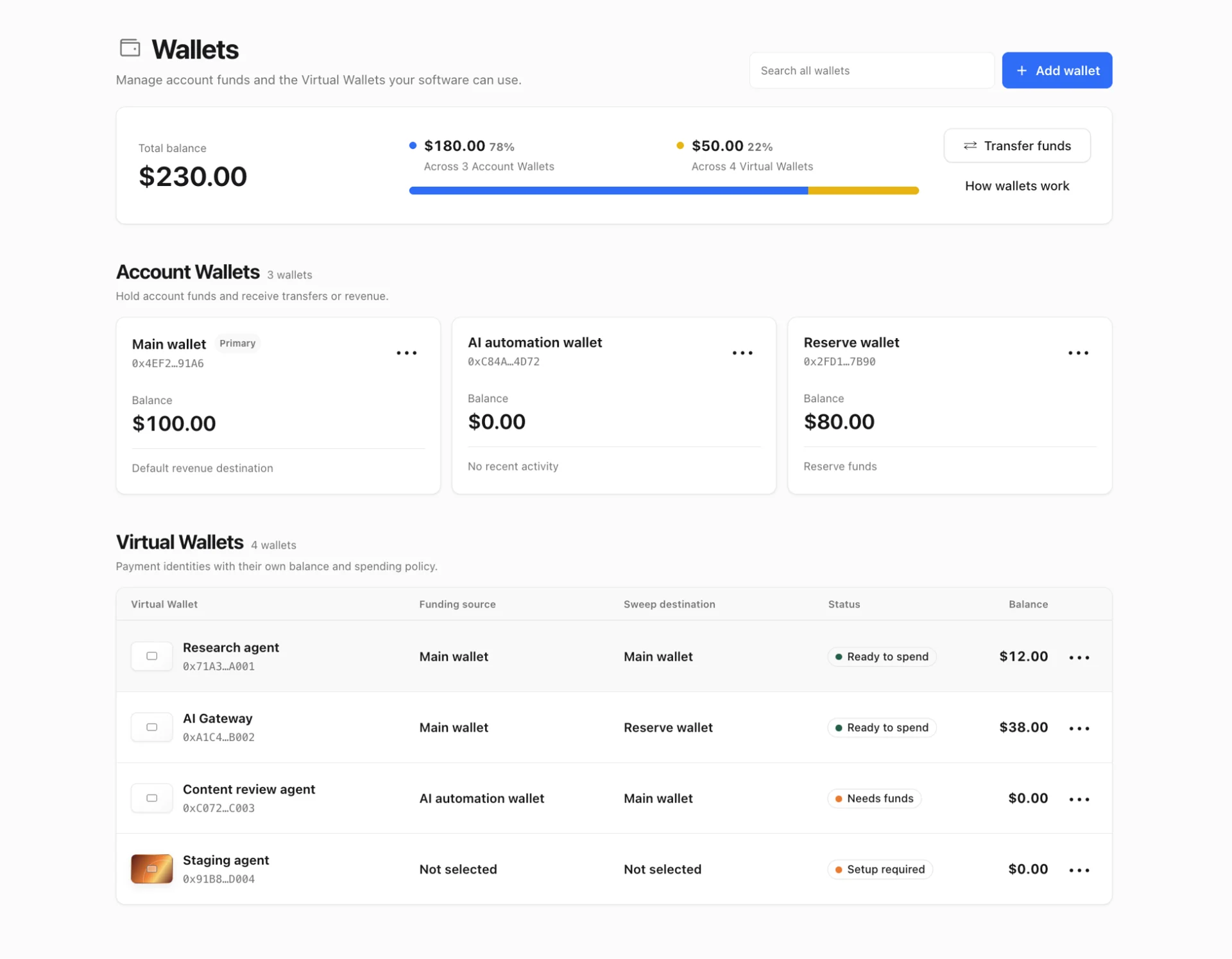
Cloudflare split the product into two distinct wallet types. Account Wallets belong to the human owner of a Cloudflare account, who funds them, delegates spending authority, and withdraws. Virtual Wallets are operated by API key and assigned to individual agents, with spending restricted to parameters the Account Wallet owner sets beforehand.
The guardrails Cloudflare specifies are a spending cap, an approved merchant list, and a maximum transaction size per payment.
"Want to give every employee a $100 per week budget for AI inference?" the product announcement asks. "Simply provision an Account Wallet with the right balance and create Virtual Wallets for each employee with that rule." When an agent trips a spending threshold or shows unusual behavior, a human reviews before anything proceeds. "When something anomalous happens, such as unexpectedly fast spending, a human will be able to review and confirm whether everything is operating as intended," the announcement states.
The identity layer runs through cloudflare.pay, where Cloudflare account owners can reserve a handle as of Tuesday. An agent can then declare that handle when it contacts a merchant, for example presenting as research.example.cloudflare.pay to show the organization behind the request. Cloudflare already supports cryptographic agent identity through Web Bot Auth, which uses keypairs. The handle is a readable label on top of that.
"We are proposing a human-readable identifier for a not-very-readable keypair, similar to the URL and IP-address pairings used in DNS," the announcement states. Agents that do not present a handle still get through but face more scrutiny. The announcement compared them to VPN users: "If someone is unidentified, they are not inherently untrustworthy, but they need to prove themselves more."
What Cloudflare did not disclose and what comes next
The announcement does not specify which stablecoins the wallets will hold, which chains they will settle on, who will custody the funds, what Cloudflare will charge, or which onramp and offramp partners are involved. The company committed only to "simple ways to onramp and offramp funds within supported geographies, with self-funding via stablecoins available as an alternative for eligible users." No launch customer was named in either the press release or the blog post.
Handle reservations at cloudflare.pay are the only feature live today. Full wallet access, including onramping and offramping funds and the ability to issue Virtual Wallets to agents, is expected in the coming months.
The infrastructure surrounding the launch is further along than the wallet itself. Cloudflare announced the x402 Foundation with Coinbase in September 2025. The Linux Foundation took over hosting the standard in April, and on July 14 launched it operationally with 40 member organizations. Cloudflare and Stripe are two of the 17 premier members, alongside Visa, Mastercard, Google, Amazon Web Services, and Circle. Cloudflare's x402 documentation lists support for Base, Ethereum, Polygon, Optimism, Arbitrum, Avalanche, Solana, Aptos, Stellar, and Sui, with USDC as the settlement asset.
Amazon Web Services and Coinbase connected x402 to CloudFront and WAF in June for publishers that want to charge agents in USDC. MoonPay open-sourced the Open Wallet Standard in March with PayPal and the Ethereum Foundation to let agents manage funds across blockchains. Cloudflare's announcement sits inside a broader infrastructure build by companies that see agent-to-agent and agent-to-service payments as a distinct and growing category.
Stephanie Cohen, Cloudflare's chief strategy officer, explained the underlying commercial logic to Fortune.
"The internet needs a different business model. In order to have a different business model, you need payments that actually will support that," she said.
 Tanya Petrusenko
Disclaimer: All materials on this site are for informational purposes only. None of the material should be interpreted as investment advice. Please note that, despite the nature of much of the material created and hosted on this website, HODL FM operates as a media and informational platform, not a provider of financial advisory services. The opinions of authors and other contributors are their own and should not be taken as financial advice. If you require advice, HODL FM strongly recommends contacting a qualified industry professional.