




Every generation gets its own crash. The S&P 500 has been through 27 bear markets since 1928, about one every 3.5 years. The average one lasted 289 days and cost roughly 35%. Averages hide the extremes, though. Some of the biggest bear markets in history took a quarter of a century to recover from.
Unless noted, figures below are price declines on closing values, peak to trough, and recovery means a close above the old peak. A 50% fall in the S&P 500 and in Bitcoin mean very different things.
How a bear market differs from a correction
The usual benchmark is a drop of 20% or more from a recent high. A decline between 10% and 20% is a correction, though Morningstar calls the 10% line arbitrary. A crash is about speed. Prices collapse within days or weeks, and a crash may or may not become a bear market.
The biggest stock market crashes before 2000
Three of the worst came before 2000.
The Great Depression stock market crash (1929-1932)
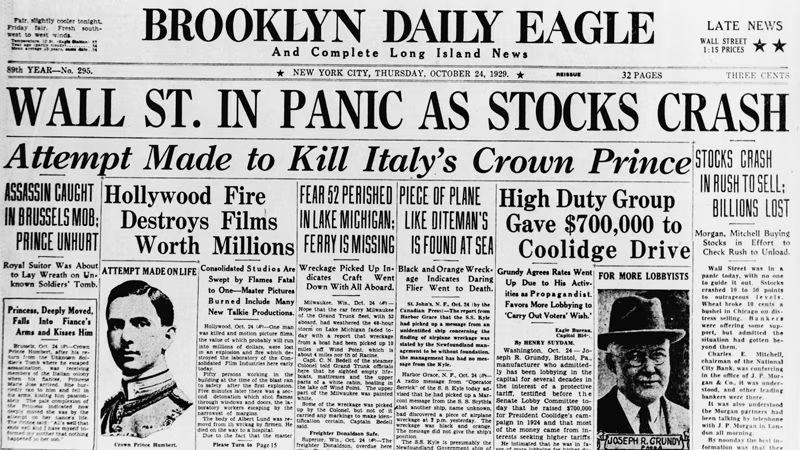
The Dow closed at 381.17 on September 3, 1929 and kept sliding until July 8, 1932. By then it stood at 41.22, about 89% lower. Margin buying had inflated the boom, and leveraged investors were forced to sell once prices turned.
Thousands of banks failed and the money supply contracted while the Fed held back. The Dow didn't revisit its 1929 high until November 23, 1954. The Securities Exchange Act of 1934 created the SEC to restore confidence in capital markets.
Oil shock and stagflation in 1973-1974
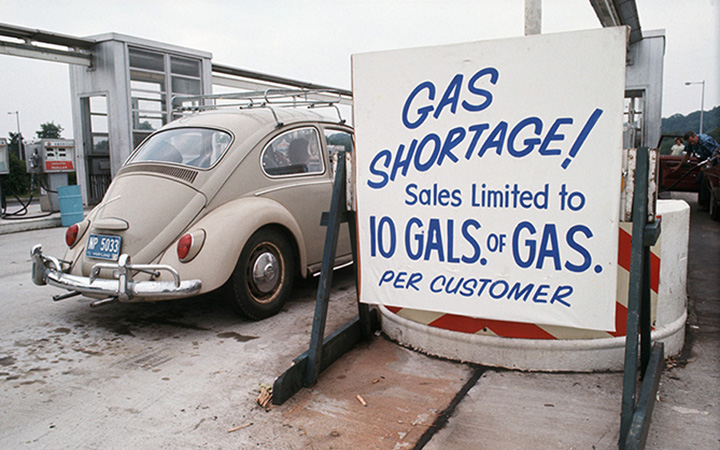
Arab producers imposed an oil embargo in October 1973, and the price of a barrel first doubled, then quadrupled. The S&P 500 fell 48.2% over 630 days between January 11, 1973, and October 3, 1974. It didn't break even until July 1980.
Black Monday and the Fed's liquidity promise
On October 19, 1987, the Dow dropped 22.6% in a single session, still its largest one-day percentage fall. The next day, Alan Greenspan said the Fed stood ready "to serve as a source of liquidity." US stocks passed their pre-crash highs less than two years later.
Bubbles, banks and the longest bear markets
A valuation built on a story or debt buried inside banks can take years to unwind.
The dot-com bust (2000-2002)
Money poured into unprofitable internet companies, and the Nasdaq Composite closed at 5,048.62 on March 10, 2000. By October 2002, it had lost about 78%. The index didn't set a new closing record until April 23, 2015.
The 2008 financial crisis
Subprime mortgage losses spread through banks that had borrowed heavily against those loans, and Lehman Brothers collapsed in September 2008. By March 9, 2009, the S&P 500 was down 57% from its 2007 peak, its worst fall since the Depression.
On price alone, the index regained its October 2007 record on March 28, 2013. With dividends reinvested, the loss was about 55% and the recovery came in August 2012.
Japan's 34-year wait
Tokyo holds the record among the longest bear markets in a major economy. The Nikkei 225 closed at 38,915.87 on December 29, 1989, at the height of a property and stock bubble. It hit a post-bubble closing low of 7,054.98 on March 10, 2009, around 82% below the peak. The old record finally fell on February 22, 2024.
Two shocks of the 2020s
This decade has already produced a record-fast crash and a year when bonds failed too.
COVID-19 and the fastest bear market on record
The S&P 500 lost nearly 34% between February 19 and March 23, 2020. On March 15, the Fed cut its target range to 0 to 1/4 percent and pledged at least $700 billion in bond purchases. The index closed at a record on August 18, 2020, six months after the old peak.
The 2022 bear market
Inflation drove this one. US consumer prices rose 9.1% in the year to June 2022, the biggest jump since 1981, after the Fed had begun raising rates in March. The S&P 500 closed at 4,796.56 on January 3 and slid to 3,577.03 by October 12, a fall of about 25%. It wasn't back at a record until January 19, 2024.
The Bloomberg US Aggregate index lost about 13% on a total return basis, its worst year since 1976. Energy bucked the trend, and the S&P 500 Energy index returned 65.7% as oil prices jumped.
Crypto bear markets run on a different scale
Bitcoin trades around the clock and has no earnings to anchor it. It's also less than 18 years old. Its swings are wilder and its liquidity thinner, so direct comparisons with stocks mislead.
Bitcoin's 2018 crypto winter
Bitcoin peaked near $19,800 in December 2017, at the end of the ICO boom. A year later it traded around $3,200, an 84% drop. The Coincheck hack and repeated SEC rejections of Bitcoin ETF applications weighed on the market through 2018. Bitcoin didn't clear $20,000 until December 16, 2020.
The 2021-2022 crash and the fall of crypto lenders
Leverage and contagion did most of the damage this time. Terra's UST stablecoin lost its dollar peg in May 2022, and roughly $40 billion of LUNA's value evaporated within days. Crypto lender Celsius filed for bankruptcy on July 13 and later disclosed a $1.2 billion hole in its balance sheet.
FTX went under in November. Bitcoin dropped to about $15,600, roughly 77% below its $69,045 high of November 10, 2021. It reached a new record in March 2024 on the back of spot ETF inflows.
Bear market history at a glance
No single index covers every episode, so each row names its own market.
The deepest bear market isn't always the longest
Percentage loss alone gives a distorted ranking. The Dow after 1929 and the Nikkei after 1989 lost the most among stock indices. Japan and the Nasdaq waited longest to recover. The 2020 crash was the quickest both ways.
So how long do bear markets last? Hartford's 289-day average is fair for the S&P 500, but recovery time matters more. The 2008 financial crisis bottomed after 17 months and needed four more years to heal. COVID took six months for the whole round trip.
Across the table, the cause sets the pace. Shocks to a working financial system, like 1987 and 2020, healed fast. Broken banks and deflating bubbles dragged on because losses had to clear balance sheets first.
How governments and central banks stepped in
Policy has changed more than markets have. In the early 1930s, the Fed let banks fail. By 1987, it promised liquidity within a day.
In October 2008, the Emergency Economic Stabilization Act authorized up to $700 billion for the Troubled Asset Relief Program. The Fed cut its policy rate to a range of 0 to 0.25% by the end of 2008. Crypto had no lender of last resort. Celsius and FTX customers waited in bankruptcy courts.
What these crashes punished
Leverage shows up again and again. Margin loans forced selling in 1929, and Celsius froze withdrawals before filing in 2022. Borrowers can't wait out a bottom.
The 2022 bond loss is the most underrated lesson here. Bonds had cushioned stock losses through the falling-rate decades before it. Inflation broke that link, and stock-and-bond portfolios lost on both sides in one year. What you owned mattered too. A Nasdaq buyer in March 2000 waited 15 years to break even, and a Nikkei buyer in December 1989 waited 34.
Are markets vulnerable to another bear market?
Nobody can date the next one. The Federal Reserve's November 2026 Financial Stability Report says asset valuation pressures remain elevated. It notes the S&P 500's price-to-earnings ratio sits well above its historical median, while corporate bond spreads are below long-run medians.
High valuations leave less room for bad news. History suggests watching inflation running ahead of rate expectations, climbing margin debt, an inverted yield curve, and stress at lenders. In 2022, Terra broke in May, and Bitcoin kept falling for six more months.
 Tanya Petrusenko
Disclaimer: All materials on this site are for informational purposes only. None of the material should be interpreted as investment advice. Cryptocurrency investments involve significant risk of loss. Please note that, despite the nature of much of the material created and hosted on this website, HODL FM operates as a media and informational platform, not a provider of financial advisory services. The opinions of authors and other contributors are their own and should not be taken as financial advice. If you require advice, HODL FM strongly recommends contacting a qualified industry professional.