





Vitalik Buterin published a side-by-side comparison of his 2023 Ethereum roadmap and the network's current planning document on X on Monday, and the gap between the two turned out to be wider than expected.
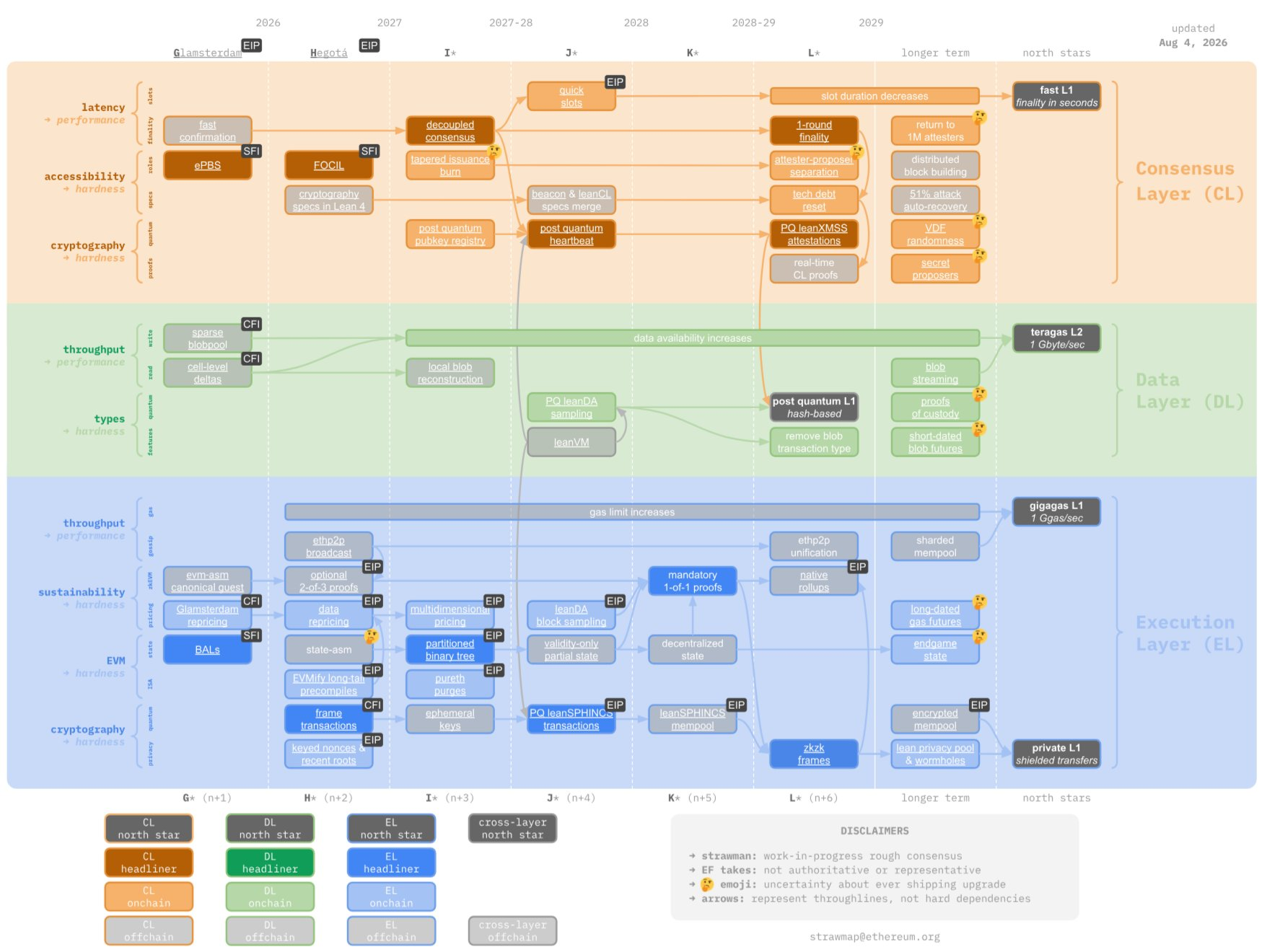
The current document, called the Strawmap, is a rolling draft maintained by Buterin alongside Ethereum Foundation researchers Justin Drake, Thomas Thiery and Toni Wahrstätter. It now charts seven protocol upgrades through 2029. Buterin said most of the original 2023 priorities still appear in the current plan, but the comparison surfaced a category of additions that had no precedent in his earlier thinking at all.
"What's most striking, however, is that some completely new things are in the strawmap that are NOT in this diagram, because they were not in the 2023 roadmap at all," Buterin wrote. "These reflect changing priorities."
Quantum safety and privacy move to the front
Quantum safety, the work to protect Ethereum's cryptographic foundation against future quantum computers, was pulled forward in priority relative to other upgrades. The Ethereum Foundation formed a dedicated post-quantum team earlier this year, and Buterin had outlined a phased plan in February to replace four potentially vulnerable components of the network's cryptographic architecture. That work now sits near the top of the Strawmap rather than further out.
Privacy received what Buterin described as "first-class attention" in the new plan, covering tools such as keyed nonces and features associated with FOCIL, the committee-based censorship resistance mechanism under development. Neither quantum safety at this priority level nor structured privacy protections appeared in the 2023 diagram.
Some older designs were dropped rather than shifted in order. Verkle trees, once central to plans for reducing node storage requirements, gave way to a unified binary tree approach specified in EIP-7864. State expiry, a longstanding plan to let old account data fall off the network, was replaced by what Buterin called new state types, which he described as "a fundamentally different paradigm to how Ethereum does scaling." Verifiable delay functions and a range of planned Ethereum Virtual Machine improvements were deprioritized.
Where STARKs and AI now fit in the protocol
Buterin named two technologies as foundations the Ethereum Foundation is prepared to commit to fully. One is STARKs, a class of cryptographic proof that can verify computations without revealing underlying data. The other is AI-assisted formal verification, a method for mathematically proving that code behaves as written.
"This can only be safe with formal verification, which is itself only feasible with modern AI tools," Buterin wrote.
The strawmap uses a specific aggregation primitive in three separate parts of the protocol: the execution layer, the consensus layer and the data layer. Buterin said that degree of reliance on a single cryptographic construction is only acceptable because formal verification can now cover it. In the 2023 roadmap, that level of dependence on unproven tooling would not have been considered realistic.
Native rollups and a question about the EVM's future
Two additions to the Strawmap had no equivalent in 2023 because the underlying technology was not ready. Native rollups, which would allow scaling layers to run directly within Ethereum's base protocol using zero-knowledge proofs, were not viable when Buterin wrote the original diagram.
"SNARKs were nowhere near mature enough to even consider this back in 2023," he wrote.
Blob and gas futures, a mechanism for pricing network resources in advance through a market-based structure, also did not exist as a concept at the time.
Buterin also raised a longer-term question about the EVM itself. The Strawmap introduces a framework called zkzk frames, which would expose users to an instruction set architecture other than the EVM. Current candidates under discussion are leanISA and RISC-V, which Buterin described as "more simple, modern and efficient than the EVM." He floated the possibility of eventually demoting the EVM to an intermediate representation that runs on top of one of those architectures, rather than keeping it as a hard-coded feature of the base protocol. He noted that deeper exploration of that direction remains too early for the Strawmap itself.
What the scaling approach has in common across new ideas
Buterin identified a shared logic in the two largest new additions to the Strawmap, state types and zkzk frames. Rather than attempting to scale all Ethereum activity uniformly, both approaches create specialized mechanisms with narrower properties that make them more compatible with high throughput.
"A common theme in scaling, found in both state types and zkzk frames (both new ideas), is that instead of trying to maximally scale ALL ethereum activity, we try to create specialized mechanisms that have more restrictive properties that make them more scaling-friendly, while supporting the heaviest loads incurred by users and applications today (eg. token transfers, swaps) and tomorrow (eg. privacy protocols)," Buterin wrote.
Buterin closed the post with a direct statement of where the protocol is headed.
"Ethereum will be quantum-safe. Ethereum will put users' privacy first. Ethereum will be secure. Ethereum will be censorship-resistant. Ethereum will be highly performant and scalable while satisfying the above. And Ethereum will be Lean."
 Roman Zaika
Disclaimer: All materials on this site are for informational purposes only. None of the material should be interpreted as investment advice. Please note that, despite the nature of much of the material created and hosted on this website, HODL FM operates as a media and informational platform, not a provider of financial advisory services. The opinions of authors and other contributors are their own and should not be taken as financial advice. If you require advice, HODL FM strongly recommends contacting a qualified industry professional.